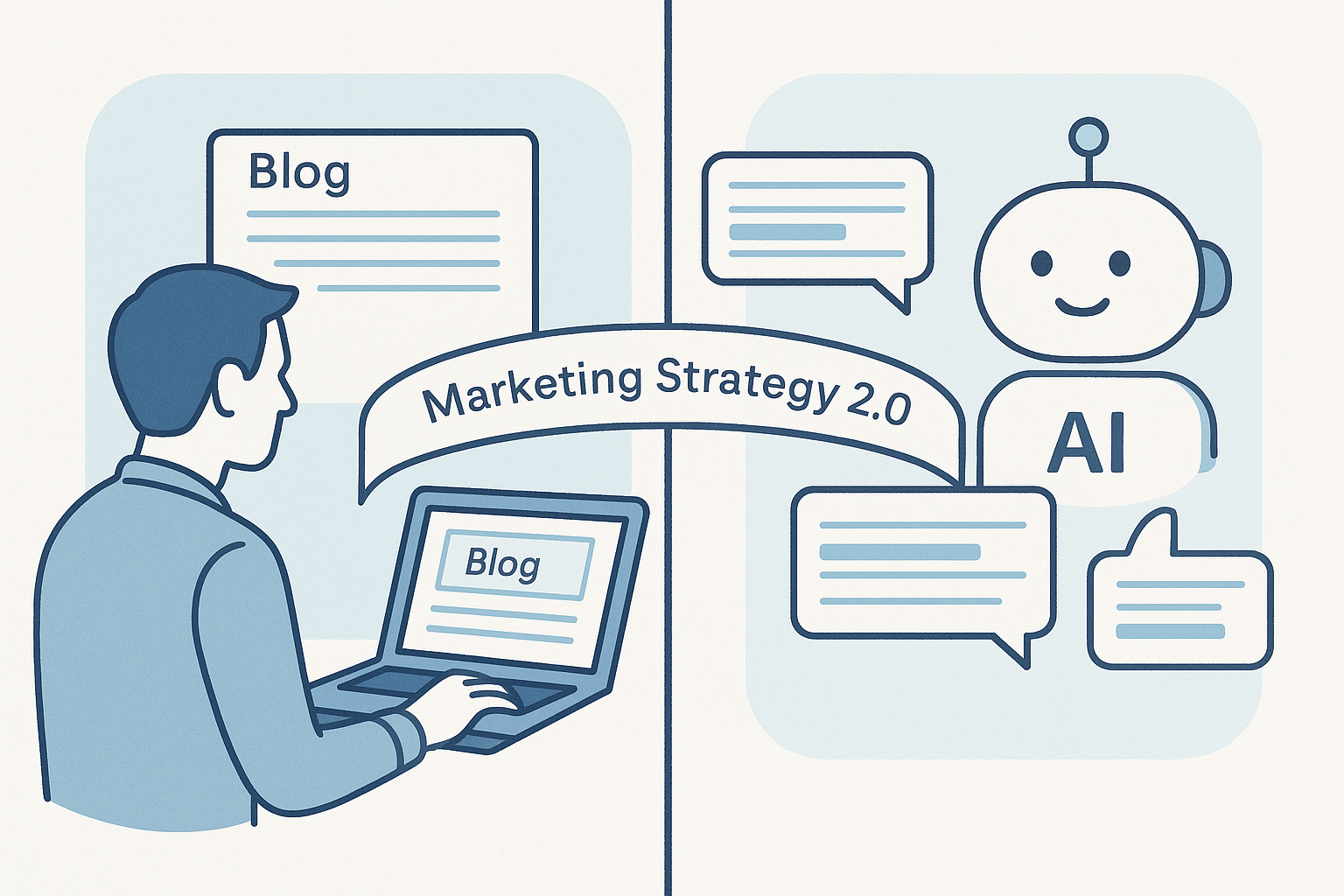
Marketing has always been a game of visibility. First, it was print. Then radio, TV, and billboards. Later, Google came along and turned clicks into currency. But now, something more radical is happening. Large Language Models (LLMs) like ChatGPT, Claude, Gemini, and Perplexity aren't just pointing to content, they're becoming the interface between your brand and your audience.
That means your marketing strategy isn't just about appealing to people anymore. It's about appealing to both humans and machines. And if you ignore the second half of that equation, you risk becoming invisible in tomorrow's search economy.
Step 1: Audit for AI-Friendliness
Traditional SEO audits asked: "Am I ranking for my keywords?"
Now you need to ask:
- "Can an AI system extract the key facts from this page without confusion?"
- "Are my main points explicitly stated, or are they buried in fluff?"
- "Does my content actually answer the question someone would ask in plain English?"
Think of LLMs as very attentive readers with zero patience for ambiguity. They don't "interpret" like humans do. If your content is vague, they'll skip you and pull from someone clearer.
Practical tip: Take your top-performing content and run it through a conversational query test. Ask ChatGPT or Gemini your target question and see if your page comes up. If it doesn't, ask why not. The answer usually reveals where your content is failing to be machine-friendly.
Step 2: Restructure for Dual Audiences
Humans skim. Machines parse. Both want clarity.
That's why content restructuring is no longer optional, it's strategic. Add FAQ sections so AIs can lift question-answer pairs directly. Use clear subheadings so both readers and crawlers can navigate. Break down walls of text into scannable lists, tables, and bullet points.
Remember: A search bot doesn't care about your poetic flair. It cares about structured clarity. The irony? Writing for AIs usually makes your content better for humans too.
Example:
Instead of writing a 1,500-word blog with insights buried in paragraph 12, start with the plain answer. Then explain it, then give examples. Humans get the context, AIs get the quote. Everybody wins.
Step 3: Redefine Success Beyond Traffic
Old-school SEO worshipped one god: traffic. The more clicks, the better. But in the age of AI search, the battlefield is different.
Imagine this: A decision-maker asks ChatGPT, "What's the best strategy for launching a SaaS in South Africa?" If your brand's content gets quoted in the answer, even if the user never clicks your site, your authority just multiplied.
This is the shift:
- From traffic-focused SEO → to authority-focused AEO (Answer Engine Optimisation).
- From chasing conversions → to shaping conversations in your industry.
Yes, clicks still matter. But what matters more is being the source machines trust enough to cite. That's long-term influence, and it compounds.
Step 4: Adapt or Fade Away
History is full of marketers who clung to the old way until the lights went out. Banner ads. Yellow Pages. Even TV-only strategies. The winners are always the ones who see the shift, experiment early, and pivot.
With LLM-driven search, that shift is now. If your content isn't structured for both readability and reference-ability, you're handing your competitors the mic.
Bottom Line
LLM search changes the rules. To win, you need to:
- Audit your content for machine-friendliness.
- Restructure for dual audiences — humans and AI.
- Redefine success from traffic to authority.
- Adapt fast, because invisibility is the cost of hesitation.
The marketers who get this right won't just keep their audience. They'll own the narrative in an AI-mediated world.





