Every agency leader knows the bottleneck: too many briefs, not enough hours. Teams drown in production tasks, reporting, and endless revisions. Talent gets stretched thin, while margins collapse under pressure.
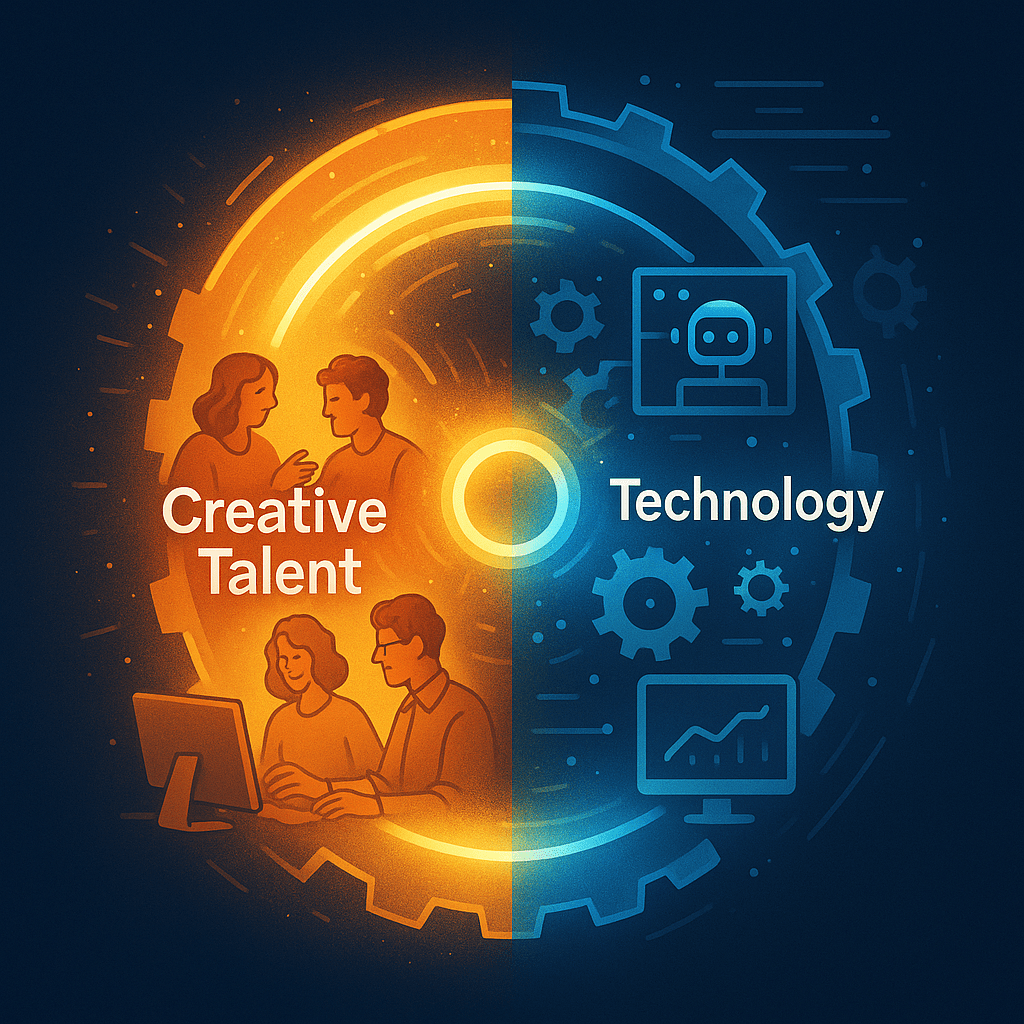
The agencies that escape this trap don’t simply hire more people or buy more tools. They build a talent–technology flywheel, where human creativity and automation reinforce each other in a self-sustaining loop.
Why Talent Alone Isn't Enough
Creativity is the beating heart of agencies. But when great strategists spend half their week resizing assets or chasing data, their real value gets buried under low-leverage tasks.
According to a 2023 Accenture Future of Work study, knowledge workers spend up to 40% of their time on repetitive, automatable tasks. For agencies, that translates into wasted billable hours, slower delivery, and demoralised staff.
Why Technology Alone Isn't Enough
On the other side, automation without human input leads to generic, uninspired outputs. AI can draft copy or assemble reports, but it cannot sense cultural nuance, spot a fresh angle, or judge when a "risky" idea might actually work.
Technology amplifies. If what you feed it is generic, you simply generate more generic work, faster.
The Flywheel Effect
The causal chain looks like this:
Automation of Low-Value Tasks → Talent Focuses on Strategy & Creativity → Higher-Impact Work → Stronger Client Results → Budget to Invest in More Tools → More Automation
Each turn of the flywheel accelerates the next. But if mismanaged, the chain reverses:
Over-Automation → Generic Output → Client Dissatisfaction → Budget Cuts → Talent Burnout
The goal is not replacement. It’s amplification.
What the Flywheel Looks Like in Practice
- Production Automation - Use AI for asset versioning, performance reporting, and media planning adjustments.
- Creative Augmentation - Deploy generative tools for idea generation, mood boards, and early drafts — always with human curation.
- Strategic Insight - Free strategists to run experiments, test hypotheses, and explore bold creative territory.
- Feedback Loops - Build systems where learnings from campaigns feed back into tools and workflows.
Case Example: Augmented Teams
A mid-sized agency piloted AI tools for reporting and asset resizing. Within six months:
- Designers spent 25% more time on concept work.
- Strategists added two new experimental campaign formats.
- Clients reported higher satisfaction due to faster turnaround.
Importantly, no jobs were cut. Instead, talent shifted focus from "busy work" to higher-order thinking.
Barriers to Adoption
- Cultural Resistance: Staff fear automation as a threat, not a tool.
- Fragmentation: Agencies buy tools piecemeal, creating workflow chaos.
- Undertraining: Teams aren’t taught how to collaborate with technology effectively.
The solution is to position AI and automation as a "junior colleague", there to handle repetitive tasks, while humans provide oversight and judgement.
Building Your Flywheel
- Audit Time Allocation: Identify where staff spend hours on repeatable work.
- Automate First, Train Second: Introduce tools in small areas, then invest in upskilling talent.
- Measure Reinvestment: Track how much time saved is being redeployed into strategy and creativity.
- Protect Culture: Frame technology as augmentation, not elimination.
Closing Argument
The future agency won't be built on talent alone or technology alone. It will thrive where the two feed each other in a compounding cycle.
The agencies that master the talent–technology flywheel will scale without burning out their people or hollowing out their craft. They’ll prove that automation isn’t the enemy of creativity — it’s the accelerant.





