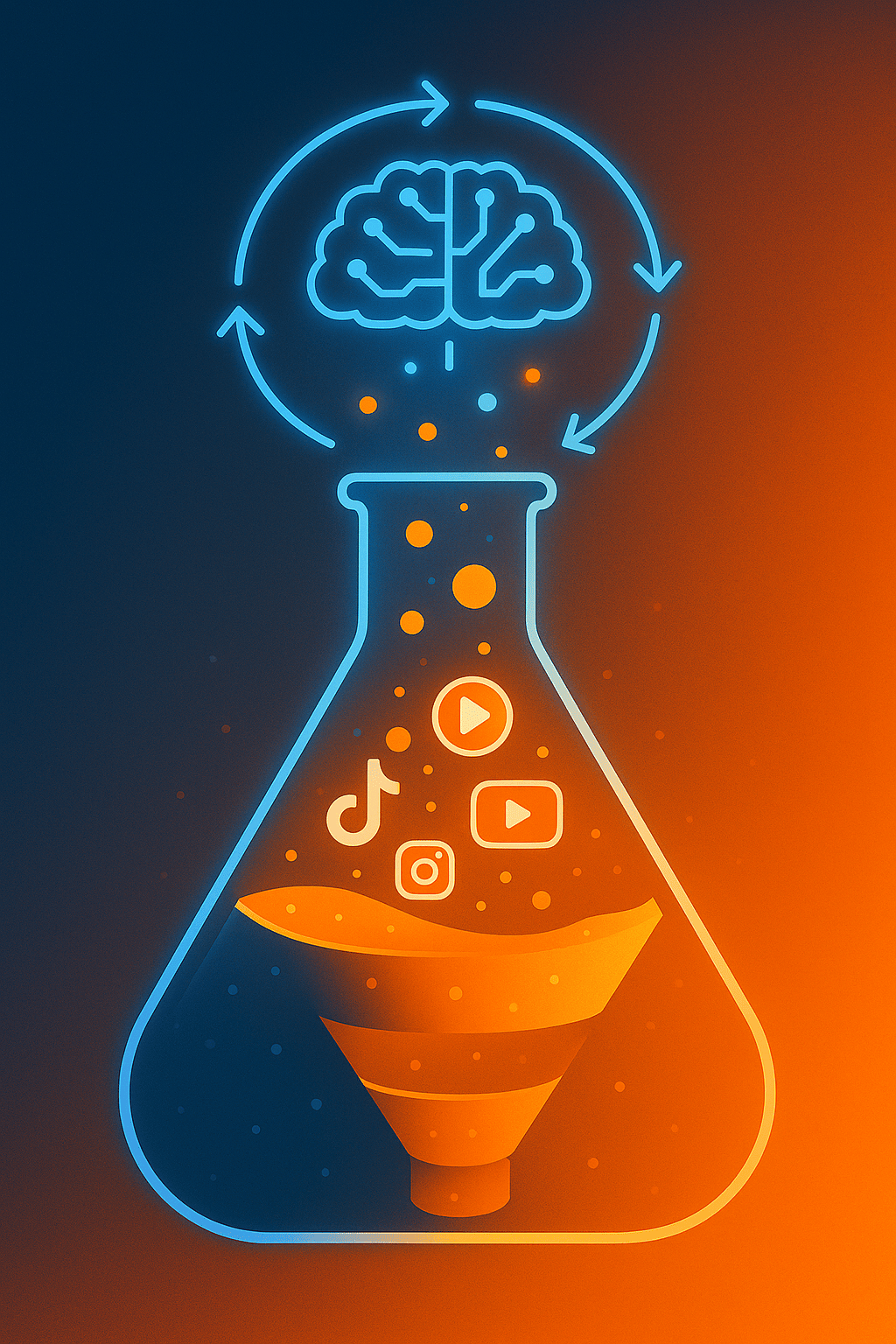
Imagine you're running a lab. Every day, dozens of scientists walk in, each brimming with ideas. Some test chemicals, some combine powders, some blow things up. You don't know which experiment will work. Most fail. But once in a while, someone cracks open a formula that changes everything, steel, penicillin, lithium-ion batteries.
Now swap "scientists" with "marketers," "formulas" with "campaigns," and "lab" with your brand. That's marketing today. We run experiments, ads, stories, activations, hoping one will produce a breakthrough in sales or brand love. The difference? Science has equations and peer review. Marketing has hunches and dashboards.
So what happens when an AI Scientist enters the picture?
What an AI Scientist really means
Periodic Labs, the new venture by Liam Fedus (co-creator of ChatGPT) and Ekin Dogus Cubuk (ex-DeepMind), is building AI that can form hypotheses, design experiments, run them, and learn from results, without waiting for human bottlenecks.
In science, that means discovering new superconductors or heat-resistant materials. In marketing, the analogy is obvious:
- Formulate a hypothesis: "If we show Gen Z short, raw TikToks instead of polished TV ads, engagement goes up."
- Design the experiment: Launch two versions across regions, control the spend.
- Run the test: Push live instantly across channels.
- Learn and iterate: Adjust in real-time, not months later.
Most CMOs already claim to "test and learn." But the truth? It's manual, slow, political. The AI Scientist doesn't argue in boardrooms. It simply runs the experiment.
Why CMOs should care
- The speed of cycles shrinks - In science, the bottleneck was lab time. In marketing, it’s campaign cycles. AI cuts both. Imagine moving from quarterly campaigns to daily iterations, without burning your team out.
- Failure becomes fuel - Scientists love negative results. They tell you what doesn't work, narrowing the search space. In marketing, we hide failures. AI reframes them as data points. Each flop is a step closer to resonance.
- Hypotheses scale beyond human bandwidth - No CMO can dream up 10,000 campaign variations and test them. AI can. It can map all the "what ifs" you'd never consider and filter which ones are worth your dollars.
- Markets become laboratories - Every impression, click, and dwell time becomes an experiment. Your customer journey is no longer a funnel, it's a lab notebook.
The challenges (don't gloss over them)
- Noise vs signal: Just like lab data, marketing data is messy. If your measurement is off, the AI learns junk. Garbage in, garbage scientist.
- Org politics: Will your creative director accept that the AI says memes outperform their award-winning campaign? The human ego is harder to automate than the experiment.
- Cost vs payoff: Automating discovery in science takes billions in robotics. In marketing, the cost is different: data pipelines, clean experimentation platforms, and the courage to let AI decide.
So what’s the play for a CMO?
Think in three shifts:
- From storyteller to experiment director - You don't need to be the scientist. You need to run the lab. Set hypotheses that matter to the business, not vanity.
- From campaign launches to continuous discovery - Stop worshipping the "big launch." The AI Scientist thrives on constant trial and error. Markets shift daily. Your experiments must too.
- From brand gut to causal proof - Replace "we believe this works" with "we know this causes growth." In science, correlation isn't discovery. Same in marketing. AI can help you move closer to causality.
Closing thought
The promise of Periodic Labs is bold: automate discovery in the hard sciences. The promise for CMOs is just as radical: automate discovery in the soft science of persuasion.
The CMO of the future isn't a brand whisperer or a media negotiator. They're a chief experimenter, harnessing AI scientists to shrink the distance between idea and impact.
Because in the end, whether in physics or marketing, the breakthroughs don't come from thinking harder. They come from running more experiments, faster, and learning ruthlessly.





