Why Prompts Matter
A prompt is just a question you ask an AI. The way you ask it determines the quality of the answer. Most marketers think they're "bad at prompting" when in reality, they’re just being vague.
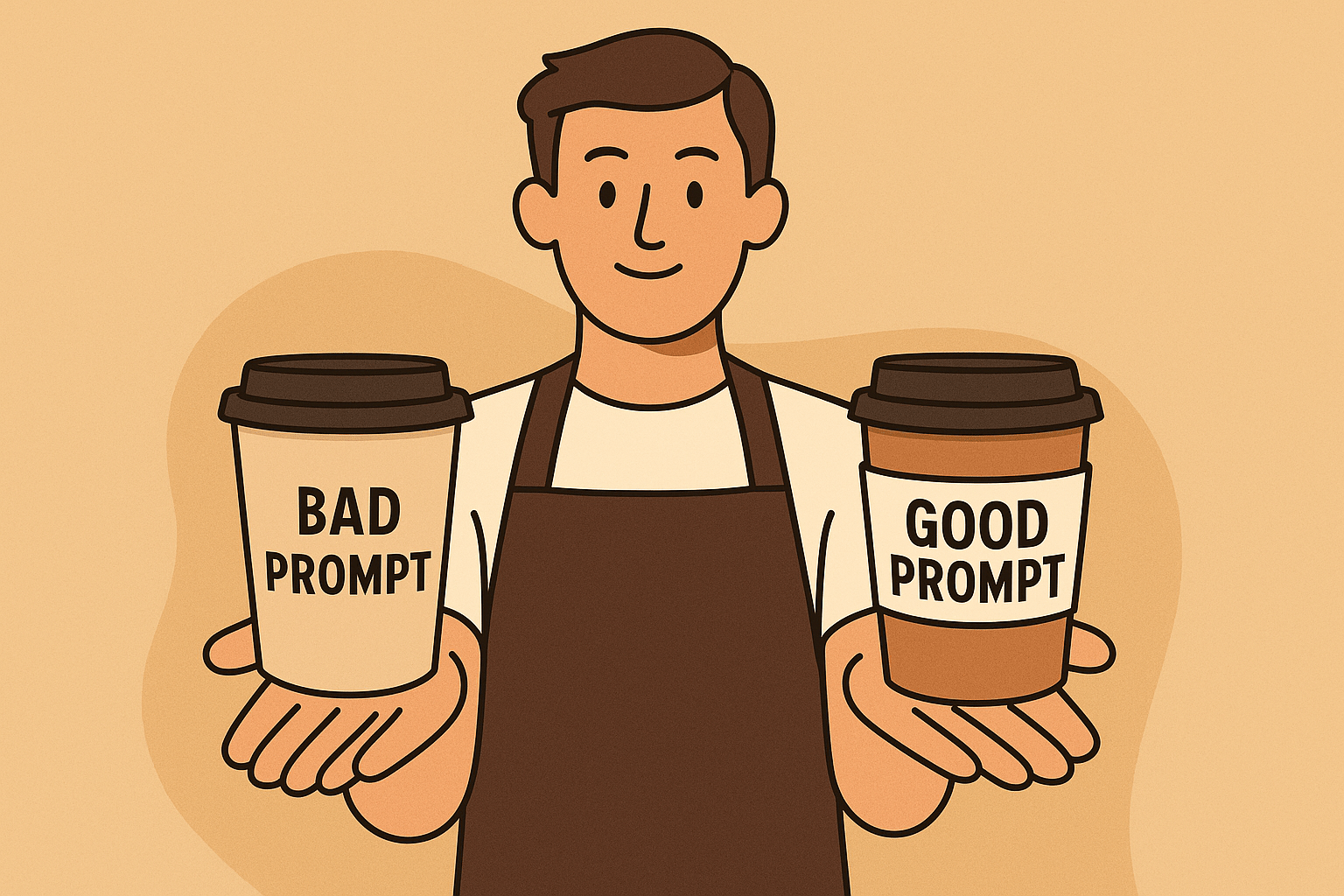
Analogy: If you walk into a coffee shop and say, "coffee," you might get an espresso, a flat white, or even a cold brew. If you say, "large cappuccino with oat milk, extra hot," you get exactly what you wanted. Prompts work the same way.
First Principles of Prompting
- Context: Who and what is this for?
- Task: What do you want done?
- Format: How should the answer be returned?
That's it. Three levers. Get those right, and your prompts become powerful.
Common Mistakes
- Too vague: "Write me a blog." (Result: generic fluff)
- Missing context: "Write an email." (But who's it for? A teenager or a CFO?)
- No format: "Give me ideas." (Do you want a list, a table, or a script?)
How to Structure Better Prompts
- Bad prompt: "Write social media posts about my product."
- Better prompt: "Write 5 Twitter posts (under 280 characters each) for small business owners about how my AI tool saves time. Make them witty and end each with a call-to-action."
A Simple Framework You Can Steal
Prompt recipe:
Act as a [role]. Write [type of content] about [topic] for [audience]. Keep the tone [tone]. Deliver it in [format].
Example:
"Act as a copywriter. Write an Instagram carousel about sustainable fashion for Gen Z. Keep the tone playful. Deliver in bullet points."
Why Marketers Should Care
Every wasted prompt wastes time. Every sharp prompt saves hours. The difference between "meh" AI and "wow" AI isn't the model, it's the marketer holding the pen.





