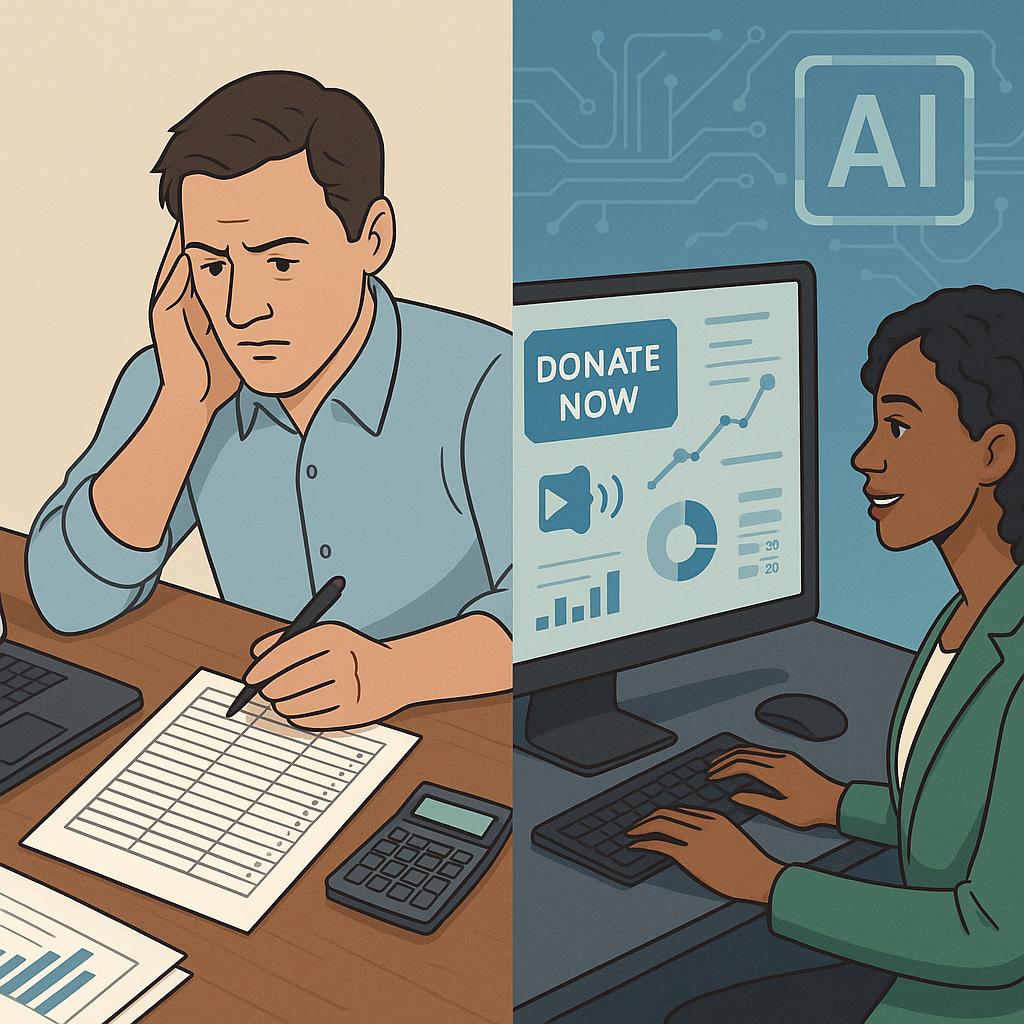
In an era where philanthropic organizations face rising donor fatigue, increasing competition for limited resources, and escalating operational costs, the need to optimize fundraising has never been more urgent. Artificial Intelligence (AI) is emerging as a decisive lever for change, empowering nonprofits to make data-driven decisions, personalize engagement at scale, and continuously improve campaign performance.
At Acalytica, we believe the future of fundraising lies at the intersection of automation, analytics, and human empathy. This article explores how AI is fundamentally rewriting the rules of campaign optimization in the philanthropic sector.
The Status Quo: Manual, Siloed, and Inefficient
Most fundraising teams still rely on manual segmentation, static email lists, and retrospective campaign analysis. While CRMs have modernized donor management, the insights they offer are often reactive rather than predictive, and limited by human processing capacity. As donor expectations evolve, mirroring the hyper-personalization of e-commerce and social platforms, this model is no longer sufficient.
A Paradigm Shift: AI as a Fundraising Copilot
AI doesn’t replace the fundraiser—it augments their ability to make decisions, act at scale, and maximize ROI. Here’s how:
1. Predictive Donor Modeling: Know Who to Ask, When, and How
Machine learning models can now score donors based on historical and behavioral data—enabling teams to:
- Forecast giving likelihood and upgrade potential.
- Anticipate donor churn and trigger retention actions.
- Identify untapped donor segments with high affinity.
Impact: One African NGO increased repeat giving by 27% within 90 days by focusing on donors flagged as “likely to lapse.”
2. AI-Generated Campaign Content: Scale Personalization Without Scaling Staff
Natural Language Processing (NLP) models such as GPT-4 can:
- Draft personalized appeal emails tailored to each donor profile.
- Generate high-conversion social media content with optimized copy.
- Create compelling thank-you letters and follow-ups automatically.
Real-world application: An environmental nonprofit used AI to personalize 15,000 emails in under 30 minutes—boosting click-through rates by 54%.
3. Real-Time Optimization: React Before Campaigns Underperform
AI tools can monitor campaigns live and respond in real time:
- Redirect spending to higher-performing channels.
- A/B test subject lines, images, and calls-to-action dynamically.
- Adjust timing and tone based on audience behavior.
Example: During a Giving Day event, an AI tool shifted ad budget mid-campaign to WhatsApp from email—leading to a 31% increase in donations.
4. Smart Donor Journeys: Create Lifecycle Engagement Flows
AI can orchestrate multi-step donor journeys based on behavior:
- First-time donors receive automated onboarding content.
- Lapsed donors are nudged with re-engagement offers.
- Loyal donors get personalized impact reports and upsell asks.
Insight: Donor journeys that are AI-optimized outperform static journeys by up to 3x in lifetime value.
5. Forecasting and Budget Optimization: Simulate Before You Spend
AI can simulate various campaign configurations:
- Predict campaign outcomes based on historical data.
- Model ROI across different channels or donor cohorts.
- Recommend budget allocations using reinforcement learning.
Benefit: A South African education nonprofit avoided a costly gala by simulating a 2x higher ROI through a digital storytelling campaign.
What This Means for Nonprofits and Foundations
Fundraising success in the AI era depends not just on data access—but on how intelligently that data is used. Leading organizations will:
- Embed AI tools directly into their fundraising workflows.
- Upskill staff to work alongside machine intelligence.
- Measure success not only in dollars raised—but in relationships built.
Acalytica’s Role: Fundraising Reimagined
At Acalytica, we’re building tools that empower mission-driven teams to:
- Generate donor-specific landing pages using AI.
- Optimize outreach through predictive analytics and personalization.
- Visualize performance and impact through real-time dashboards.
Through our platform, even small teams can execute large-scale, intelligent campaigns, without needing a data science team.
Conclusion: From Gut Feeling to Growth Engine
AI enables a shift from intuition-based fundraising to evidence-based decision-making, without sacrificing the human connection at the heart of philanthropy. For organizations willing to embrace AI as a partner, the rewards are tangible: more engagement, higher efficiency, and ultimately, greater impact.
You create the mission. We help you grow it.





