Let's start with a simple question:
What drives marketing success, the story you tell, or where you tell it?
Most marketers, when budgets tighten, chase placement efficiency. They tweak CPMs, adjust bid strategies, optimise timing. It feels scientific. But often, it's the creative, the signal, that determines whether any of that spend actually matters.
In physics terms, media placement is the medium, creative quality is the energy.
You can amplify a weak signal all you want, but it’s still noise.
The First Principles Lens
To understand this properly, strip away all the jargon, CTRs, ROAS, GRPs. and get to the invariant core.
Every campaign exists to do one thing:
Transfer belief from brand to brain.
Creative quality determines what belief is transferred.
Media placement determines whose brain receives it, and when.
The causal relationship looks like this:
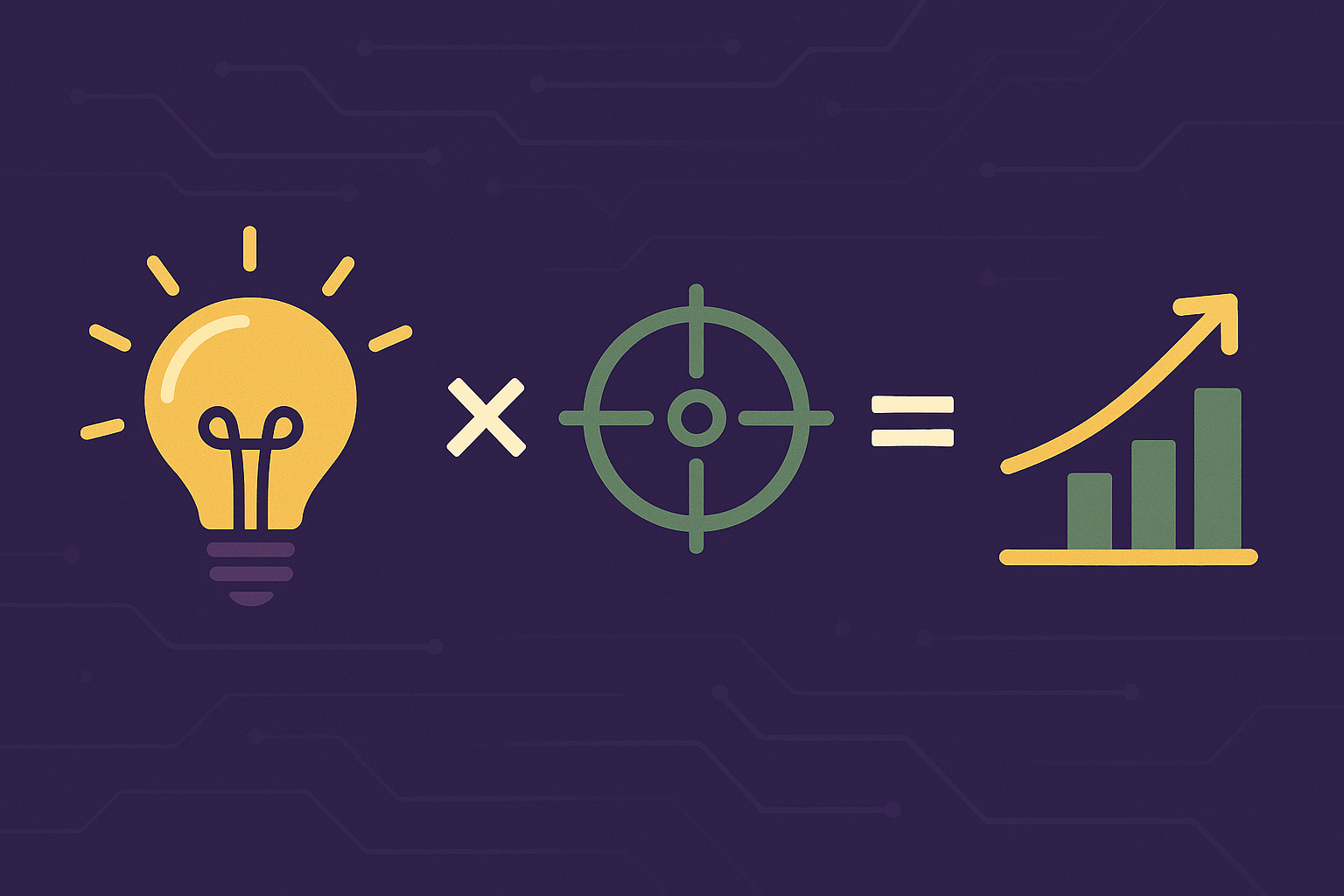
Effectiveness ≈ Creative Quality × Media Placement
Notice the multiplication, not addition.
If either is zero, the result is zero.
A brilliant ad in the wrong place dies in silence.
Perfect placement with dull creative is efficient irrelevance.
Why We Overvalue Placement
Media feels measurable. Creative feels mysterious.
You can log into a dashboard and see impressions, conversions, and CPC trends. You can't easily quantify the emotional punch of a headline or the charm of a voice-over. So we fall for the illusion of control, measuring what’s easy, not what matters.
That’s how many brands end up optimising for visibility, not vitality.
But humans don’t buy because an algorithm found them. They buy because something moved them.
What the Data Actually Says
Independent studies (IPA, Nielsen, System1) converge on the same truth:
- Creative accounts for roughly 60% of long-term campaign ROI.
- Media placement contributes around 40%, still vital, but secondary.
- Brand equity, pricing, and macro factors fill the remaining gap.
So when a CMO says "our ads aren’t performing," the right question isn't where they're running, but why should anyone care when they see them?
How AI Changes the Game
AI has quietly turned the old "creative vs media" debate into creative × media fusion.
Machine learning models can now:
- Test hundreds of creative variations in real time.
- Auto-optimise placement based on engagement signals.
- Adjust tone, format, or even copy per micro-audience.
Placement precision is no longer the differentiator, algorithms handle that.
The new battlefield is creative intelligence: the ability to generate, adapt, and interpret messaging that still feels human in an automated system.
In other words, media is becoming self-driving; creativity remains the pilot.
A Simple Experiment
If you're unsure where your leverage lies, try this:
- Run the same creative across multiple placements (TikTok, YouTube, OOH) → You'll learn how context amplifies or muffles the message.
- Run different creatives in the same placement → You'll learn how much the story itself matters.
When you multiply both optimisations, compelling story × perfect context, you approach marketing asymmetry: outsized returns from elegant precision.
The Equation for Growth
We can express campaign growth as a simple system:
Growth = Message Resonance × Audience Relevance × Feedback Speed
- Message Resonance = Creative Quality
- Audience Relevance = Media Placement
- Feedback Speed = Intelligence Layer (AI, analytics, learning loops)
Creative wins attention.
Media ensures attention meets intent.
Intelligence ensures you improve the loop faster than competitors.
The Takeaway
Don't let dashboards trick you into mistaking motion for progress.
A thousand perfectly placed irrelevancies are still wasted.
Creative quality is not the cherry on top, it's the cake.
Media placement just decides who gets a slice.
The brands that win aren't the ones shouting loudest or buying smartest; they're the ones that say something worth amplifying.
So before you ask "Where should we place this?", ask first:
"Is it worth placing at all?"





