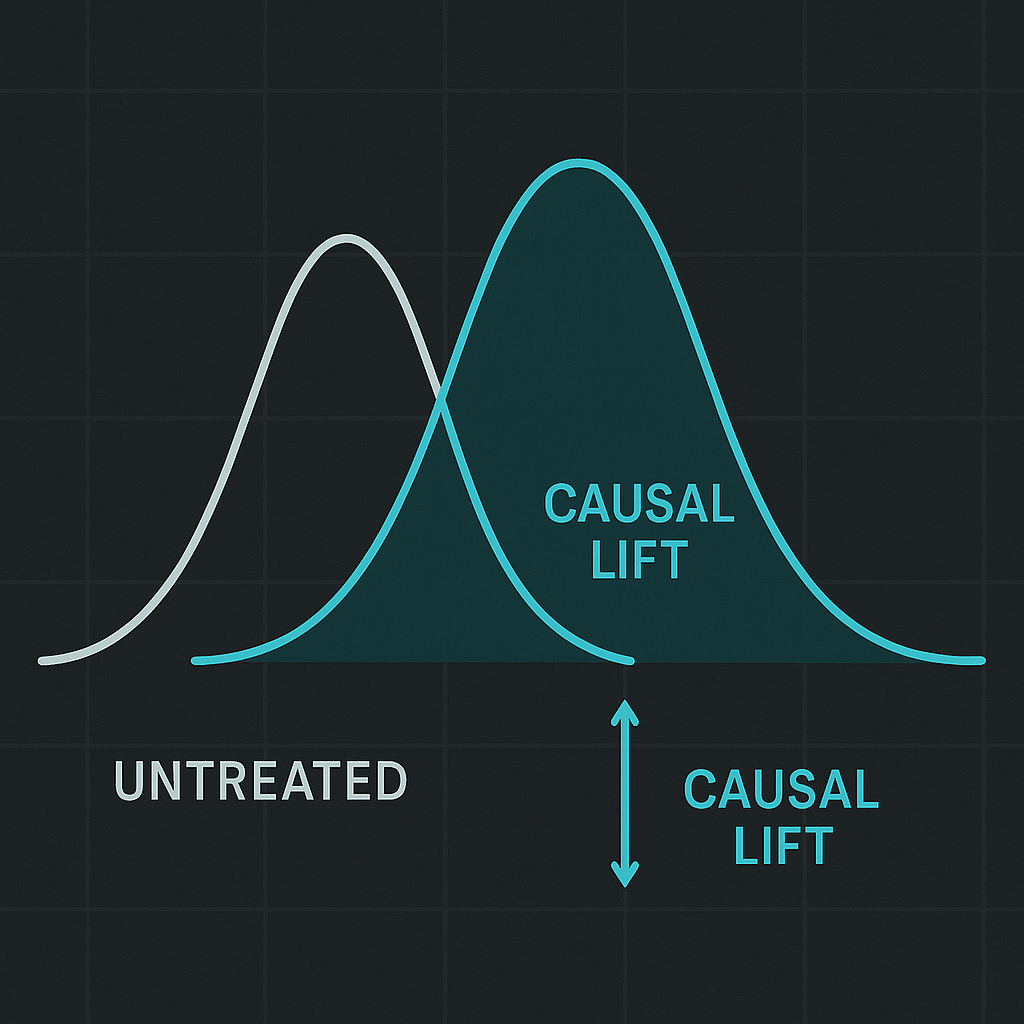
Marketers love movement. When dashboards light up green, campaigns feel alive. But movement isn't proof of causation. It's often just noise wearing the mask of momentum. The concept of causal lift strips away that mask and asks a blunt question: What part of this growth happened because of you, and what would have happened anyway?
The Mirage of Metrics
Most marketing analytics report correlation, not causation. A spike in conversions after an ad launch looks like success, but it may just be coincidence, seasonality, competitor downtime, payday, or random traffic shifts. Traditional metrics like CTR or ROAS tell you what changed. Causal lift tells you what changed because of you.
It's the difference between thinking "my ad caused a 10% uplift" and discovering "only 3% of that uplift was actually caused by the ad." The remaining 7% would have shown up even if you’d done nothing.
The Counterfactual You Can't See
Every causal question hides a ghost world, the counterfactual.
- In our world, a customer saw your ad and bought.
- In the ghost world, they didn’t see your ad. Would they still have bought?
You can never observe both worlds for the same person. The art of causal lift estimation is to reconstruct that ghost world using data science and design logic. That's why A/B testing, matching, and modelling exist: to approximate the world that didn't happen.
The Mathematics of Responsibility
Causal lift = (Outcome if treated) – (Outcome if not treated).
Simple in theory, brutal in practice.
To estimate it, you need one of two conditions:
- Randomisation - pure luck decides who sees the ad. Then difference in outcomes is genuine lift.
- Adjustment - when luck isn't available, you model or match people with similar traits to simulate randomness.
Without one of these, your metrics are hallucinating.
When Data Becomes Evidence
Imagine you send an email campaign to 100 000 users.
- Treated group (got email): 12% converted.
- Control group (no email): 10% converted.
Your causal lift is 2 percentage points. The causal contribution is (2 / 12 = 16.7%). Meaning 83.3% of conversions would have happened without you.
Now you're not just reporting performance. You’re measuring responsibility.
Why It Changes Everything
Causal lift transforms how marketers allocate resources. Instead of optimising for clicks or impressions, you optimise for incremental outcomes. That reframes budgets: stop funding tactics that harvest inevitability.
It also reshapes attribution. Instead of arguing whether Google Ads or Instagram deserves credit, you ask: Which channel actually changed behaviour?
It disciplines creative testing too. A message that looks like a winner in raw engagement might have zero lift when tested against a clean control. Impact requires falsifiability.
The Hidden Ethics
Causal lift also has an ethical edge. Measuring causality protects customers from wasteful or manipulative targeting. You stop spamming segments where lift is zero or negative. You stop mistaking visibility for persuasion. You design for effectiveness, not addiction.
From Performance to Causality
Marketing without causality is astrology with dashboards.
Marketing with causal lift becomes experimental science, falsifiable, interpretable, and accountable.
A true marketer doesn't celebrate correlation. They hunt for the smallest measurable push their work exerts on reality. That push is causal lift. Everything else is weather.





