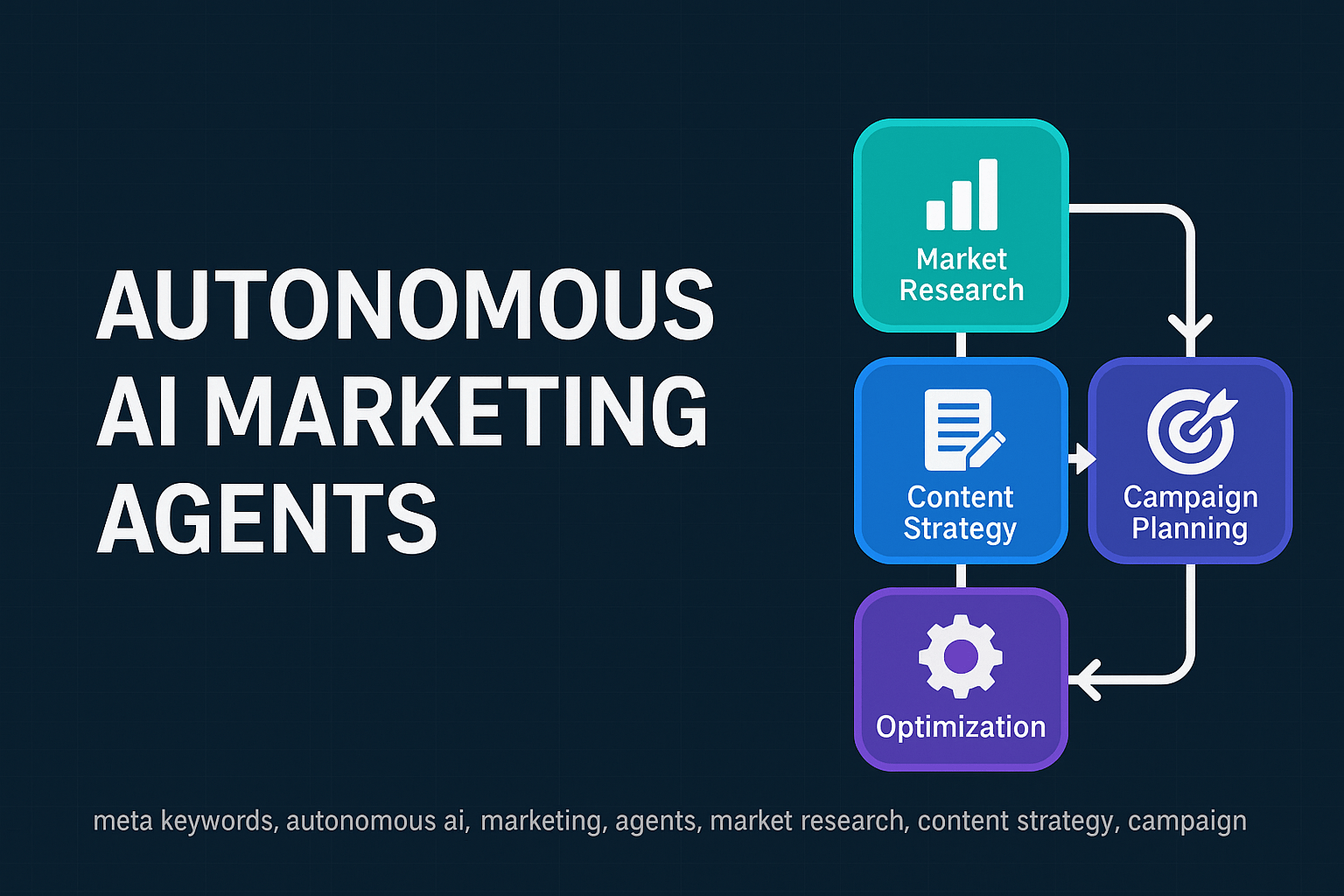
Marketing work has always followed one pattern. Humans research a market, humans write the content, humans plan the campaign. It takes weeks because humans must do everything in sequence. The page you referenced breaks that logic by doing something deceptively simple. It lets AI agents talk to each other and complete the same workflow in minutes. I'll rebuild the ideas in plain reasoning so the mechanism becomes obvious.
The underlying puzzle
One large language model can answer anything but cannot coordinate multiple dependent tasks reliably. Ask it for market research, then ask for a strategy informed by that research, and it loses the thread unless you manually curate context. The cost is cognitive drag and operational bottleneck.
The page introduces a system that removes those bottlenecks. It defines multiple specialised AI workers, each with a role, goal and method. Then it connects them so the output of one becomes the input of the next without human glue. The chain becomes a functioning workflow.
How the system works
The core behaviour is sequential cooperation.
Agent 1 receives the brief and generates market intelligence. Because the agent is defined as a “Market Analyst”, it behaves like one.
The system hands this output directly to
Agent 2, the “Content Strategist”. This second agent operates on the first agent’s analysis, not a generic prompt.
The system repeats the pattern through any number of agents: campaign planning, compliance, optimisation and more.
The critical detail is the automatic context-passing. Humans no longer move information between steps. The system orchestrates the entire run in minutes.
Why this collapses campaign timelines
A human sequence behaves like a relay race. Each runner hands over the baton. AI agents behave like parallelised logic. They move through the work faster because they don’t tire, don’t wait and don’t forget. The cost of a “full team of specialists” becomes the cost of a few API calls. A traditional workflow that cost tens of thousands and took weeks dissolves into a ten-minute automated run.
What this means for marketers
The page demonstrates a single example: a youth digital savings campaign. But the pattern generalises. Once agents handle the repetitive scaffolding of research, analysis, content and planning, humans shift to judgment and interpretation. The gain is not about replacing people. It’s about removing the parts of marketing that never needed a human in the first place.
Why this matters beyond marketing
If multiple agents can coordinate a full campaign, multiple agents can coordinate any structured knowledge workflow. Product research, segmentation, onboarding journeys, FAQ generation, competitor mapping and even basic performance reporting can run the same way. The principle is not domain-specific. It is a new organisational primitive.
The simplest way to see this in action
The fastest route to internalising the concept is to watch the agents run. The page includes a full tutorial, source code and slides. One hour is enough to build a two-agent system. Ten minutes is enough to run a complete campaign. Once you see it happen, the abstraction becomes concrete.





