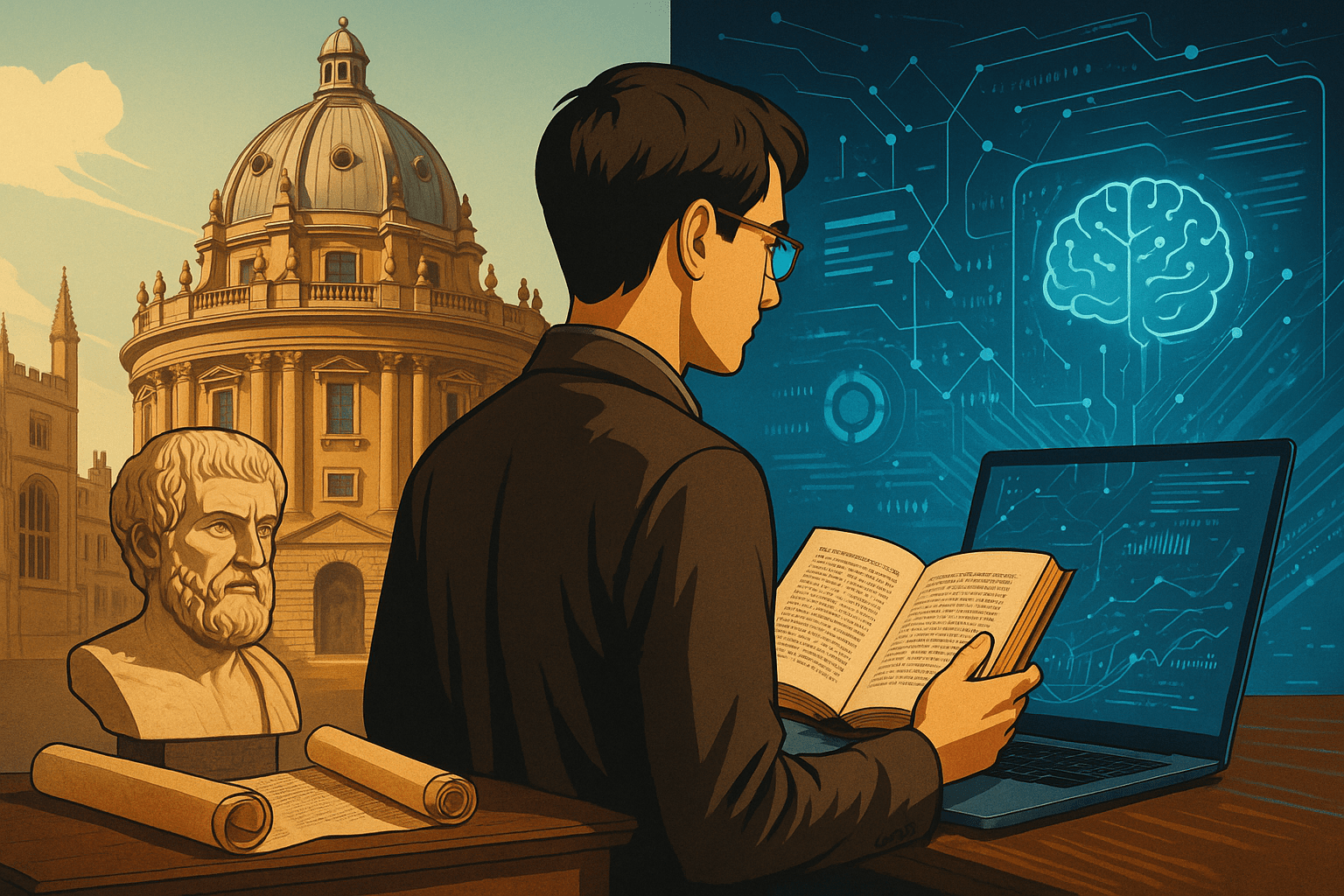
Universities often get accused of being out of touch. "Why study philosophy when you can learn to code?" "Why waste time on the classics when the future is AI?" Yet here's the twist: the very subjects people once dismissed as impractical are the ones proving most valuable in a world ruled by technology. Oxford's centuries-old bet on philosophy, anthropology, and the classics turns out to be not just tradition but foresight.
The Decay Rate of Knowledge
Think about this: technical skills age like milk, not wine. Programming languages fall out of fashion, industries reinvent themselves, and platforms vanish overnight. The half-life of "job-ready" skills is shrinking every year.
By contrast, philosophy, anthropology, and the classics focus on cognitive frameworks, the way we reason, interpret, and navigate uncertainty. Those don't expire. They compound. A graduate who can structure arguments, decode human behaviour, and apply lessons from centuries of problem-solving is equipped for an AI-accelerated world where the only constant is change.
Philosophy: The Engine of Clear Thinking
Philosophy isn't about memorising dead philosophers. It's about training your brain to cut through noise. Logic, ethics, metaphysics, they force you to ask: What's really being said? What assumptions are baked in? What follows and what doesn't?
In an era where algorithms flood us with information, discernment is gold. Anyone can access ChatGPT or Google; few can question, filter, and apply the output responsibly. Philosophy sharpens that edge.
Anthropology: Seeing Systems of Meaning
AI is good at spotting statistical patterns. But humans don't just operate on patterns, we live inside cultures, symbols, rituals. Anthropology equips you to step outside your own frame of reference and see the hidden wiring of human behaviour.
Designing a product for township SMEs in South Africa, marketing pizza to rugby fans, or building AI that people trust, all require deep cultural intelligence. Anthropology makes you fluent in the real operating system of humanity.
The Classics: Long Memory in a Short-Sighted Age
When you read the Greeks, Romans, or ancient epics, you're not indulging in nostalgia. You’re accessing humanity's oldest experiments with power, ethics, governance, and innovation.
Consider this: Plato was already wrestling with the dangers of unchecked rhetoric, the same problem we face with viral misinformation. The Stoics thought deeply about resilience in uncertainty, a skill CEOs and policy-makers are scrambling to teach today.
The classics are less about "what they said" and more about recognising the rhymes across history. Patterns of ambition, collapse, adaptation, they show up again and again, whether in the fall of Rome or the rise of AI-driven economies.
Why This Matters Now
Automation eats tasks but not meaning. AI can translate languages, but it can't decide what justice is. It can predict behaviour, but it doesn't know which behaviours are worth encouraging. It can recommend, but not reflect.
The gap is clear: the tools are powerful, but the compass is missing. And the compass lives in disciplines that train moral judgment, cultural awareness, and historical depth.
That's why Oxford's emphasis wasn't an indulgence. It was insurance. The graduates who can argue like philosophers, see like anthropologists, and remember like classicists are the ones who can lead in a world where the rules keep shifting.
The First-Principles Lesson
If you strip it down:
- Skills that change fast = fragile.
- Frameworks that shape thinking = durable.
- The future belongs to those who can learn, unlearn, and reframe faster than machines can replace them.
So yes, Oxford was right. The subjects people once mocked as "impractical" might just be the most practical education of all.