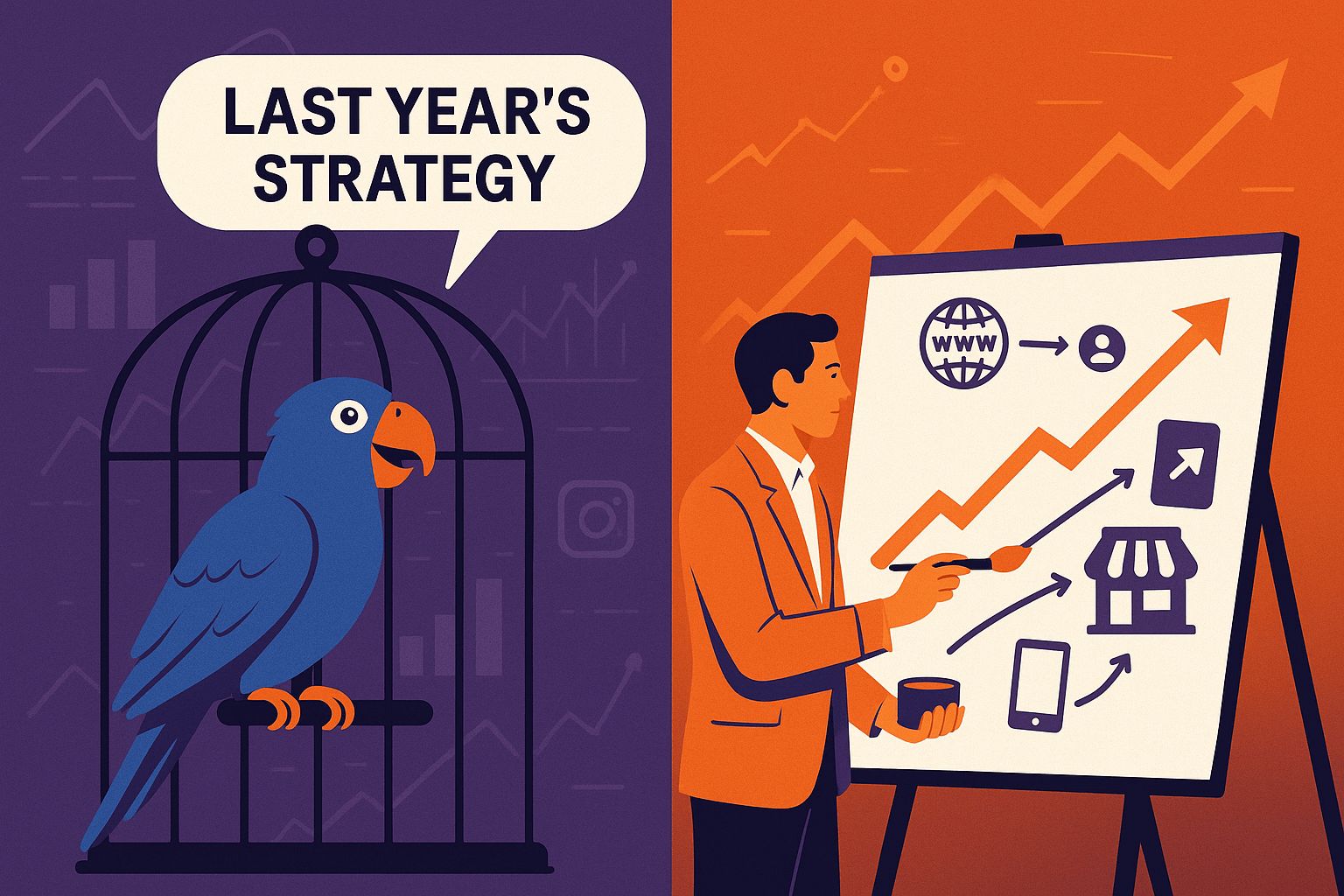
If you teach a parrot to say "Polly wants a cracker," the bird repeats the sound exactly, but it doesn't understand crackers. The parrot has "overfit" on a particular phrase. This is the same problem AI faces. It often memorises patterns without grasping the deeper structure behind them.
What Overfitting Really Means
Imagine you're trying to guess the rule of a sequence: 2, 4, 6, 8… You'd say, "Ah, it's adding 2 each time." That's generalisation, you've found the simple underlying rule.
But suppose you had a computer that looked only at the training data. It might invent a rule like:
"Start with 2, then add 2 until you reach 8, then stop."
This rule matches the training data perfectly, but fails the moment we ask, "What comes next?" That's overfitting. The model fits the given data too tightly and fails to extend the idea.
AI models, particularly large ones, are masters at memorising every wiggle of the training set. What they're not so good at is knowing which wiggles matter.
Why Does This Happen?
Three forces make overfitting almost inevitable in AI:
- Data is noisy. Real-world data is messy. People make typos, weather shifts, markets wobble. If the model treats all of this as signal, it will learn noise as if it were law.
- Models are too powerful. A neural network with billions of parameters can describe any curve you want. It can draw a line through every point in a scatterplot, even if the points are random. The more powerful the learner, the easier it is to overfit.
- Objectives are shallow. Most training is built on the principle: "Minimise error on this dataset." But datasets are not reality; they're samples. Optimising for perfect training accuracy is like practising only the exam questions you've already seen, you ace the test, but fail at life.
The Cost of Overfitting
Overfitting isn't just an academic concern. It shows up in the real world:
- Finance: An AI trained on last year’s stock patterns might "predict" perfectly, until the market shifts, and it loses billions.
- Healthcare: A model trained on hospital scans from one city may diagnose patients well there, but collapse when applied in another city with different equipment.
- Marketing: You can build a campaign model that works wonders on past click data but misfires when people's habits change next season.
Everywhere you look, overfitting means the system fails to transfer knowledge.
How Humans Generalise Differently
Humans aren't perfect, but we're better at extracting the essence. Once you ride a bike, you don't need to relearn when the bike is red or blue. You know the principle: balance on two wheels while pedalling. That’s generalisation.
Our brains constantly discard irrelevant detail. We compress the world into manageable rules and test them. If the rules fail, we adjust. In other words, we don't just memorise, we hypothesise and revise. That's what current AI still lacks.
Fighting Back Against Overfitting
Researchers have a toolkit to push back against overfitting:
- Regularisation: Punishing complexity so the model favours simpler rules.
- Dropout: Randomly switching off neurons during training so the model can't rely on brittle shortcuts.
- Data augmentation: Feeding the model distorted, varied, or synthetic data so it learns to handle diversity.
- Cross-validation: Testing on data it hasn't seen, to catch overconfidence early.
- Causal AI: Instead of just mapping correlations, building models that learn cause-and-effect.
These techniques help, but they're patches. The fundamental gap is still there: AI doesn't yet understand meaning.
The Deeper Lesson
Overfitting is not just a technical bug. It's a mirror of how we define intelligence. If intelligence is just memorising facts, then machines are already brilliant. But if intelligence is the ability to see why the world behaves as it does, to imagine counterfactuals, and to test general rules, then AI is still in its infancy.
We can think of it this way: AI is a parrot with a vast vocabulary. It can sing any song we've ever written down. But to truly generalise, it must become a scientist, it must discover the principles behind the song.
Final Thought
The problem of overfitting is really the problem of intelligence itself. To generalise, a machine must do what humans do instinctively: separate signal from noise, learn the deep rules of the game, and apply them flexibly in new situations. Until then, AI will remain brilliant parrots, loud, impressive, but not yet wise.





