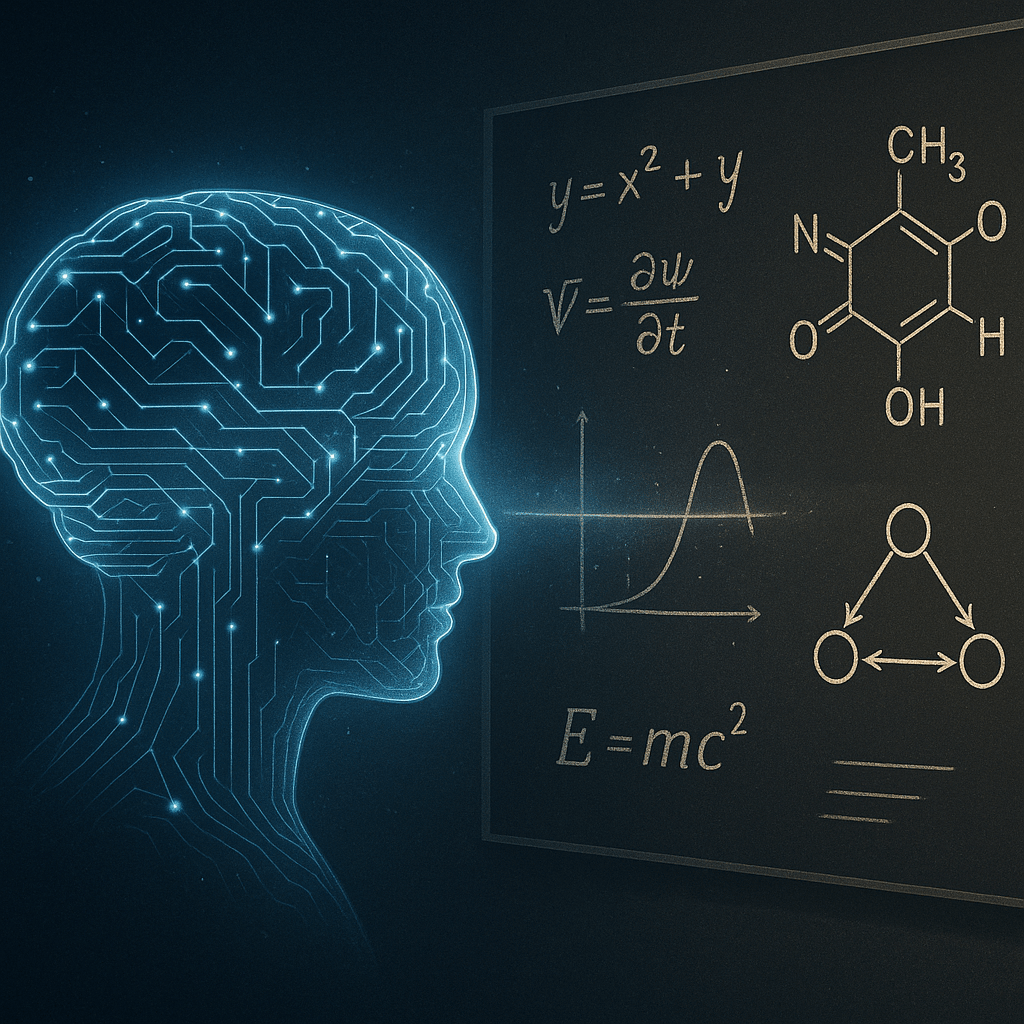
Science isn't about knowing things. It's about finding out, asking nature questions and listening carefully to what she says back. So if an AI is to become a real scientist, it must stop being a machine that predicts and start being a mind that wonders.
The Difference Between Knowing and Understanding
Today's AI systems are superb at prediction. They can tell you what image looks like a cat, what sentence should come next, or what molecule might bind to a protein. But they do not know why. They swim in oceans of correlation without ever touching the shore of causation.
A scientist doesn't just notice patterns. They build models, little stories about how the world works, and then try to break them. Until an AI can do that, it's not reasoning, it's autocomplete with a PhD.
Hypothesis: The Spark of Science
The scientific method begins with a question that can be wrong. That's the secret power of a hypothesis, it invites failure in exchange for truth. An AI scientist would need to do the same: generate conjectures not from data alone, but from curiosity about why the data looks that way.
That means developing a logic of abduction, the ability to invent explanations that could be tested. Machine learning as we know it can't do this. It fits functions to data but never asks, "What if the world could be simpler than this?"
The Experiment Problem
Real science isn't just about thinking, it's about poking. Scientists intervene in the world to see how it responds. That's how causality is revealed. If you only ever watch the world, you get fooled by coincidences. To understand, you must disturb.
For AI to qualify as a scientist, it must not only observe but also act, design experiments, gather evidence, and update its beliefs. This requires a bridge between algorithms and environments, between theory and touch. Without experimental agency, an AI remains a spectator to the universe.
The Need for Compression
All genuine scientific insight is compression. Newton compressed the motion of the planets and the fall of an apple into one equation. Darwin compressed the diversity of life into a single principle of natural selection. Science is the art of finding what stays the same beneath what changes.
For an AI to do that, it must learn to discard noise and preserve invariants. It must invent concepts, not just memorise features. This means building systems that reason in abstractions, machines that can say, "This mechanism explains many things at once." That's what makes a theory powerful: parsimony, not horsepower.
Self-Correction and Meta-Reasoning
The best scientists doubt themselves. They design their experiments not to confirm but to falsify. An AI scientist would have to internalise this ethos. It must inspect its own assumptions, measure its uncertainty, and adjust its confidence when wrong.
This isn't optimisation; it's epistemic hygiene. Without it, the AI would become just another sophist, clever, articulate, and completely untrustworthy.
Communication and the Human Loop
Science is communal. Knowledge doesn't exist until it can be explained. If an AI discovers something but can't translate its reasoning into human-understandable form, it hasn't done science. It has hallucinated privately.
The AI scientist, therefore, must not only reason but teach. It must expose its causal models, the evidence that supports them, and the limits of their validity. That transparency is not a nicety; it’s what turns belief into knowledge.
The Moment of Becoming
An AI crosses the threshold into science not when it learns faster or stores more data, but when it does something deceptively simple:
- It asks a question about the world.
- It imagines an answer that could be wrong.
- It performs an experiment to find out.
- It learns from the failure.
- It shares what it found in a way others can test.
That's the scientific loop. That’s curiosity formalised.
The Real Frontier
Building an AI scientist isn't about stacking more GPUs or enlarging the next language model. It's about engineering epistemic autonomy, the ability to form, test, and revise beliefs about reality.
The first true AI scientist will not be the smartest calculator in the room. It will be the first machine to admit, "I don't know, but I can find out."





