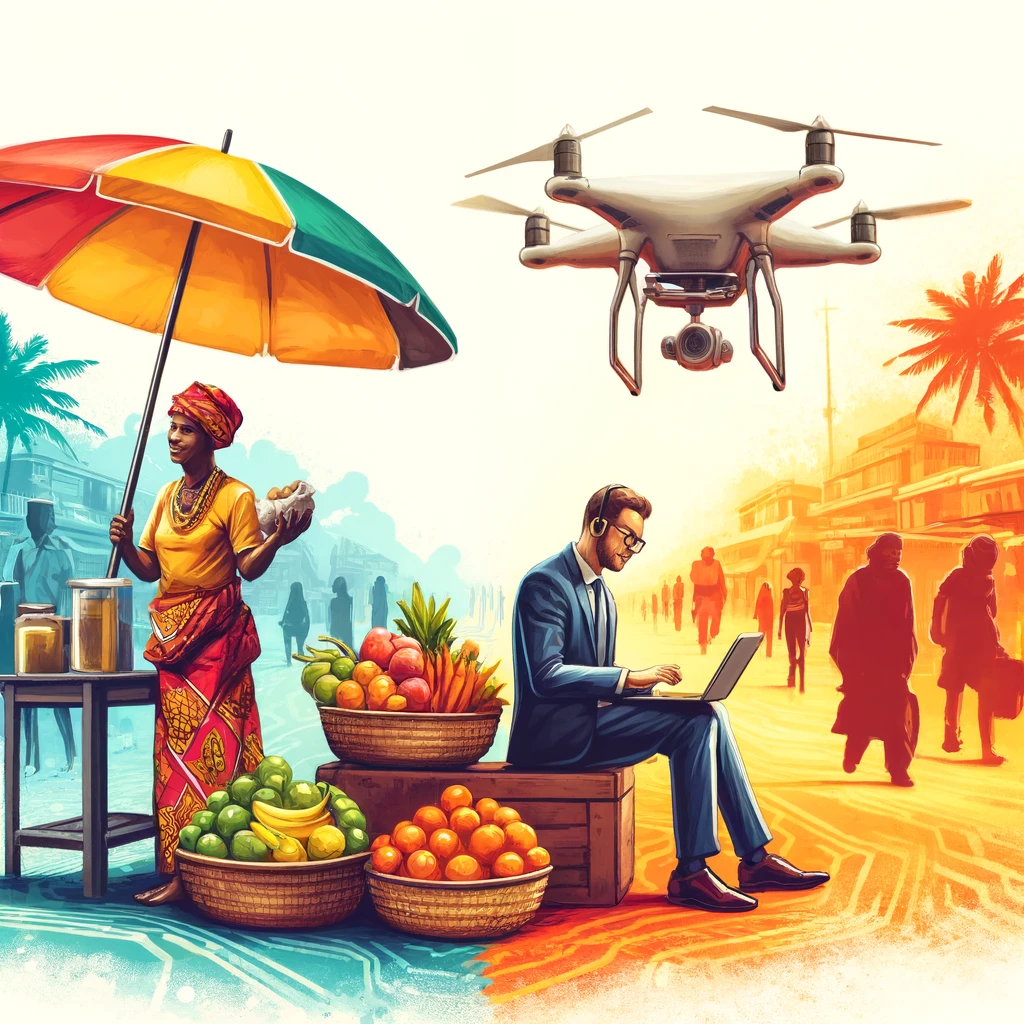
If you’ve ever walked through a bustling African market or watched a drone deliver medicine to a remote village, you’ve seen two sides of Africa’s entrepreneurial story. On one hand, there’s the street vendor selling fruits to feed her family; on the other, there’s the tech innovator revolutionising access to healthcare. These two types of entrepreneurship—transactional and transformational—paint a vivid picture of a continent balancing survival with innovation.
Why is transactional entrepreneurship so prevalent in Africa? And what’s fuelling the rise of transformational ventures? Let’s dive in.
The Economics of Necessity
Imagine you’re a 25-year-old in Nairobi. You don’t have a formal job, but you do have a sharp eye for opportunity. You notice that commuters buy bananas for breakfast. So, you set up a roadside stand, sourcing bananas from a farmer at dawn and selling them by midday. You make just enough to cover your expenses, with a little left over.
This is transactional entrepreneurship in its purest form: low-cost, low-risk, and focused on immediate returns. Across Africa, necessity-driven entrepreneurship is the dominant form. According to the Global Entrepreneurship Monitor (GEM), Africa has some of the highest rates of entrepreneurship in the world, but much of it is survival-based.
Why? The answer lies in three intersecting factors:
- Unemployment: With limited formal jobs, people turn to small businesses as a way to make ends meet.
- Low barriers to entry: Selling goods like food or clothing requires little capital and minimal technical skills.
- Fast cash flow: In economies where daily earnings determine daily meals, long-term planning takes a back seat.
The Rise of the Innovator
Now imagine you’re another 25-year-old in Nairobi, but you’ve just returned from studying in London. You’ve seen how fintech apps revolutionise access to financial services, and you want to bring this idea home. You launch a mobile app that allows small business owners to accept payments via SMS. Your goal? Not just to make a profit but to solve a systemic problem: lack of access to banking for millions.
This is transformational entrepreneurship: high-risk, high-reward ventures that aim to create sustainable impact. In contrast to transactional entrepreneurs, transformational entrepreneurs think big. They’re not just looking to meet today’s needs—they want to shape the future.
The Data Speaks
Here’s a surprising statistic: while Africa has a higher percentage of entrepreneurs than most continents, only about 20% of these businesses survive beyond five years. Why? Because most are transactional, operating in the informal economy where scalability is limited.
Yet, transformational ventures are thriving, particularly in sectors like technology and renewable energy. For instance:
- M-Pesa, a mobile money service launched in Kenya, transformed how people save, send, and spend money. Today, it processes over 1.7 billion transactions annually.
- Zipline, a company using drones to deliver medical supplies, operates in Rwanda and Ghana, slashing delivery times from hours to minutes.
The Survival-Innovation Spectrum
It’s easy to think of transactional and transformational entrepreneurship as opposites, but in Africa, they often coexist. Many transformational entrepreneurs start in transactional spaces. For example, before they build scalable apps, many young tech enthusiasts in Lagos earn money fixing computers or developing websites for small businesses. The profits from these transactional ventures fund their transformational dreams.
On the flip side, some transactional entrepreneurs inadvertently become transformational. A small-scale farmer who adopts solar irrigation to boost yields isn’t just feeding her family—she’s creating a scalable solution to food insecurity.
The Barriers to Transformation
So, what’s stopping more Africans from becoming transformational entrepreneurs? The barriers are significant:
- Access to Capital: While Silicon Valley startups raise millions, African entrepreneurs often struggle to secure even small loans. Venture capital is growing, but it’s concentrated in a few hubs like Lagos, Nairobi, and Cape Town.
- Infrastructure Gaps: Inconsistent electricity, poor internet connectivity, and weak transport networks make scaling a challenge.
- Policy Bottlenecks: Bureaucratic red tape often slows down innovation, particularly in regulated industries like healthcare and finance.
The Future of Africa’s Entrepreneurs
Despite these challenges, the tide is shifting. Here’s why:
- Youth Power: With 60% of its population under 25, Africa has the world’s youngest workforce. These digital natives are driving innovations in fintech, edtech, and agritech.
- Impact Investment: Funds like the African Development Bank’s Jobs for Youth initiative are channeling billions into transformational ventures.
- Tech Adoption: Africa is leapfrogging traditional development stages with rapid adoption of mobile technology and renewable energy.
But the key to unlocking Africa’s potential lies in blurring the lines between transactional and transformational entrepreneurship. Imagine if the street vendor selling bananas could accept mobile payments via an app built by a transformational entrepreneur. The profits from her transactional business would feed her family—and perhaps fund her children’s transformational dreams.
A Hustle Economy in Transition
Africa’s entrepreneurial ecosystem is like a symphony in motion, with transactional and transformational entrepreneurs playing distinct yet harmonious roles. The street vendors and the tech innovators, the banana sellers and the drone pilots—they’re all part of the same narrative.
As Africa continues to tackle its challenges and embrace its opportunities, the line between surviving and thriving will blur. And when that happens, the continent won’t just be the world’s most entrepreneurial—it’ll be the most innovative.





