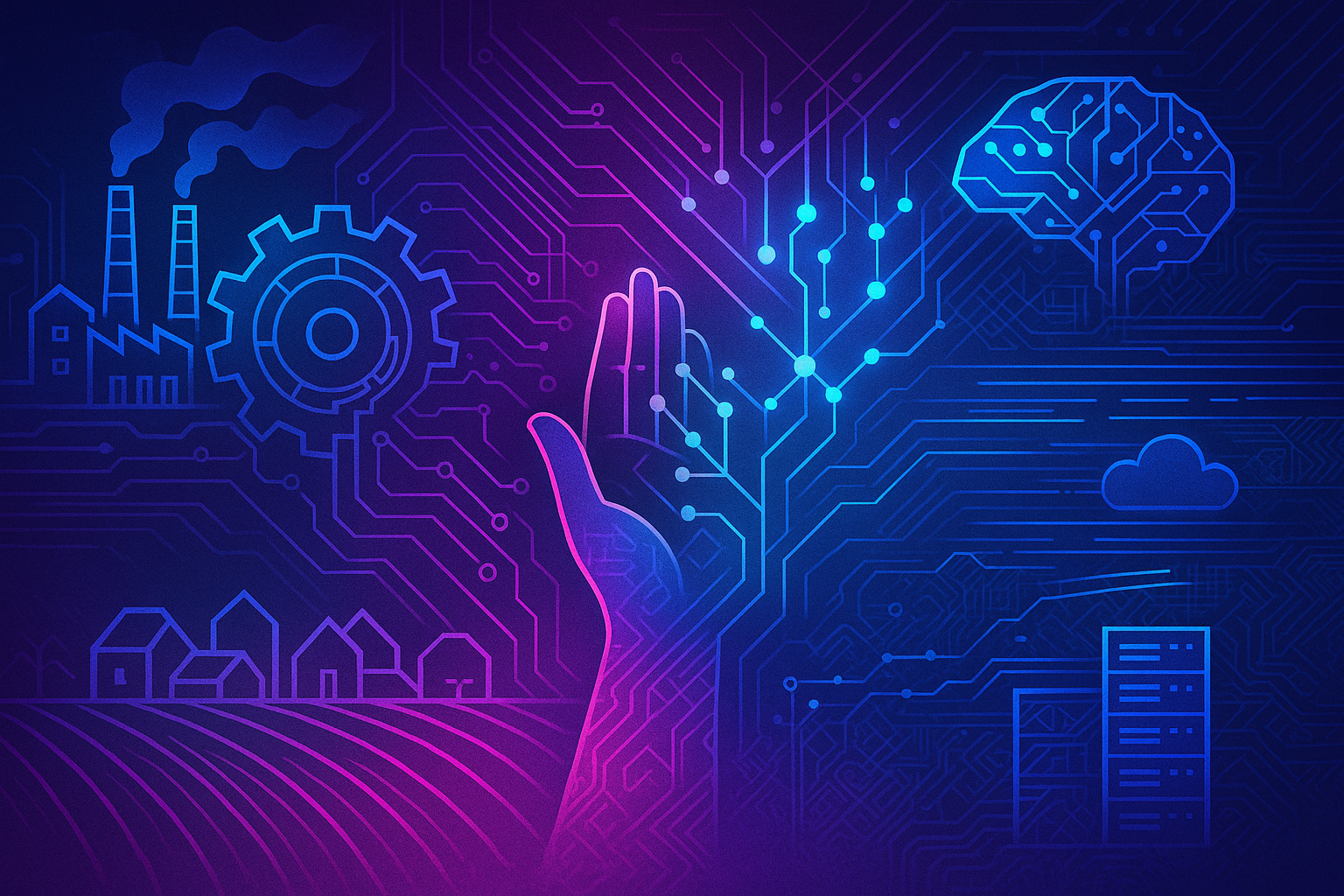
In every major era of economic transformation, the means of production, the resources and tools used to create value, have shifted. From land in agrarian societies, to factories in the industrial age, to code and connectivity in the digital era. But now we stand at the edge of a new frontier: the AI-powered economy. And in this post-AI world, the very definition of production is being rewritten.
So, what replaces the tractor, the factory, the assembly line?
Let’s dive in.
Intelligence as Capital
In a post-AI world, intelligence itself becomes capital.
Not human intelligence alone, but machine intelligence, algorithms, models, and learning systems. These are no longer just tools; they are autonomous economic actors. Large Language Models, decision engines, and generative systems don’t just assist, they create. They ideate, code, design, write, diagnose, trade, and negotiate.
Owning a state-of-the-art model is like owning a gold mine with infinite regeneration. The more it's trained, fine-tuned, and scaled, the more economic value it generates. Whoever controls the models, controls the flow of intelligence. And that’s power.
Data Is the New Raw Material
If intelligence is capital, data is its fuel.
Data is no longer an exhaust or a by-product. It’s the core ingredient, structured, labelled, and contextualised, powering AI. The better the data, the more accurate and useful the AI outputs.
But here’s the twist: data is not evenly distributed. It’s often extracted from people, communities, and nations without compensation. That’s why the idea of data sovereignty, especially for the Global South, is so critical. If we don’t own our data, we don’t own our future.
In the post-AI era, the new landlords are those who own the datasets: healthcare networks, fintech platforms, mobility companies, learning platforms, and social graphs.
Compute as the New Factory
In this new economy, production doesn’t happen in physical factories. It happens in data centres.
These data centres, stocked with GPUs, TPUs, and bleeding-edge chips, are the equivalent of industrial-age factories. The gates are guarded by the likes of NVIDIA, AWS, and Google Cloud.
And just like in past industrial revolutions, this infrastructure is expensive, centralised, and geopolitical. But we’re starting to see the rise of decentralised compute networks and edge AI systems that could flip the game, if accessible, scalable alternatives reach the hands of creators and entrepreneurs across the world.
Labour Becomes Oversight
Human labour doesn’t disappear. It evolves.
In the post-AI means of production, humans shift from producers to curators, trainers, and supervisors of machine intelligence. The new skilled trades include prompt engineering, model tuning, synthetic data generation, and AI ethics auditing.
We go from doing the work to designing the system that does the work. That’s a seismic shift in how we think about value and effort.
Digital Platforms Are the New Assembly Lines
Platforms like Acalytica, Shopify, and even OpenAI are the new digital factories.
You show up with your ideas. You plug into their ecosystem. You produce, distribute, and monetise. But you don’t own the rails. They do.
And herein lies the challenge: digital platforms offer leverage, but also dependency. They give you power but can also pull the plug. In many cases, creators are building their livelihoods on rented land.
The platforms you choose shape the rules of your economic life. Owning distribution, owning your audience, and owning your brand have never been more important.
Synthetic Labour and Generative Capital
AI agents can now autonomously generate products, content, services, and even relationships. This isn't hypothetical, it’s happening now.
AI writes songs, answers legal questions, codes websites, handles customer support, and soon will run autonomous businesses. This gives rise to what we can call generative capital, assets (like AI models or bots) that continuously generate value without direct human involvement.
Think of it as passive income on steroids. But again, only if you own the agent.
The Coming Power Struggles
This new landscape raises tough questions.
Who owns the models? Who controls the data? Who has access to compute? Who sets the rules for digital platforms?
Right now, we’re seeing consolidation of power in the hands of a few tech giants. But there’s also a counter-current: open-source AI movements, data cooperatives, federated learning systems, and decentralised infrastructure. These are the seeds of a more equitable post-AI economy, if we water them.
What This Means for Africa and the Global South
Let’s be clear. If we do nothing, we risk becoming digital colonies, consuming AI, producing data, and owning nothing.
But we have a window. A chance to leapfrog by investing in data sovereignty, open infrastructure, public compute, and platforms that reflect our values.
Africa can become a producer in the AI economy, not just a consumer. But it requires strategic intent, local innovation ecosystems, and a mindset shift: from extractive digital participation to ownership.
Final Thought
In the post-AI world, the means of production are no longer land, labour, and capital in the traditional sense.
They are:
- Intelligence (AI)
- Data (fuel)
- Compute (infrastructure)
- Platforms (distribution)
- Human oversight (value alignment)
This isn’t just a new industrial era. It’s a new kind of civilisation. And the question that matters most is:
Are you renting the rails—or building the tracks?





