1. We Refuse to Be Fooled by Complexity
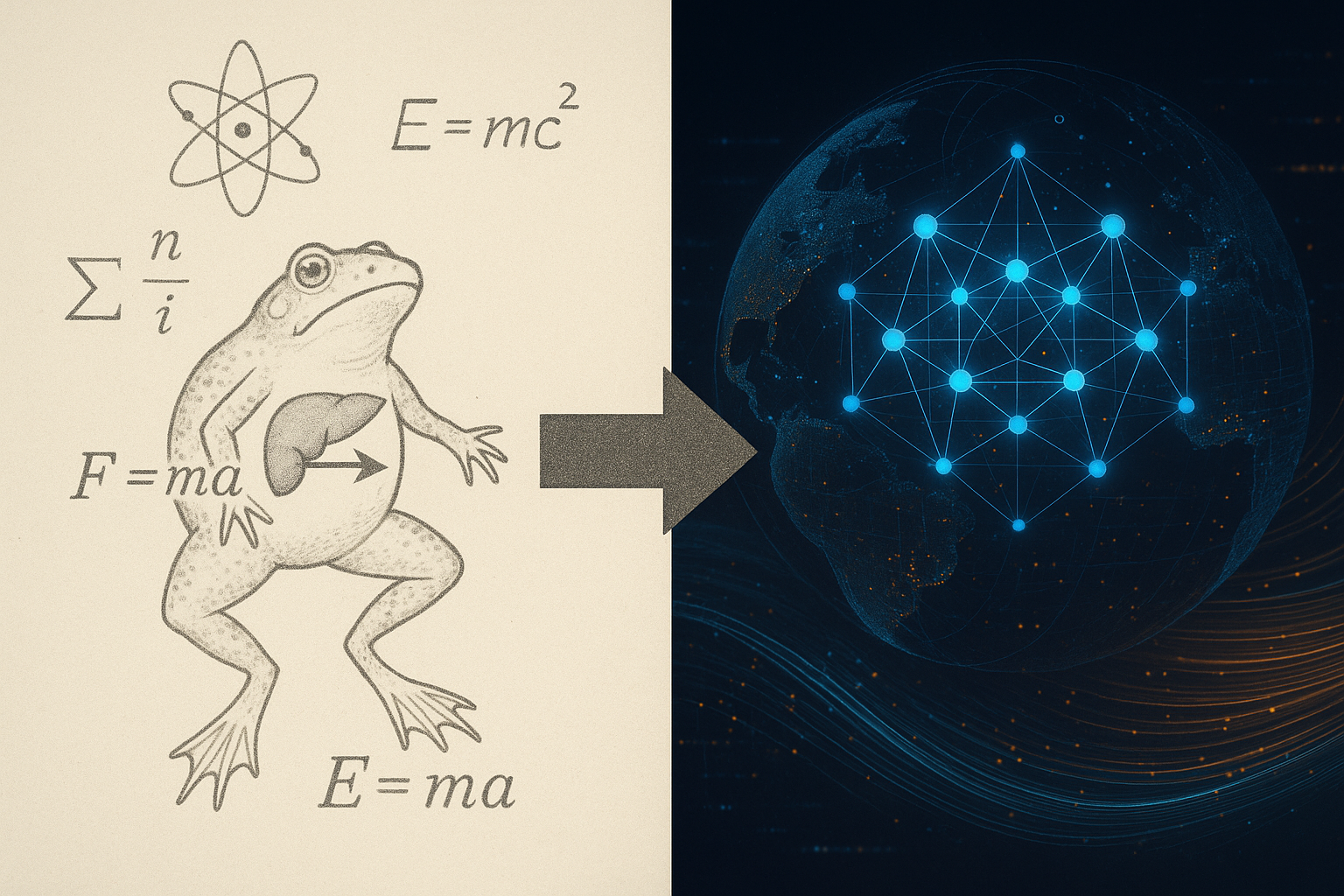
Once, we understood the world by taking it apart, frogs, radios, atoms. We called this reductionism. It worked. It gave us science, rockets, penicillin, and cat videos on the internet.
But now the problems we face, climate change, protein folding, economic chaos, are tangled beyond clean dissection. We can’t just slice the frog; we must watch it leap.
2. We Use the Old Method… But We Upgrade It
The old scientific method was a straight arrow:
- Observe.
- Guess.
- Test.
- Refine.
- Repeat.
It was slow, elegant, and human. But in the AI era, we can run ten million experiments before breakfast. Data no longer waits for theory. The arrow now loops, forks, and runs in parallel. We let AI guess first — and then we decide what’s worth understanding.
3. We Work With the Whole, Not Just the Parts
Reductionism will always matter. The details are where truth hides.
But AI lets us model the entire mess, the whole climate, the whole genome, the whole market, without cutting it to bits first. We now have telescopes for complexity.
We will not waste them.
4. We Demand Understanding, Not Just Prediction
AI can predict. But prediction without explanation is trust without understanding.
We refuse to be button-pressers who accept answers like magic tricks.
We will dig until we know why. We will challenge every pattern, verify every claim, and expose every black box.
5. We Keep the Human Instinct to Doubt
Machines can find patterns that look perfect but are completely fake.
The human advantage isn’t speed or memory, it’s the ability to call BS.
We will keep that instinct sharp. Doubt is not the enemy of science, it’s the oxygen it breathes.
6. We Merge Reductionism and Holism
- When the system is too big, we model the whole.
- When the answer is too vague, we drill into the parts.
- We know that wisdom lives in switching lenses.
7. We Build for the Future, Not Just the Next Quarter
AI changes the tempo of discovery. It can accelerate science a thousandfold.
But acceleration without direction is chaos. We choose our problems wisely.
We aim not just for what’s publishable or profitable, but for what matters to the future of humanity.
Our Oath
We are the heirs of the scientists who cut open frogs and split atoms.
We are the pioneers of a science that can see everything, everywhere, all at once.
We will use AI not as a crutch, but as a microscope, telescope, and compass combined.
We will break things down when it helps, model the whole when it’s needed,
and never stop asking, “But why?”
We will not be passengers in the age of AI.
We will drive.





