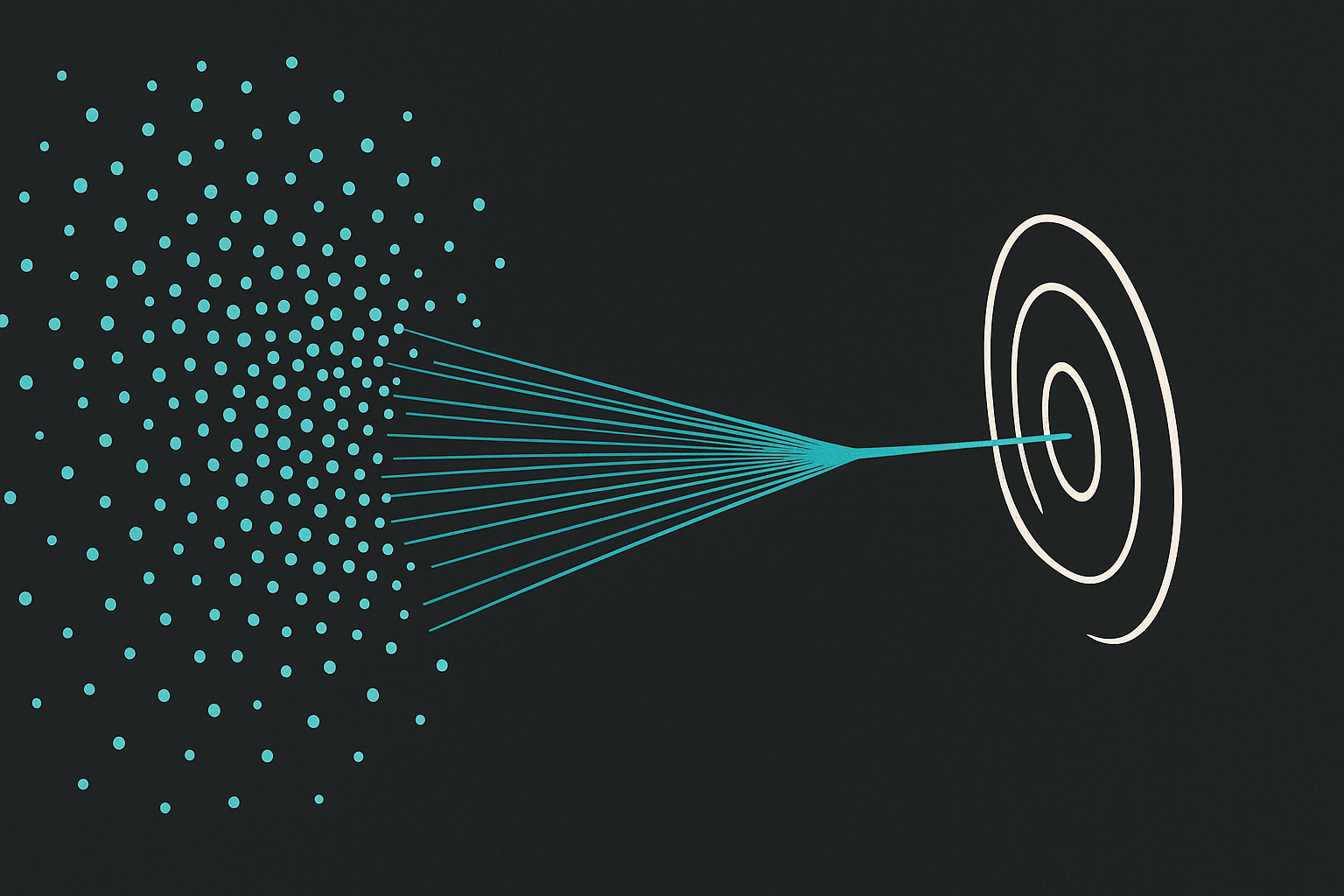
The Law of Large Numbers is the quiet confidence behind every claim that "the model will improve with more data." It says that if you repeat an experiment enough times, your observed average will approach the true average. That's the heartbeat of statistics, and by extension, modern AI. But the law is often misused, misunderstood, or misapplied in machine learning. Let's dissect the main misconceptions with logic, not slogans.
More Data Guarantees Truth
The law says averages converge, not that truth emerges. If your samples are biased, collecting more of them just gives you a better estimate of the wrong thing. If you feed a model millions of distorted or homogeneous examples, it will converge confidently, to nonsense. The problem isn't quantity; it's representativeness. The law assumes each observation is independent and identically distributed (i.i.d). Real-world data isn't.
In other words: if you ask the same group of people the same bad question, no number of repetitions will make their answers correct.
Convergence Means Understanding
Convergence is mechanical, not intelligent. The law doesn't imply that the system knows why the mean is what it is, it simply pushes numbers toward stability. AI systems often stabilise loss functions and prediction curves, but that's not understanding; that's arithmetic gravity. Without interpretability or causal reasoning, large models can appear intelligent simply because their averages have settled down. The mistake is equating statistical calm with conceptual truth.
The Law Works Everywhere
The Law of Large Numbers only applies under specific conditions: independence, identical distribution, and finite variance. AI data violates all three. Internet text is correlated (everyone repeats everyone else), non-identical (some sources dominate others), and heavy-tailed (a few extreme cases skew everything). Yet we act as if scale alone washes these impurities away. It doesn't. It just smooths bias into a more polished shape. You can't clean correlation with quantity.
Big Data Solves Small Thinking
AI engineers often treat data as disinfectant. When models misbehave, they add more samples. But if the architecture encodes flawed assumptions or the labelling pipeline embeds cultural bias, no statistical law will save you. The Law of Large Numbers doesn't fix model structure, it only guarantees consistency given a correct one. Garbage in, converged garbage out. Big data doesn't correct small thinking. It just amplifies it at scale.
Variance Reduction Equals Progress
Reducing variance makes outputs stable, not necessarily better. A model that predicts the average temperature of every city as 20°C will be consistently wrong but show low variance. The Law of Large Numbers ensures that such mediocrity is statistically smooth, not scientifically meaningful. Reliability without relevance is precision in the wrong direction.
The Real Lesson
The Law of Large Numbers is a law about limits, not wisdom. It tells us what happens if our assumptions hold, not that they ever do. In AI, the law rewards disciplined sampling, diverse data, and models that generalise rather than memorise. It punishes faith in scale as a substitute for structure. The law is not an excuse for blind data accumulation; it's a warning about what happens when you mistake convergence for comprehension. Intelligence isn't what happens when data gets large. It's what happens when understanding keeps pace with it.





