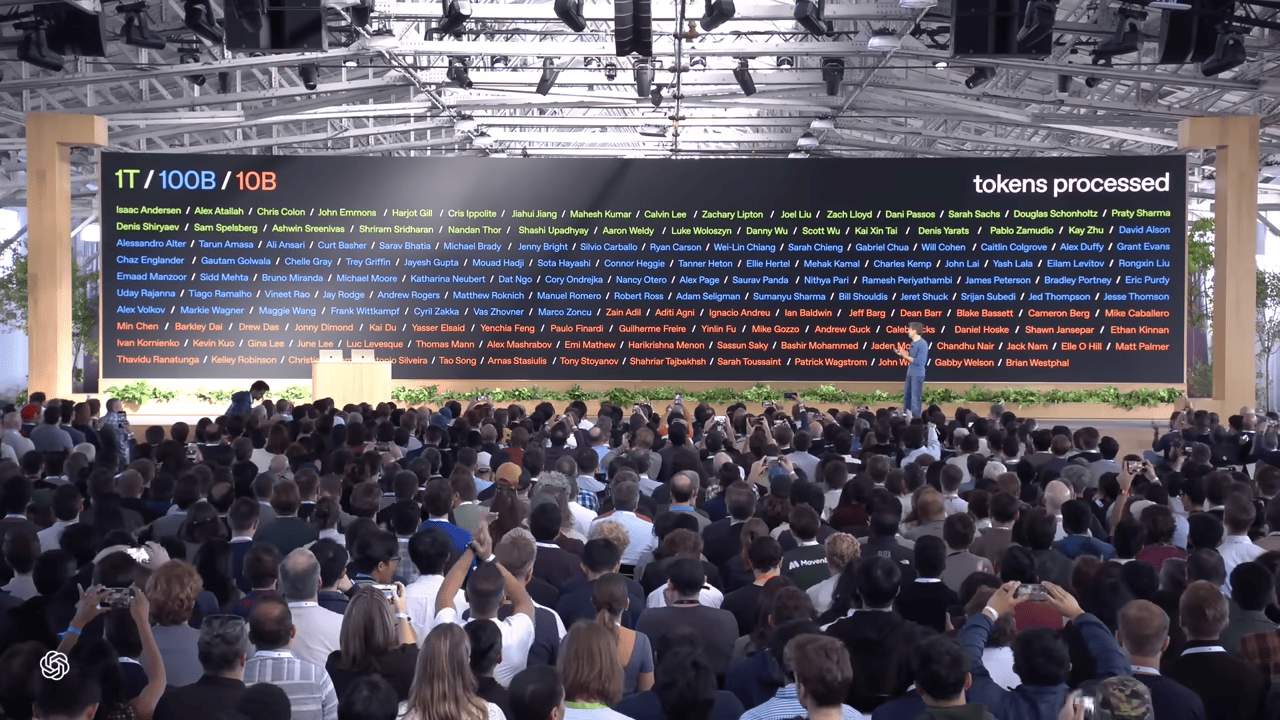
When OpenAI put up that slide, a dazzling wall of names under "tokens processed", the audience saw the future of AI commerce.
Rows of engineers, founders, scientists, and CEOs. 1 trillion tokens, 100 billion tokens, 10 billion tokens, each a digital receipt for thinking done by machines.
And then you look closely.
Not one name from Africa.
That's not just a statistic. It's a signal.
What's really being measured
A "token" isn't just a chunk of text or a fragment of code. It's the smallest unit of reasoning you can buy.
When companies burn trillions of tokens, they're not merely calling an API, they're training organisational reflexes.
Each token represents a question asked, a hypothesis tested, a decision accelerated.
So when you see 1T tokens consumed, you're looking at a company building a neural habit, a machine-augmented way of thinking.
Africa's absence from that list means that right now, the continent is not training its reflexes at scale.
We're not buying enough "thought bandwidth" to shape how our markets, governments, and languages are represented inside these models.
The illusion of access
People often say: "But everyone has ChatGPT!"
That's like saying everyone in 1995 had the internet because they could send an email from a café.
Access is not participation.
In the token economy, what matters isn't who chats, it's who trains.
The trillion-token consumers aren't typing prompts for fun, they're wiring AI into their production systems, data flows, and revenue models.
They're owning the feedback loops that teach the model what "useful" means.
Africa, by contrast, is still at the mercy of defaults designed elsewhere, foreign data, foreign priors, foreign optimisation targets.
Economics of exclusion
Tokens are not cheap. A trillion of them can cost between R4.5 million and R160 million, depending on the model.
That's not pocket change for an ecosystem where most startups still fight to raise R5 million seed rounds.
But the real cost isn't financial, it's compound learning loss.
When other regions run millions of AI experiments per month, they discover edge cases, efficiencies, and cultural heuristics that compound over time.
By the time Africa joins, those lessons are already baked into global models, and into the margins of the companies that trained them.
Every missing token is a missing experiment.
Every missing experiment is a missing dataset.
Every missing dataset is a missing representation of how Africans think, buy, and behave.
The first-principles fix
Let's strip it to fundamentals:
- Computation = Capital: Whoever controls the compute controls the curve of progress. Africa needs local GPU supply chains, not charity credits.
- Tokens = Training: Every token is feedback. We must design African contexts for these feedback loops, in local languages, business practices, and regulatory logic.
- Infrastructure ≠ Intelligence: Renting models is fine for prototyping, but without regional fine-tuning hubs, we're just paying rent on someone else's brain.
- Markets learn by doing: Africa needs usage velocity, millions of small teams burning tokens on real problems: logistics, climate, agriculture, credit risk, public health.
Thats how local priors emerge.
What it will take
Breaking into the "100B token club" isn't about brute forcing compute.
It's about structured experimentation, systems that let startups, universities, and corporates collectively generate useful data and insights.
Imagine an African Token Commons:
- Shared infrastructure for LLM access
- Local fine-tuning datasets in Swahili, Zulu, Yoruba, and Sesotho
- Transparent economics (tokens as micro-investments in shared intelligence)
That's not utopia, it's causal design. Change the data-generation mechanism, and the equilibrium shifts.
The real danger
If Africa doesn't participate at token scale, the continent becomes a statistical ghost inside the global AI brain.
Our accents will be mis-transcribed, our economies mis-modelled, our ethics mis-weighted.
And when algorithms allocate credit, health support, or advertising spend, they'll follow the priors of places that burned the most tokens.
In short: those who train the models train the markets.
The opportunity hiding in the void
The good news is that absence means room.
Africa can leapfrog, not by outspending the giants, but by out-optimising them.
- Use causal inference to identify the smallest number of tokens that generate the most insight.
- Build regional AI observatories that measure and publish "token productivity" rather than token volume.
- Incentivise SMEs and creators to generate structured local data as economic assets.
Because the future won't just be who has more tokens, it'll be who uses them more intelligently.
Final thought
When I saw that wall of names, I didn't feel left out. I felt challenged.
The token economy is just math, and math is neutral.
If Africa learns to wield it with precision, we can catch up faster than anyone expects.
But it starts with this simple principle:
Don't rent intelligence. Build it. Token by token.





