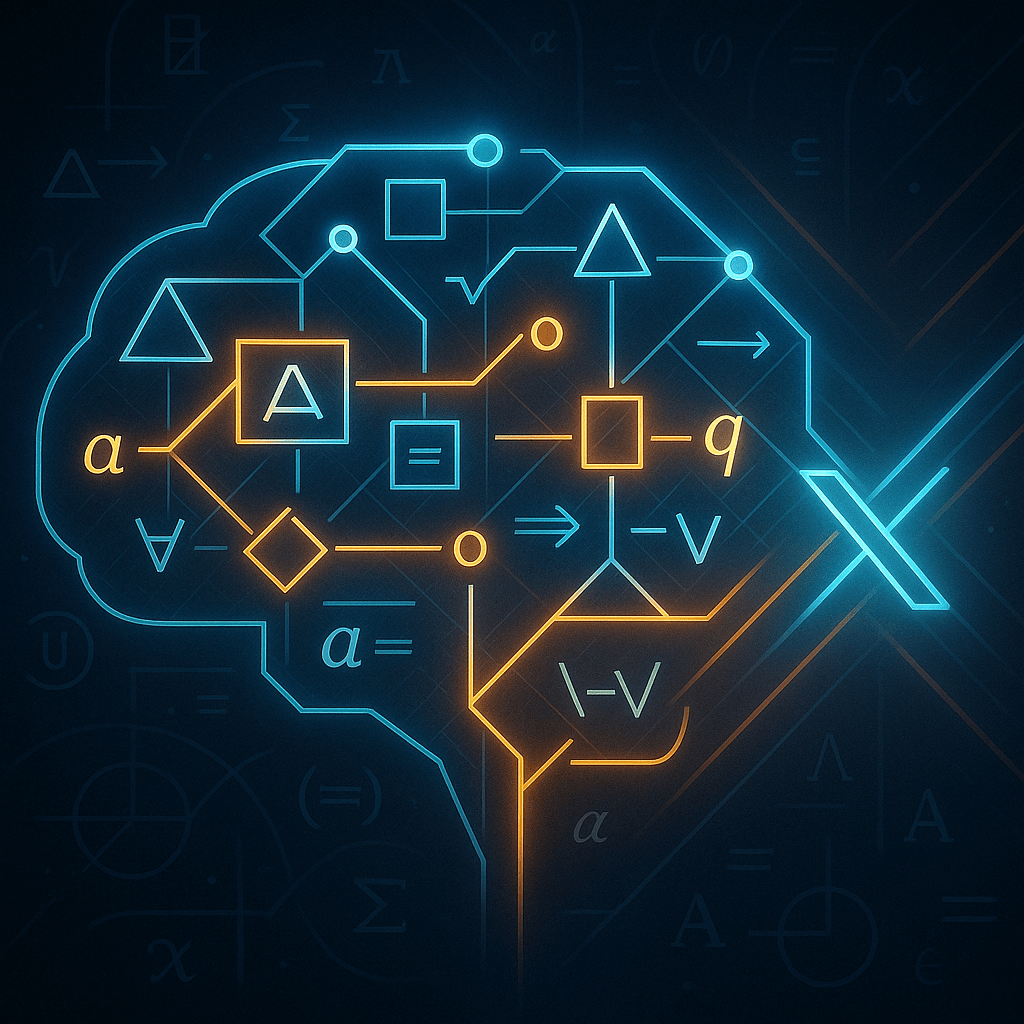
Modern AI models don’t understand; they correlate. They’re master impressionists, not philosophers. When Elon Musk says Grok is now capable of “cogent analysis,” he’s trying to flip that paradigm. He’s describing an AI that doesn’t just autocomplete thoughts, it audits them.
From Pattern Matching to Principle Mapping
Most large language models (LLMs) work like an extreme form of predictive texting. Feed them half a thought, and they’ll statistically infer the next word based on trillions of past examples. They’re imitation engines. Useful, yes. Insightful, no.
Cogent analysis is what happens when you stop asking an AI to “finish the sentence” and start asking it to justify the logic behind that sentence. The machine must identify the axioms, the foundational assumptions underlying any claim, then test whether those assumptions are (a) true, (b) consistent, and (c) sufficient to reach the stated conclusion.
This shifts AI from pattern completion to causal reasoning. In human terms, from mimicry to understanding.
Truth as a Structural Property
A statement can sound right but still be wrong. “The louder a thunderstorm, the closer it is” works until you meet a valley. Statistical AI confuses patterns with truths because it has no internal compass for coherence. Cogent analysis forces an AI to interrogate itself—“does this follow?”—not just “has this been said before?”
In Musk’s framing, Grok’s “maximally true-seeking” mode operates like a synthetic logician. It breaks arguments into their elementary propositions and checks for contradiction, missing premises, or circular logic.
Truth, in this view, isn’t a social consensus; it’s the degree to which conclusions reliably emerge from validated premises. That’s what he means by “critical thinking.”
Why It Matters
Wikipedia tells you what people believe. Grokipedia, Musk’s testbed for this new model, tries to tell you why those beliefs hold, or don’t. It’s not fact retrieval; it’s argument reconstruction.
This matters because the internet is no longer short on data; it’s short on epistemic hygiene. The problem isn’t ignorance but narrative overfitting. When every side has infinite facts, truth becomes a casualty of framing. Cogent analysis is an attempt to mechanise the process of frame correction.
If it works, it means an AI could flag manipulative statements not by ideology but by structure: “The conclusion doesn’t follow.” That’s not politics; that’s logic.
The Meta Shift
Think of human thought as two layers: intuition and introspection. LLMs mastered intuition, the raw statistical association between ideas. Cogent analysis introduces introspection, metacognition, the ability to reason about reasoning.
In physics, this is like the difference between describing motion and explaining why motion follows from force. One is observation; the other is law. Musk’s “cogent” Grok is an early experiment in giving AI access to the second.
Limits and Leverage
No algorithm guarantees objectivity. Every “truth model” still inherits its creators’ definition of valid inference. Cogent analysis won’t remove bias; it will formalise it. But that’s progress, not peril. You can’t fix what you can’t see.
The promise here isn’t that AI will think like humans. It’s that it will reason visibly, making its logic auditable. If traditional AI is a black box of predictions, cogent AI is a glass box of premises and consequences.
That shift, from opaque probability to transparent reasoning, is the only plausible bridge between human trust and machine autonomy.
The Broader Equation
In essence, Musk’s experiment reframes the purpose of AI:
Prediction = imitation of the past
Cogent analysis = simulation of reasoning
Where one compresses data, the other expands understanding. One copies thought; the other constructs it.
If that sounds philosophical, it’s not. It’s engineering at the level of epistemology. The real test of AI’s intelligence isn’t how well it writes, it’s how rigorously it argues.
Summary:
“Cogent analysis” is Musk’s shorthand for turning AI into a logic engine instead of a parroting engine. It means training systems like Grok to deconstruct, verify, and rebuild human arguments from first principles, forcing every answer to prove itself, not just predict itself.





