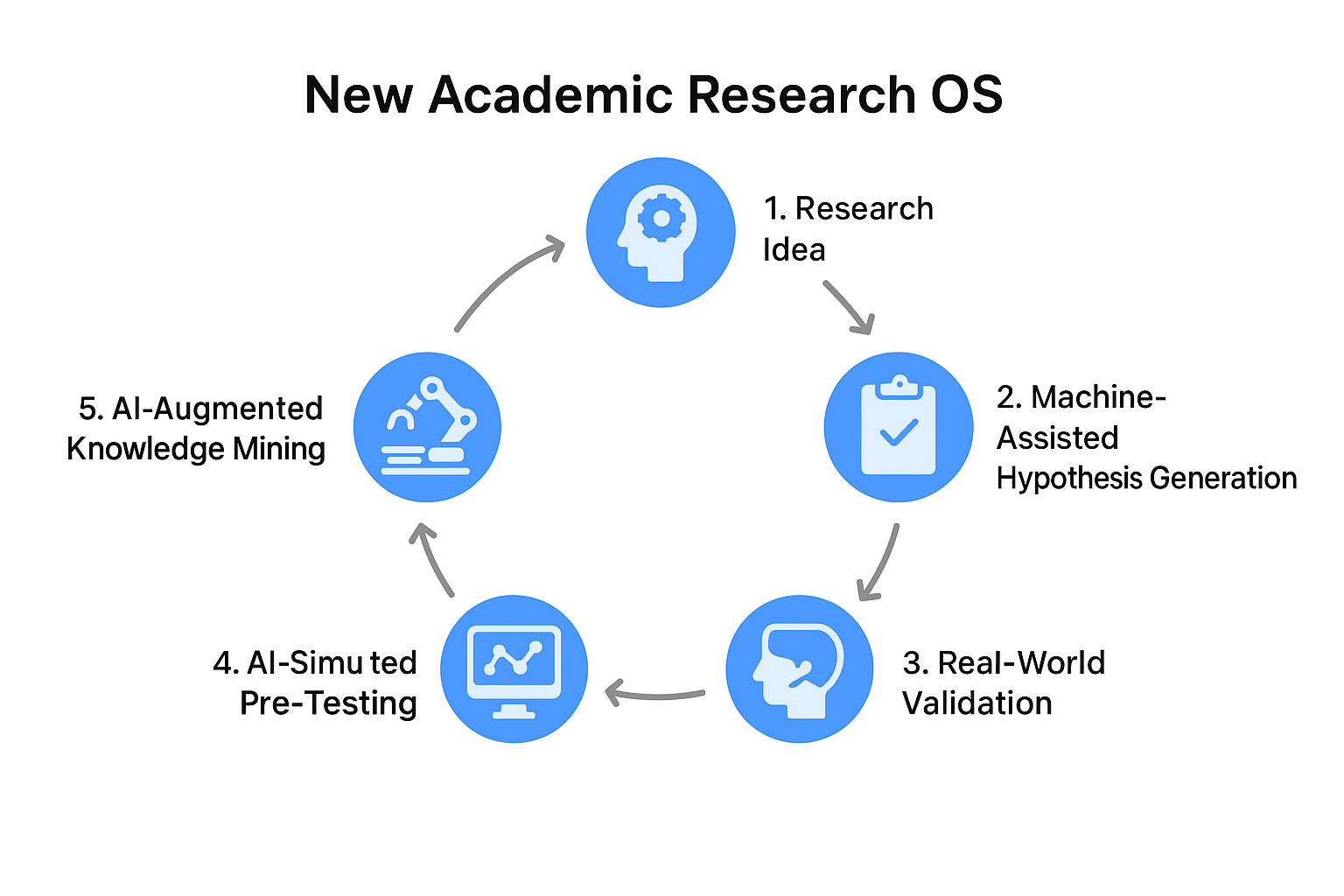
AI is transforming not just what we can discover, but how discovery happens. This article explores how the academic research process can be re-engineered for the AI era, merging reductionism with system-wide modelling, introducing machine-assisted hypothesis generation, and moving from static publications to living research assets.
For centuries, science has been powered by a simple but potent habit: take things apart until they make sense.
From dissecting frogs to splitting atoms, reductionism gave us the microscope for truth. Coupled with the scientific method, observe, hypothesise, test, refine, it built the modern world.
But the world’s toughest problems today don’t yield so easily.
Climate change, pandemics, economic instability, and the mysteries of the brain are systems too tangled for neat, part-by-part analysis.
Enter AI, not as a faster calculator, but as a telescope for complexity.
It’s changing not just what we can discover, but how discovery itself works.
The Limitations of the Old Way
Traditional research moves in a linear procession:
- Literature review — read what’s known.
- Hypothesis — make a guess.
- Experiment — test it.
- Analysis — confirm or reject.
- Publication — seal it in a PDF.
This works for problems with clean variables and controlled environments. But in messy, dynamic systems:
- The variables are infinite.
- The relationships are non-linear.
- The “correct” answer changes over time.
AI Flips the Script
AI doesn’t always start with a hypothesis. It starts with data.
It gulps down terabytes from sensors, papers, images, social signals, finds patterns we’d never see, and then lets us reverse-engineer why they exist.
The workflow shifts from:
Theory → Experiment → Data
to
Data → Pattern → Theory
This is not the death of the scientific method. It’s its re-engineering.
The New Research Operating System
Here’s how we can rebuild the academic process to match the tools of the AI era.
1. AI-Augmented Knowledge Mining
Forget manually sifting through 5,000 papers.
An AI research assistant can map the entire field in hours, cluster ideas, and surface underexplored “white space” ripe for breakthroughs.
2. Machine-Assisted Hypothesis Generation
Instead of starting with human intuition alone, feed the AI datasets to spot anomalies, hidden correlations, or counterintuitive trends.
Humans then apply domain knowledge to decide which are worth testing.
3. Virtual Pre-Testing
Before touching a pipette or building a prototype, run thousands of in-silico experiments in a digital twin of your lab.
Kill bad ideas early; double down on promising ones.
4. Multi-Modal Data Fusion
Integrate text, images, sensor data, and genomic sequences into a unified knowledge graph.
Reductionism still matters, but so does modelling the whole system at once.
5. Rolling Peer Review
Instead of waiting for a post-mortem peer review, share intermediate findings via collaborative AI platforms.
AI “review bots” can scan for statistical errors, ethical concerns, and reproducibility risks mid-project.
6. Explainability as a Research Stage
Every project gets an “explainability audit” — using tools like SHAP values or counterfactual testing, so we don’t just predict accurately, but understand why.
7. Living Publications
No more static PDFs.
Publish “live papers” linked to datasets, code, and updating AI models, making research a constantly evolving, collaborative asset.
Culture Change: Humans Still Drive
AI can accelerate research by a thousandfold. But acceleration without direction is chaos.
Humans remain the architects: choosing questions, setting ethical boundaries, interpreting meaning.
AI is the relentless co-pilot, crunching data, finding patterns, running simulations, and flagging the unexpected.
From Reductionism to Complexity Mastery
We don’t abandon the old microscope, we add the telescope.
Reductionism still gives us precision; AI-driven holism gives us reach.
The real breakthrough is knowing when to switch lenses.
Because in the AI era, the danger isn’t that machines will replace scientists.
It’s that scientists who don’t work with machines will be replaced by those who do.






