The Trap Agencies Walked Into
Let's play a simple thought experiment. Imagine a friend who runs a restaurant. Instead of charging customers for food, they say:
"Pay us whatever you like, and we’ll throw in some extra dishes for free. If you smile and like us, we’ll cook even more at no charge."
Sounds insane, right? Yet that's exactly how most creative agencies behave.
The industry slipped into what I call service culture: a mindset where the main goal is to please clients by over-delivering, over-servicing, and over-giving.
The Rise of the "Goodwill Agency"
In service culture, success is measured not by impact but by politeness:
- Did the client like us?
- Did we say yes to everything?
- Did we give away our best thinking in the pitch?
- Did we deliver extra work for free "to keep the relationship strong"?
This creates what we can call the Goodwill Agency, a business that survives on pleasing, not creating.
And while it may feel nice in the short term, it’s commercially suicidal in the long term.
How Service Culture Strangles Creativity
Here’s the paradox:
- Agencies exist because of creativity.
- Yet service culture traps creativity inside hours, processes, and tasks.
Instead of being valued for what the work achieves, agencies are judged by:
- How many hours they logged.
- How many deliverables they pushed out.
- How much they gave away for free.
It's like judging an architect not by the building they designed, but by how many pencils they wore down in the process.
When creativity gets trapped like this, three things happen:
- Commoditisation – Every agency offers the same “services,” so clients see no difference.
- Margin squeeze – More work is given away for less money.
- Loss of stature – Agencies get treated like vendors, not partners.
Why "We" Is a Dangerous Word
Look at most agency websites. They say things like:
- "We are a strategic, independent, creative, digital-first full-service agency."
- "We deliver brand experiences through design, strategy, and innovation."
Now pause and ask: good for you, but what does that mean for me as the client?
This is the service culture in action. Agencies talk about themselves, their process, their toolkit. But value doesn’t live inside the agency. Value only exists in the client’s hands — in their growth, their markets, their audiences.
The Buffet Problem
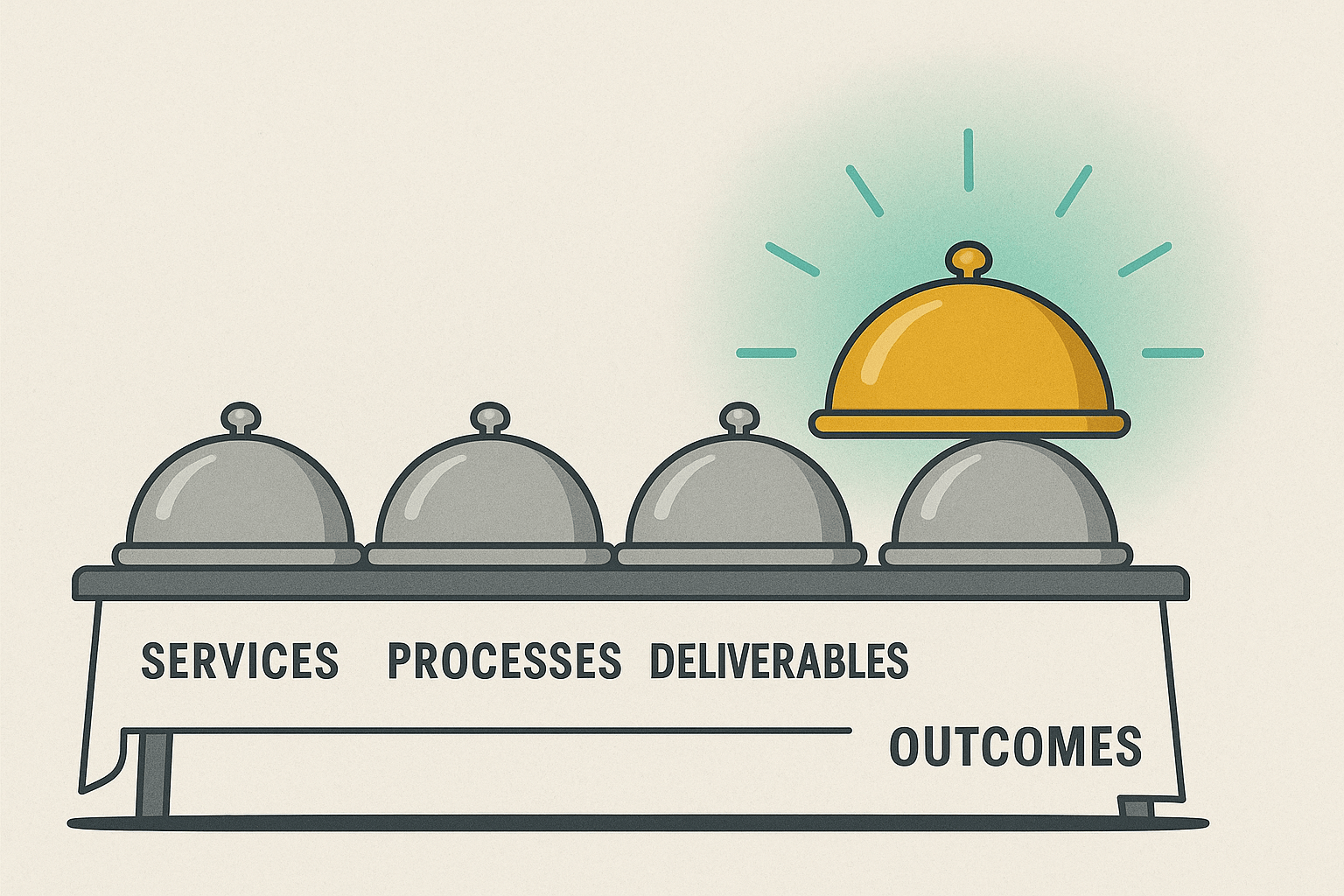
Clients often describe agencies as an "all you can eat buffet." The menu looks full, but every agency buffet looks the same.
And like real buffets, clients gorge themselves for a year, then move on to the next one. There's no loyalty, no differentiation, just volume.
The problem? Creativity doesn’t thrive in a buffet. It thrives when it’s packaged, focused, and connected directly to outcomes.
How to Break Free
To escape service culture, agencies must kill three dangerous habits:
- Stop over-giving. Free work in pitches teaches clients that ideas have no value.
- Stop over-servicing. Extra hours without extra fees trap your business in inefficiency.
- Stop talking about yourself. Shift from "we do" to "you get."
And instead, adopt three new behaviours:
- Sell outcomes, not hours. Creativity is valuable because of what it does in the market, not how long it took.
- Differentiate by value. Don’t offer a buffet. Offer a signature dish only you can cook.
- Reframe the client relationship. You’re not a vendor. You’re a partner in creating business results.
A Simple Analogy: The Taxi vs. Uber
Old agencies behave like old taxis: charging by the meter, slow, inefficient, hoping the client doesn’t notice the long route.
New models behave like Uber: clear outcomes (get me there fast), transparent pricing, and value measured by the rider’s experience, not the driver's effort.
Agencies need to stop being taxis and start being Uber.
Closing Thought
Service culture began with good intentions, trying to keep clients happy. But in trying to please, agencies gave away their crown jewel: creativity.
If creativity is the engine, then service culture has been the chokehold.
And unless agencies break free, they'll keep suffocating under their own goodwill.
Because clients don’t need another buffet. They need a partner that serves one thing brilliantly: outcomes.





