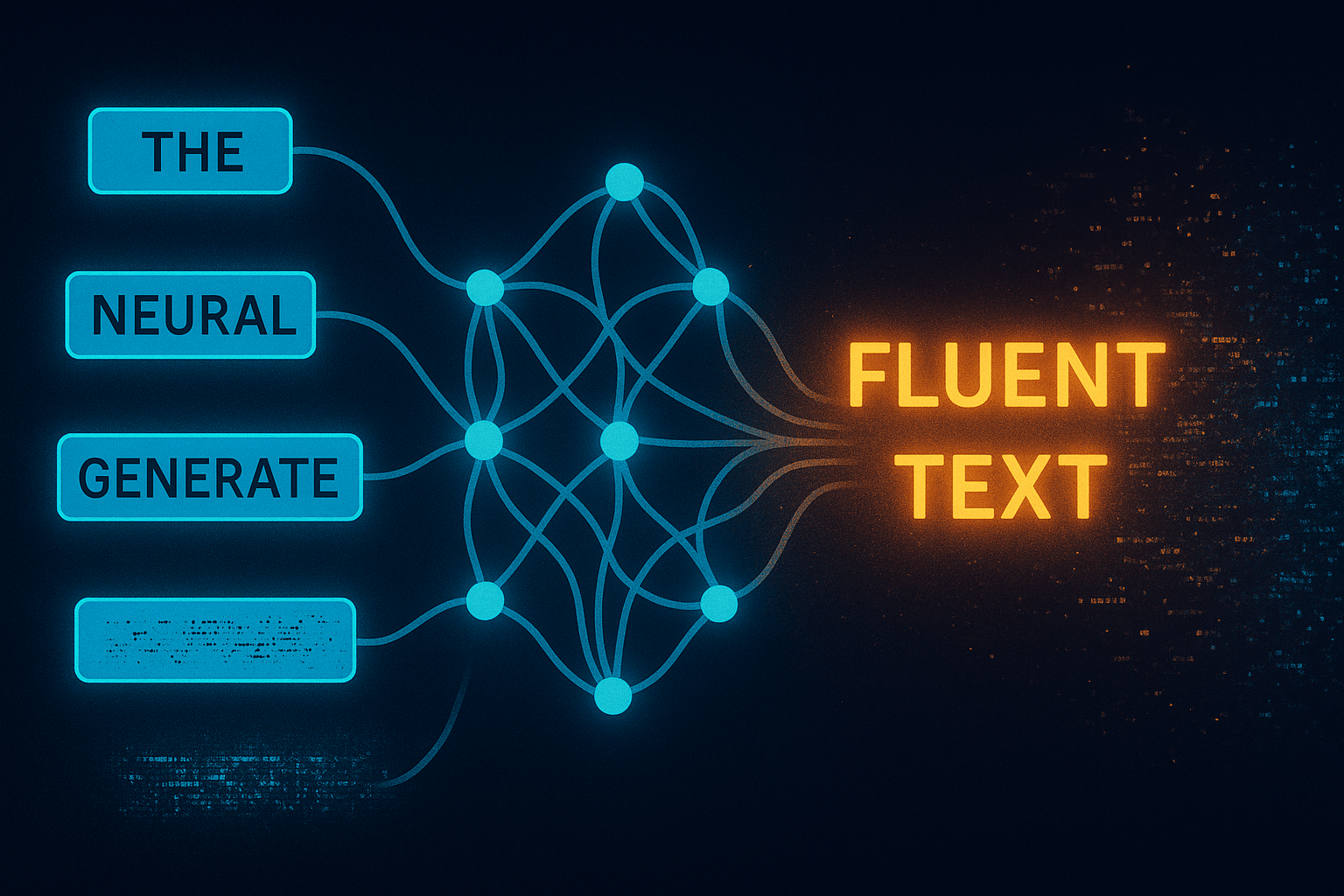
Large language models (LLMs) don't try to be right. They try to be probable.
Every answer they produce is a guess at the most likely next token, given the tokens before it. This design choice explains why they can sound authoritative while being completely wrong.
Why hallucinations happen
- Token prediction ≠ truth - LLMs optimise for fluency, not accuracy. They stitch together the most likely sequence of words. That sequence may be factually correct, or not.
- Training distribution gaps - If the training data lacks coverage (e.g. niche scientific facts), the model will improvise. It produces "closest match" guesses rather than admitting ignorance.
- No grounding in external reality - LLMs don't connect outputs to sensors, databases, or knowledge graphs by default. Without grounding, they fill gaps with plausible fiction.
Why hallucinations persist
- Useful in creativity: For ideation, writing, or brainstorming, hallucinations can spark unexpected angles.
- Harmful in precision domains: In law, finance, or medicine, they break trust. The same mechanism that fuels creativity undermines reliability.
Reducing hallucinations: today’s levers
- Retrieval-Augmented Generation (RAG): Ground model outputs in external documents or APIs.
- Structured reasoning: Force step-by-step logic (chains, trees, graphs) to reduce free-form guessing.
- Alignment methods: Fine-tuning with human or AI feedback to nudge responses toward correctness.
- Causal inference checks: Use counterfactual reasoning and structured causal models to test if an output follows from evidence.
None of these erase hallucinations entirely, but they constrain them.
The open question
Hallucinations may not be a solvable bug, they may be a permanent feature of probabilistic models. The challenge is deciding where to tolerate them and where to suppress them.
- In creative work: treat them as a feature.
- In high-stakes domains: treat them as a liability.
The line between those two worlds is where the next wave of LLM innovation will happen.
Curious to hear what you think: Are hallucinations something we’ll eventually eliminate, or something we’ll just learn to manage?





