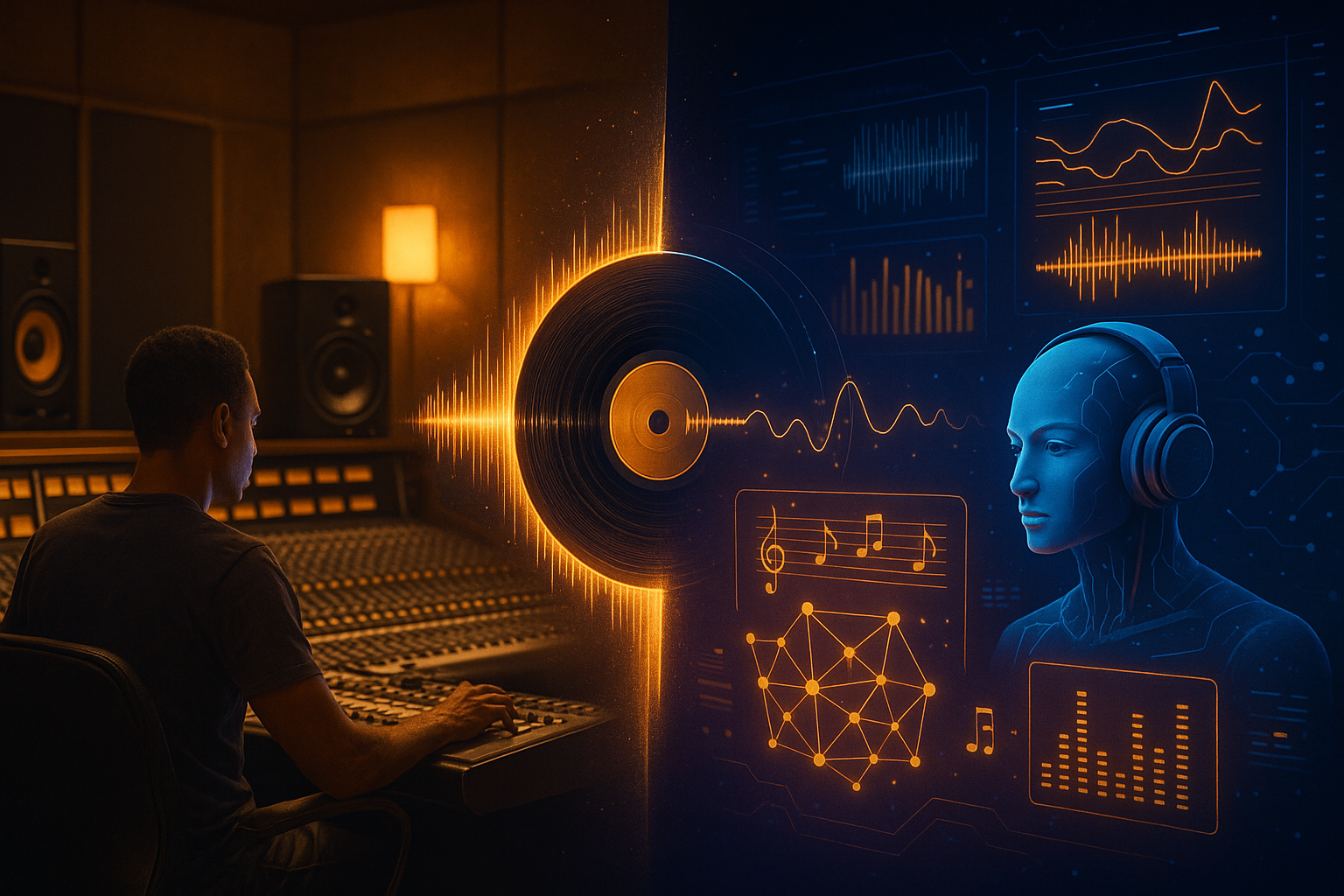
Generative AI has already rewritten the rules in visual art, copywriting, and film, and now it’s tuning its sights on the music industry. For musicians, the conversation is no longer “Will AI affect music?” but rather “How fast will it reshape it, and on whose terms?”
Having worked with AI-assisted music creation, I see both the allure and the risk. AI is not a replacement for human creativity, it’s a multiplier. In the right hands, it’s like adding a co-producer who never sleeps, has perfect pitch, and can instantly test a hundred arrangement ideas. In the wrong hands, it’s a creativity flattener, churning out homogenised tracks with no soul.
The Current State: Policy Playing Catch-Up
Most music companies and rights holders are still drafting their first AI usage policies. Those ahead of the curve recognise the need for guidelines that balance innovation with intellectual property protection. Without them, creators risk watching their catalogues become free training data for someone else’s algorithms.
In my own work, AI is treated strictly as a tool. The human creator, composer, producer, performer, retains full copyright. That’s non-negotiable. The machine doesn’t get a “share”; it gets credit as a piece of technology, like a mixing desk or a guitar pedal.
Where AI Fits in the Studio
Right now, AI is most valuable in specific, well-defined areas:
- Stem separation — platforms like LALAL.AI and Moises AI make remixing and remastering almost trivial.
- Melody and harmony generation — tools like MuseNet offer a starting point for composition.
- Lyric writing — AI can break creative blocks or suggest alternative phrasing.
- Mastering — services like LANDR speed up production cycles without sacrificing too much quality.
These aren’t shortcuts to bypass creativity; they’re accelerators to get ideas to market faster.
The Creative Impact
Positives:
- Rapid ideation
- Lower costs for experimentation
- Easier collaboration across geographies
- Access to pro-level tools for indie creators
Negatives:
- Risk of sound homogenisation
- Legal grey zones on copyright
- Overreliance on algorithmic taste
- Dataset bias influencing musical direction
AI won’t kill music, but it could kill originality if everyone leans on the same datasets and presets.
Protecting Creators in the AI Era
At present, copyright protections in AI-assisted music are inconsistent at best. A few industry bodies are beginning to address it, but legislation is lagging. If we don’t push for robust frameworks now, we’ll be playing catch-up for the next decade.
Here’s what needs to happen:
- Clear Labelling — AI-generated works should be identified as such.
- Licensed Training Data — AI developers must prove rights clearance for the datasets they use.
- Opt-In Consent — Creators decide whether their works enter training sets.
- Modernised Law — Copyright statutes must explicitly cover AI use cases.
- Creator Education — Artists must understand how to safeguard their works before they’re absorbed into the machine.
Conclusion: The Turning Point
Generative AI in music is neither purely a threat nor purely an opportunity, it’s a turning point. How we handle policy, attribution, and rights protection over the next few years will determine whether AI becomes a co-pilot for creativity or a ghostwriter that erases the human touch.
One thing’s for sure: pretending it’s not here is the fastest way to lose control of the score.





