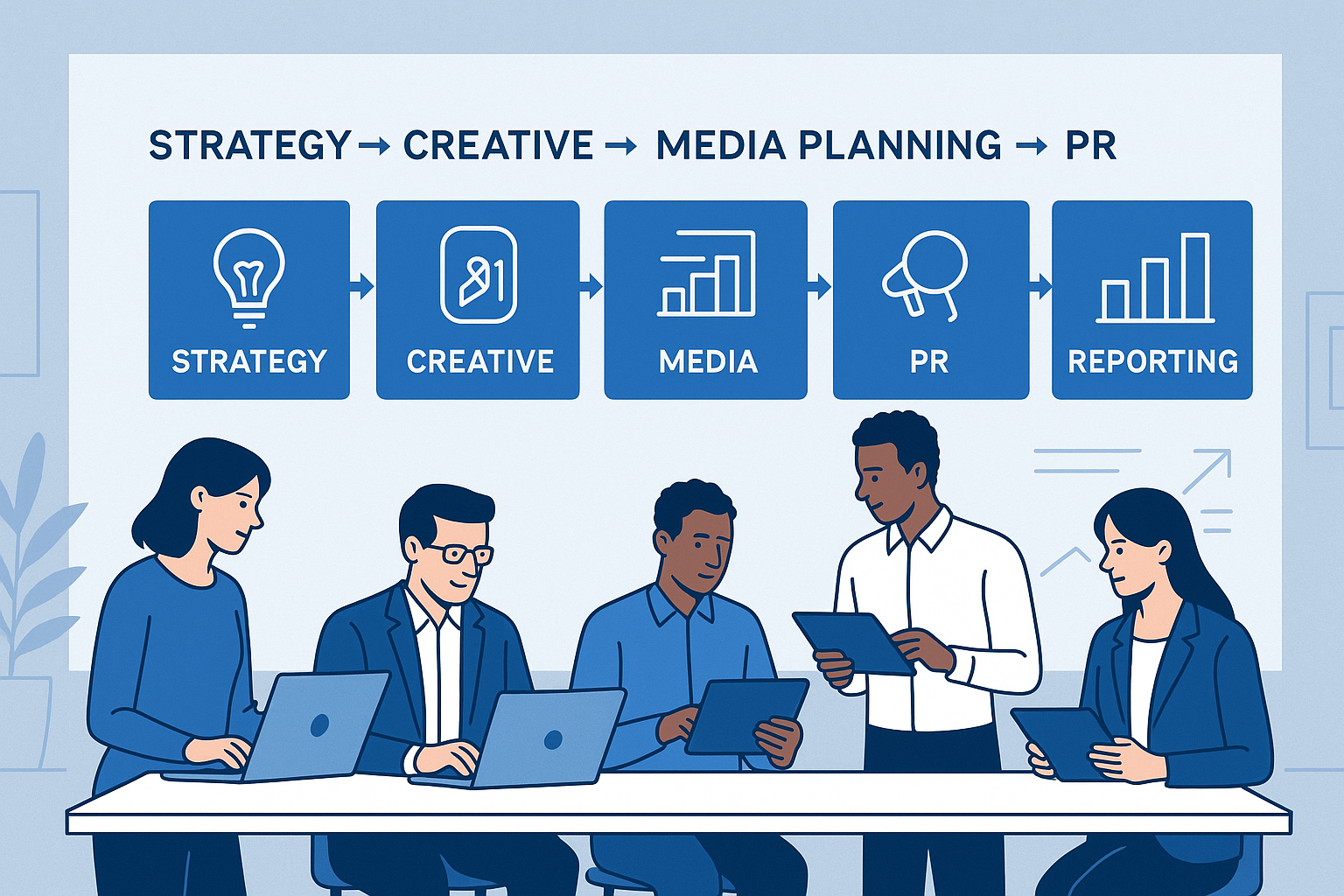
Marketing agencies today are no longer judged solely by their creativity—they're measured by how fast they deliver, how deeply they understand audiences, and how clearly they prove impact. The shift from analog to digital was just the beginning. Now, a second transformation is underway, powered by artificial intelligence. And it’s not theoretical. Leading agencies are already using AI to rethink the entire value chain—from how they strategize to how they report.
The goal is not to automate for the sake of automation. The goal is to augment human capability at every touchpoint, allowing small teams to deliver enterprise-level results.
The New Workflow: Where AI Adds Value
Let’s walk through how agencies are embedding AI into their core functions—and the outcomes they're seeing.
1. Insight-Driven Strategy
AI excels at pattern recognition, making it ideal for strategic planning. Agencies are feeding unstructured data—such as social sentiment, web traffic, and CRM data—into machine learning models to identify:
- Emerging audience behaviors
- Underperforming customer segments
- Hidden whitespace opportunities
This allows for rapid development of insights that previously took weeks of research.
Tactical Application: A strategic planner uses an AI-powered prompt to generate audience personas based on past campaign data and web behavior in under 5 minutes.
2. High-Volume Creative Without Sacrificing Quality
AI-powered copy tools now generate multiple content variants with just a few inputs. When trained on a client’s voice and tone, these tools help teams:
- Draft multiple ad versions
- Create SEO blog outlines
- Generate press releases and email sequences
This isn’t about replacing creativity—it’s about accelerating it.
Tactical Application: A content team auto-generates 10 ad headline variants and instantly A/B tests them on Meta platforms.
3. Agile Media Planning & Optimization
Media teams are using AI to plan and dynamically allocate budgets in real-time based on projected ROI. Rather than waiting for end-of-campaign results, they optimize mid-flight.
Tactical Application: A media buyer uses an AI-powered planner to simulate spend impact across Google, TikTok, and OOH, then adjusts the mix instantly.
4. AI-Driven PR & Reputation Management
NLP (natural language processing) tools scan the web 24/7 for client mentions, sentiment shifts, and potential crisis triggers. This allows PR teams to get ahead of problems—before they trend.
Tactical Application: A publicist receives a real-time alert about a negative brand mention and uses an AI writing assistant to draft a timely response.
5. Automated Reporting & Client Proof-of-Value
AI is transforming how results are communicated. Instead of overwhelming clients with data, agencies now deliver insights and recommendations with context.
Tactical Application: A client report is generated with natural language summaries, auto-highlighted anomalies, and campaign attribution—all white-labeled and ready to present.
The Hidden Power: Standardization Without Stagnation
Most agencies struggle with scalability. The brilliance of AI lies in its ability to standardize the process, not the outcome. By systematizing repetitive tasks, agencies free up brainpower for higher-level thinking, creative judgment, and client consulting.
This is where platforms purpose-built for agencies—like structured AI templates—come in. They guide your team from input to insight, without requiring prompt engineering or coding knowledge.
From Inputs to Impact
Agencies no longer have to choose between creative excellence and operational efficiency. AI offers a third path—scalable brilliance. When used wisely, it compresses time, boosts output, and enhances strategic clarity.
The best part? This shift is already happening. The only question is whether your agency will lead or lag behind.
Start powering your workflow today with 15+ plug-and-play AI tools:
You create. We’ll help you grow.





