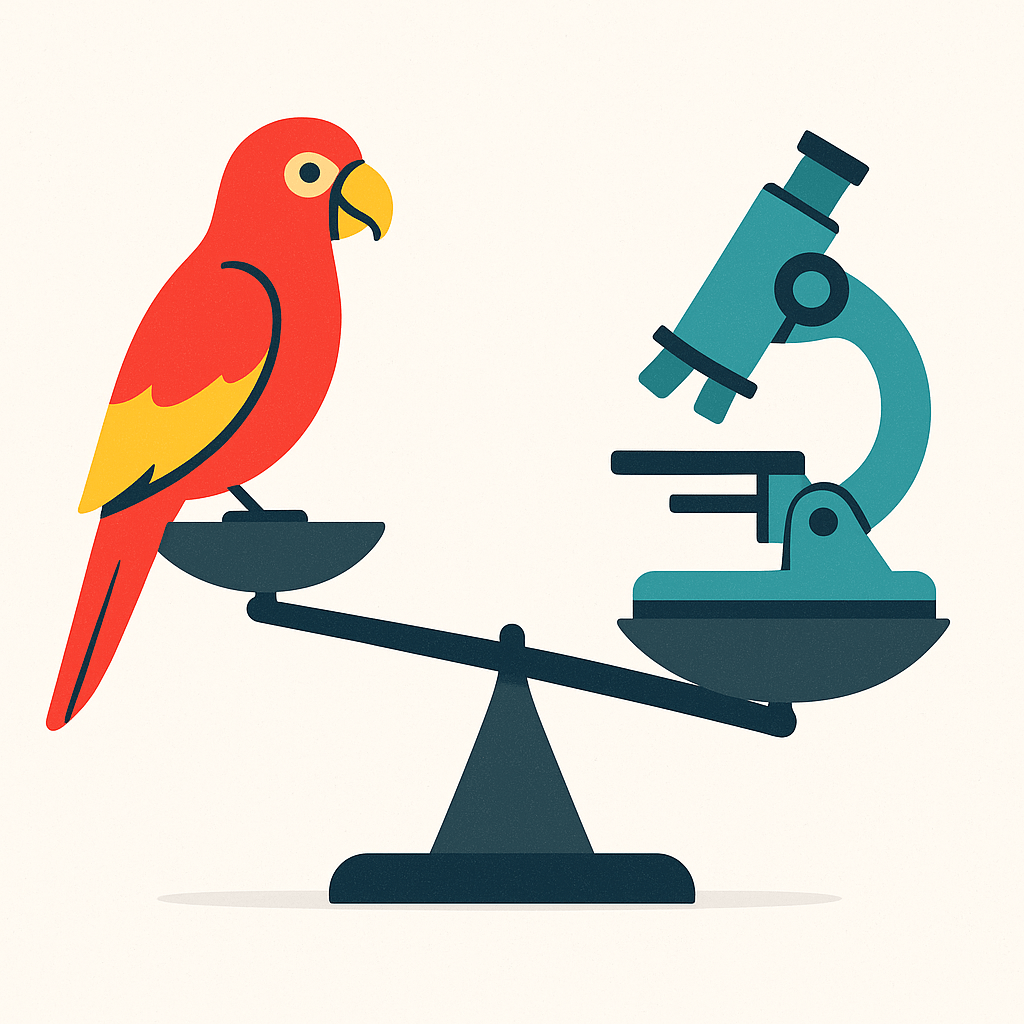
Why today's AI feels clever but fragile
Look closely at the current wave of AI tools. They're brilliant parrots. They can mimic speech, generate essays, even imitate art styles. But here's the catch: they don't actually understand.
Ask them to imagine something outside their training data, and they stumble. Feed them a strange edge case, and they confidently spit out nonsense. It's impressive mimicry, but it's still mimicry.
This is the cost of building AI by analogy, treating it like "autocomplete on steroids" rather than reducing intelligence to its first principles.
Step 1: What parrots can't do
A parrot can repeat Shakespeare, but it doesn't know what tragedy is. In the same way, today's large language models remix text without grounding it in cause-and-effect.
That's why they:
- Struggle with reasoning across time.
- Fail to test their own hypotheses.
- Collapse when conditions shift.
They're powerful assistants but brittle scientists.
Step 2: What scientists do differently
Science works by discovering rules, not memorising examples. It's the leap from description to understanding.
At its core, scientific intelligence is built on three principles:
- Causality. Don't just notice patterns, ask why they happen.
- Experimentation. Test predictions against reality, refine, repeat.
- Generalisability. Apply rules to new situations, not just old ones.
First Principles AI borrows this approach. Instead of predicting the next word, it models the underlying system. It doesn't just copy, it discovers.
Step 3: A practical example, health AI
- Today's AI: Memorises medical papers, predicts a likely diagnosis string, and returns it.
- First Principles AI: Models biology as a system, understands constraints, and tests hypotheses (e.g. "If this symptom exists, then this causal pathway might be active").
The difference? One guesses from memory. The other reasons like a scientist.
Step 4: Why this matters for businesses
If your AI only mimics, it will break the first time reality shifts. Markets change, customer behaviour evolves, regulations tighten, mimicry can't adapt.
But if your AI works like a scientist, it will:
- Discover new rules as conditions change.
- Explain why decisions were made, not just what decision was made.
- Survive shocks because it anchors itself to fundamentals, not patterns of yesterday.
That's resilience.
Step 5: Embedding ethics from the ground up
When you rebuild AI from first principles, you don't bolt ethics on top as an afterthought. You bake them into the foundation: transparency, value alignment, accountability.
That makes systems trustworthy by design, not by PR.
The punchline
The leap from copycat to scientist is the leap from fragile to robust AI.
"First Principles AI" isn't about chasing bigger models. It's about moving from mimicry to discovery, from parroting to reasoning. The winners of the AI era will be those who stop treating intelligence as imitation and start engineering it as understanding.





