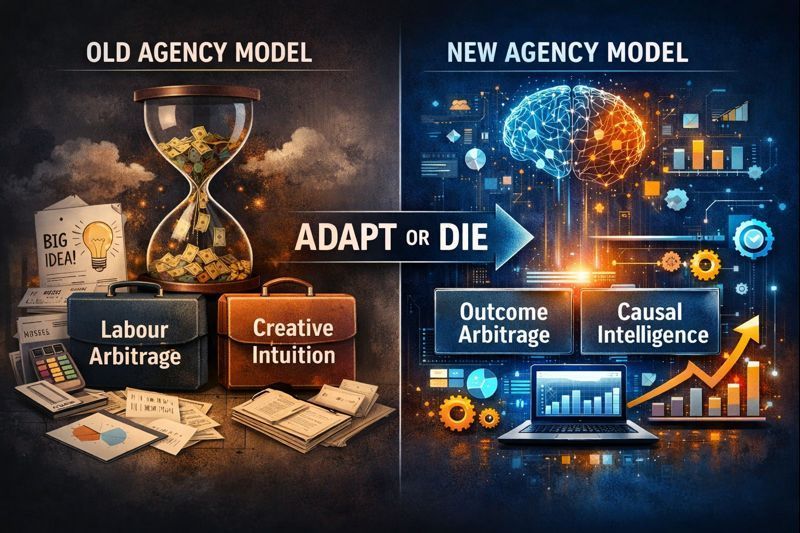
Most agency leaders resist this framing because it strips the romance from the business. But reduced to first principles, the modern agency model runs on two assets only.
Labour arbitrage and creative intuition.
Everything else is theatre.
This is not an insult. It is a structural diagnosis.
The Real Agency Business Model
1) Labour arbitrage
Agencies buy human time at one price and resell it at a higher blended rate.
Junior-heavy teams
Offshoring
Retainers padded with low-leverage hours
Opaque billable structures
Effort-based pricing disguised as value
The unit of production is time.
The unit of revenue is time.
The margin is the spread between the two.
Scale requires hiring.
Hiring increases fixed cost.
Utilisation becomes the hidden god.
Scope creep becomes a feature, not a bug.
Risk is transferred to the client via vague deliverables.
This is not a growth business.
It is a staffing business with branding.
2) Creative intuition
Agencies package taste, pattern recognition, and experience as differentiation.
“Strategy” is often post-rationalised instinct.
“Creativity” is remixing cultural priors.
“Insights” are heuristics with good storytelling.
“Timing” is gut feel plus luck.
There is real signal here.
But it is unpriced, non-replicable, and weakly attributable.
When results improve, agencies claim credit.
When results fail, they cite market conditions.
This keeps accountability soft.
This keeps contracts safe.
This keeps outcomes unowned.
Everything Else Is Justification Layer
Decks are narrative shields.
Processes are liability shields.
Awards are marketing.
Tool stacks are rented credibility.
Clients are not paying for these things.
They are paying to outsource uncertainty.
Why This Model Is Now Structurally Fragile
The agency model worked when two conditions held:
- Time was scarce
- Intuition was rare
Both conditions are collapsing.
Labour arbitrage is dying
AI, no-code, automation, and content engines have destroyed time scarcity.
Junior leverage collapses first.
Design, copy, research, media ops, and reporting are now commodity outputs.
The cost curve is falling faster than agencies can reprice.
You cannot protect margins when your core input is becoming free.
Creative intuition is being decomposed
Pattern recognition is now machine-augmented.
Taste is being A/B tested.
Timing is being forecast.
Insights are being inferred from behavioural data.
Correlation dashboards are replacing gut feel.
Causal inference is replacing post-hoc narratives.
Feedback loops are replacing quarterly strategy decks.
The mystique is leaking.
The Replacement Model Is Not “Better Services”
It is not more creativity.
It is not better branding.
It is not more sophisticated decks.
It is a category shift.
The Post-Agency Model
1) Outcome arbitrage
The new arbitrage is not time.
It is reliable impact.
Whoever can map actions to business results wins.
This requires:
Clear causal models
Controlled experimentation
Decision-grade analytics
Real attribution
Closed-loop learning
Clients will stop paying for effort.
They will pay for delta.
2) Causal intelligence
Correlation dashboards tell you what happened.
Causal intelligence tells you what to do next.
This is the real moat.
Not data.
Not dashboards.
Not “insights.”
But counterfactual reasoning:
What would have happened if we did nothing
What will happen if we do X instead of Y
Which lever actually moves revenue, not vanity metrics
This collapses intuition into system logic.
3) Productised growth systems
Bespoke decks do not scale.
Reusable systems do.
Templates
Pipelines
APIs
Automation layers
Experiment frameworks
Decision engines
This is compounding leverage.
Once built, these assets deliver value without linear headcount growth.
This is software economics.
4) Risk transfer
Agencies currently externalise risk.
The future internalises it.
Performance pricing
Revenue share
Milestone-linked fees
Skin in the game
This forces model quality.
This forces outcome ownership.
This forces real differentiation.
What Agency Leaders Must Do Now
This is not a branding pivot.
It is an operating-system pivot.
1) Kill the billable hour as your core unit
Replace it with:
Outcome-linked pricing
Fixed-scope automation bundles
Performance tranches
Revenue participation
If your revenue depends on time sold, you are structurally exposed.
2) Decompose intuition into systems
Audit where your best people consistently outperform.
Then formalise it:
Decision rules
Causal hypotheses
Experiment protocols
Templates
Prompt libraries
Playbooks
Turn tacit knowledge into codified leverage.
If it cannot be versioned, it cannot scale.
3) Build a causal layer into your offering
Not dashboards.
Not vanity analytics.
Real causal tooling:
Controlled experiments
Matched cohorts
Synthetic controls
Uplift modelling
Counterfactual forecasting
Clients do not need prettier charts.
They need decision-grade confidence.
4) Productise your core value
If your value disappears when your top strategist goes on leave, you do not have a business.
You have a personality cult.
Build:
Growth engines
Attribution frameworks
SEO-AI loops
Content pipelines
Conversion optimisation systems
Automated reporting
Sell systems, not services.
5) Take outcome risk deliberately
This is where most agencies flinch.
But this is where the moat forms.
If you cannot bet on your own work, neither should your client.
Start small.
One performance contract.
One revenue-share deal.
One milestone-based engagement.
Let the data prove your edge.
The Endgame
Agencies that survive become software companies with a services wrapper.
Agencies that do not become freelancers with branding.
The labour arbitrage model is ending.
The intuition monopoly is ending.
The next generation of agencies will not sell time.
They will sell decision infrastructure.
They will not sell creativity.
They will sell causal signal.
They will not sell decks.
They will sell compounding leverage.
This transition is not optional.
It is already happening.





