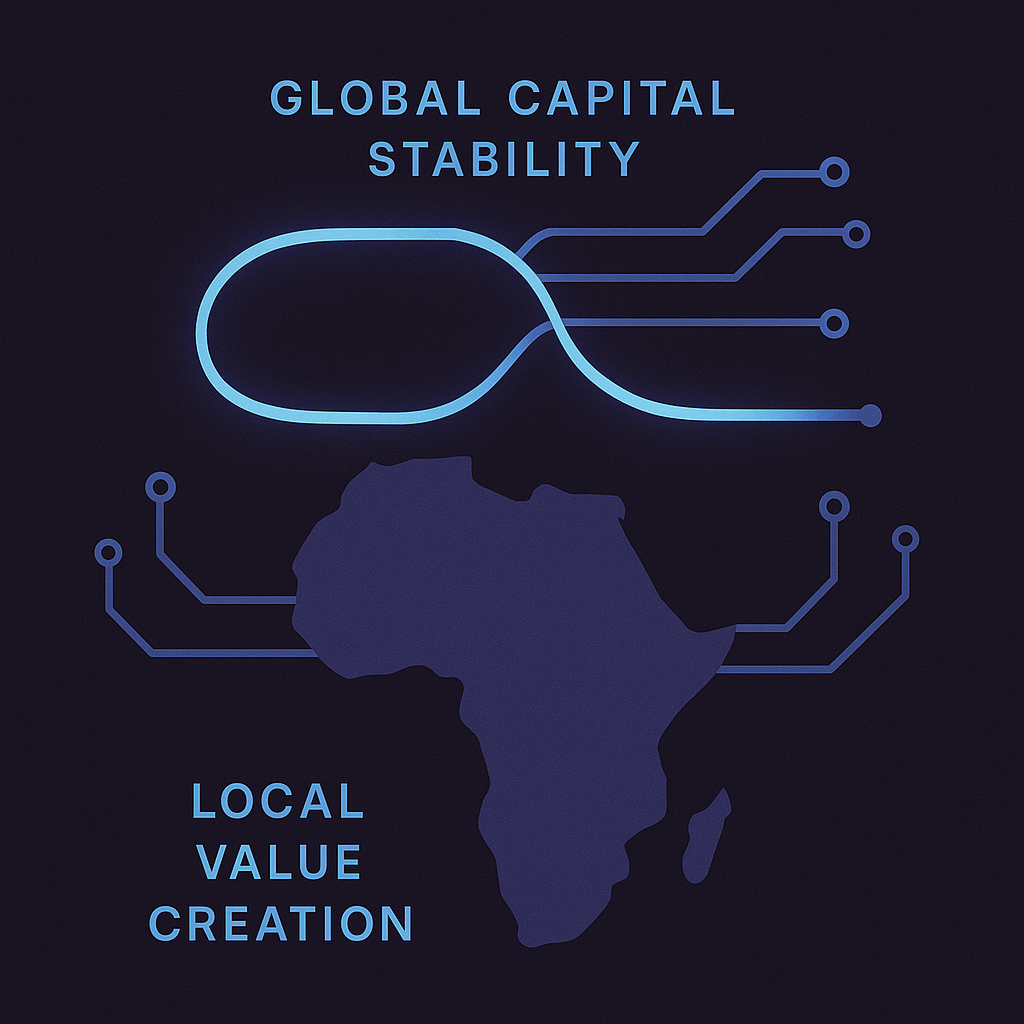
Round-tripping sounds like financial trickery: money leaves a country, circles offshore, and returns dressed as “foreign investment.” In its unethical form it’s a shell game. But the mechanics themselves are neutral. A mechanism is only as dirty or clean as the intent behind it. Strip it to fundamentals and you’re dealing with three levers: jurisdictional arbitrage, capital signalling, and risk redistribution. Used honestly, those levers create a predictable runway for African startups that are building real products in volatile environments.
Jurisdictional Arbitrage
The physics is simple. Investors want enforceable contracts, stable courts, and clean ownership records. African markets have pockets where these ingredients are fragile. Incorporating a holding company in Mauritius, Delaware, or the UK gives you a stable legal container. The local operating company then becomes the engine, not the place where long-term contracts live.
This structure doesn’t magically fix a bad business. It only removes artificial friction. You convert political risk into legal stability. That stability lowers your discount rate, which increases your valuation. That valuation then buys time to build the actual product.
The common misconception is that the arbitrage is the growth. It isn’t. It’s the scaffolding that lets real growth happen without being swallowed by structural noise.
Capital Signalling
Investors respond to perceived risk, not actual risk. When money re-enters an African startup through a respected offshore entity, it signals that the business is investable under international standards. This signalling compresses the trust gap. It changes the question from “Will this founder survive the system?” to “Does this business have traction?”
Signal is not substance. It simply buys the startup a fair hearing. With honest round-tripping, the signal is backed by a real engine on the ground. The offshore label becomes a clarity device, not camouflage.
This matters because African startups often fight two battles: proving their product works and proving their environment won’t distort returns. Ethical round-tripping isolates the first problem from the second.
Risk Redistribution
An African founder operates in environments where currency shocks, regulatory whiplash, and political shifts can erase value faster than failure itself. By routing investment through a stable jurisdiction, founders relocate financial exposure without relocating impact. The jobs, operations, customers, and economic value stay local. What moves is the legal shell that absorbs macro-level volatility.
This unlocks longer-term bets. You can invest in R&D. You can build data infrastructure. You can negotiate enterprise contracts that require legal stability. You can raise from global funds that cannot deploy to high-risk jurisdictions even when the underlying business is healthy.
Risk redistribution is not extraction if the operating value chain remains embedded in Africa.
Ground Rules for Genuine Value Creation
Remove the grey areas and you’re left with a simple checklist.
- The operating company is real, hiring locally, paying taxes, and generating verifiable impact.
- The holding company exists to stabilise ownership, not to hide it.
- Intellectual property flows to where enforcement is strongest, not where accountability disappears.
- Capital raised offshore flows back into African operations in measurable form.
- Reporting, governance, and books remain transparent.
- The structure is disclosed to regulators and partners.
- No circular fake revenues, no inflated valuations built on recycled capital, no phantom traction.
These rules convert round-tripping from a loophole into a structural upgrade.
The Actual Growth Engine
Once the mechanics are clean, the growth engine becomes clear.
- Lower discount rates attract larger cheques.
- Larger cheques allow multi-market expansion.
- Multi-market expansion increases defensibility.
- Defensibility attracts global partners.
- Global partners reinforce trust.
- Trust reduces capital friction.
This is a positive feedback loop. Not because money travelled offshore, but because the startup converted structural instability into strategic leverage without abandoning local value creation.
Why It Works in Africa
African markets have large demand, fragmented infrastructure, latent inefficiencies, and a population that leapfrogs slow systems. The bottleneck is rarely product quality. It’s uncertainty. Ethical round-tripping eliminates the cost of uncertainty while leaving the productive system intact.
The continent keeps the value generation. The startup gains global-grade capital. Investors gain predictable governance. Everyone escapes the drag of structural instability.
The Principle Underneath
A stable legal home improves capital flow. A local operational home improves real-world impact. Roundtripping, done cleanly, is the bridge between these two truths. It aligns incentives instead of distorting them.
The trick is simple: use the structure as insulation, not illusion. Use it to absorb risk, not fabricate demand. Use it to build actual products solving African problems rather than financial artefacts that impress pitch decks.
Treat the structure as plumbing. Treat the business as the source of water.
Real value creation will do the rest.





