In 2006, Amazon launched a side project that almost no one understood. It wasn't a new store, a new device, or a new media play. It was infrastructure: raw compute and storage rented by the hour. Wall Street shrugged. Most of the press treated it as a quirky bet by a company that already had enough on its plate.
Today, AWS generates more than $100 billion in annual revenue and is worth more than the rest of Amazon combined by some measures. It is arguably the most successful corporate spinout in modern business history.
Marketing agencies in the AI era are sitting on a similar opportunity. Most won't see it. The ones that do could build companies that dwarf their service businesses.
What AWS Actually Was
The popular myth is that Amazon had spare server capacity lying around and decided to rent it out. That story is wrong, and the wrong version hides the lesson.
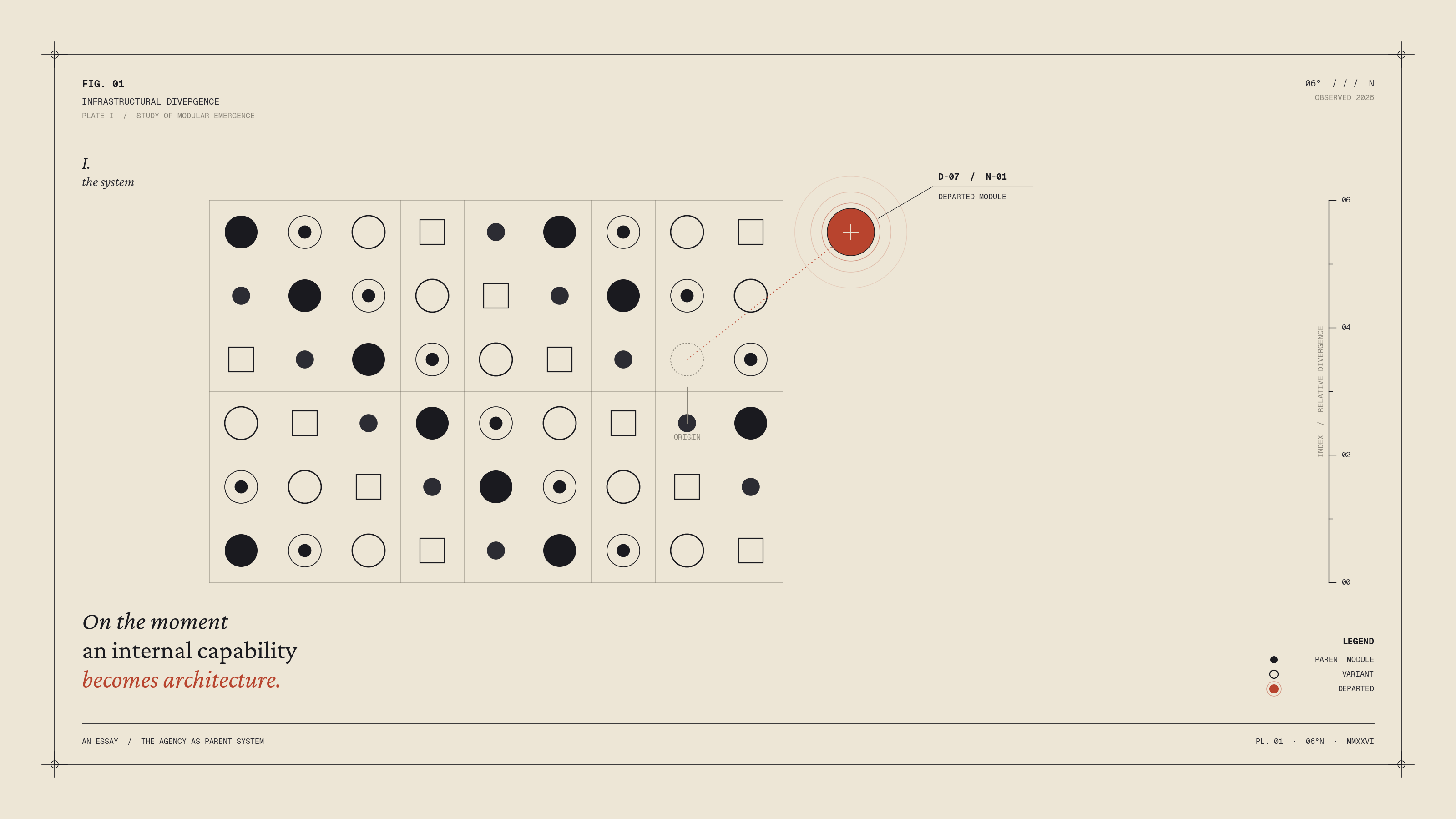
What actually happened: Amazon spent years building internal infrastructure to solve its own brutal scaling problems. Engineers were tired of reinventing storage, compute, and networking for every new project. So they built reusable internal services with clean APIs. Then, crucially, someone realised that the capability itself, not the leftover capacity, was the product. Other companies had the same scaling problems. Amazon could sell them the solution.
The pattern has three ingredients. First, a hard internal problem you've solved better than most. Second, a tool or system that encapsulates that solution. Third, a market of others facing the same problem who would pay to skip the pain.
Why This Matters for Agencies Right Now
Agencies in 2026 are caught in a vice. Clients want more campaigns, faster, cheaper, with AI in the loop. They are also increasingly asking whether they need an agency at all when ChatGPT can write copy and Midjourney can generate visuals.
To survive, smart agencies have been quietly building internal AI systems. Prompt libraries tuned to specific brands. Fine-tuned models that hold a client's voice. Brief-to-creative pipelines that compress weeks of work into days. Content QA workflows. Performance prediction models. Custom RAG systems that pull from years of campaign data.
That internal stack is your AWS.
The agencies that recognise this and act on it have a window to build product companies on top of their service businesses. The ones that don't will keep treating these tools as competitive moats inside the agency, where they will be valued at agency multiples (one to two times revenue) instead of software multiples (five to fifteen times ARR).
Four Spinout Paths That Are Actually Working
The vertical AI platform. Take the workflow you've perfected for one industry and turn it into SaaS. Fintech compliance copy. Pharma regulatory review. DTC ad iteration. You're not selling "AI tools." You're selling a system that already understands the rules, tone, and review cycles of that vertical. Jasper started as an agency tool. So did the earliest versions of Copy.ai. The depth of vertical expertise is the moat.
The brand-voice engine. Most agencies have built custom GPT wrappers, fine-tunes, or RAG systems to keep AI outputs on-brand for clients. Productise that as a self-serve platform where any brand can train, store, and deploy their voice across tools. This is essentially what Writer and Typeface are doing, both with agency DNA in their origins.
The creative ops layer. Agencies have figured out how to manage AI-augmented production pipelines: brief intake, generation, human review, asset management, performance feedback. Package that orchestration layer. The work is unglamorous but the market is enormous because every brand running AI-generated creative needs this scaffolding.
The measurement and attribution product. If your agency has built proprietary models for predicting creative performance, attribution, or audience response, that capability is potentially more valuable than the campaigns themselves. Brands will pay for prediction. They've stopped paying premium rates for production.
How to Actually Execute the Spinout
The structural lessons from AWS and similar spinouts are non-obvious and matter more than the product idea itself.
The product has to serve outsiders, not just you. Amazon rebuilt its internal tools with proper APIs, documentation, and SLAs before selling them. Your agency tool that kind of works if you know the tricks isn't a product yet. The gap between an internal hack and shippable software is where most agency spinouts die.
Separate the cap table early. Agencies are services businesses valued at one to two times revenue. SaaS products are valued at five to fifteen times ARR. If you bury the product inside the agency P&L, you'll never get credit for it, and you'll never attract the engineering talent or venture capital needed to scale it. Spin it into a separate entity, ideally with its own CEO who isn't running client work.
Use the agency as the unfair advantage, not the anchor. Your agency gives the spinout three things competitors don't have: real client problems to validate against, distribution to other agencies and brands, and case studies. But the spinout has to be free to sell to your competitors. AWS sells to Netflix even though Netflix competes with Prime Video. If your spinout can only serve your existing clients, it's a feature, not a company.
Eat your own dog food publicly. Amazon's credibility was that amazon.com ran on AWS. Run your own agency on the platform and let that be the proof point. Nothing sells software to other agencies like watching a peer use it to win.
The Honest Caveats
A few things worth saying plainly.
Most agencies that try this fail. Building software is fundamentally different from delivering services. The talent, timelines, margins, and unit economics are nothing alike. Agencies that have succeeded, like R/GA with its various ventures, Huge's product spinouts, Jasper's origin, typically had a founder or partner who genuinely wanted to leave services and run a product company. If no one on your leadership team wakes up wanting to be a software CEO, the spinout will starve.
Not every agency should do this. Sometimes the right move is to be the best AI-native services firm in your category. The spinout makes sense when you have a genuinely differentiated capability, evidence that other people want it, and the appetite to run two very different businesses. Without all three, you're better off using your AI stack as a margin advantage in services and skipping the product fantasy.
Finally, the window is real but not infinite. The same agencies thinking about this are watching well-funded startups attack the same problems with no services baggage. Your advantage is domain depth and existing customer relationships. Their advantage is focus and speed. The agencies that move in the next twelve to twenty-four months have a fighting chance. The ones that wait until the playbook is obvious will be buying the winning product, not building it.
The Bigger Picture
AWS worked because Amazon was willing to do something most companies refuse to do: take their hardest-won internal capability and let it become a business in its own right, even when that meant selling it to competitors and accepting that the parent company was no longer the most important customer.
The agencies that will matter in the AI era are the ones willing to make the same trade. Your service business is not your moat anymore. The systems you've built to do that service work at AI speed and AI scale, those are the moat. The question is whether you'll let them stay buried inside the agency, or set them free to become something bigger.
Amazon chose the second path. The agencies that choose it now will be telling their own founding story in twenty years.





