Core Idea
The claim collapses once you separate understanding the inner machinery from mastering the behaviour of a system in the real world. Those are different skill sets solved by different types of knowledge.
The false premise
The argument runs like this.
AI is complex.
Therefore only people who understand how the internal machinery works can use it effectively.
It sounds reasonable until you notice how often the same logic fails everywhere else.
If deep technical understanding were the prerequisite for effective use, then mechanics would dominate Formula One, surgeons would be the best athletes, and electrical engineers would lead the world in audio production. But they don’t.
Why?
Because the constraint is not mechanical knowledge. It is the ability to model system behaviour, observe feedback, calibrate actions, and optimise outcomes. That is a different kind of intelligence.
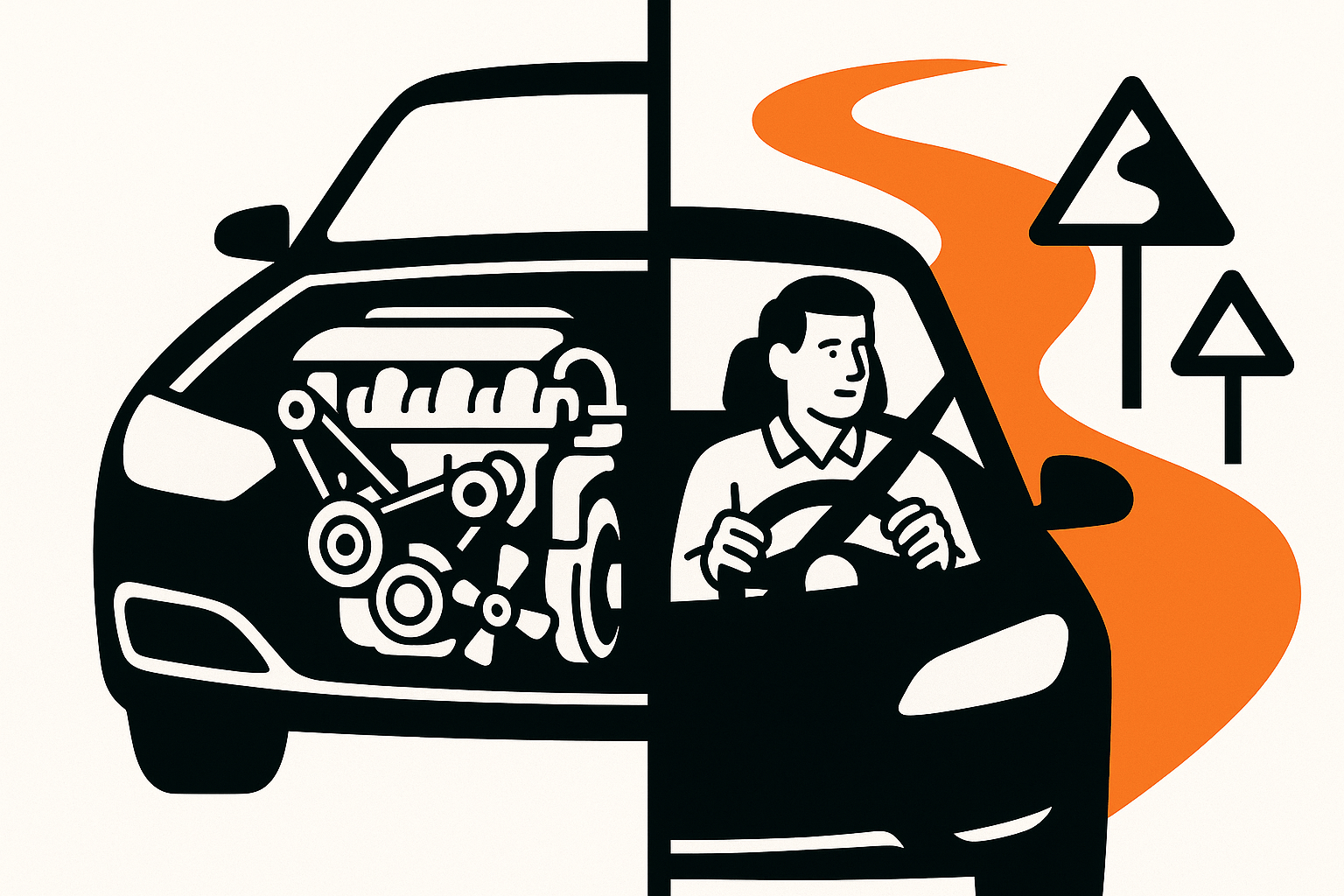
Driving vs fixing: two separate domains
A mechanic understands the combustion cycle.
A driver understands the road.
A mechanic knows thermal expansion tolerances.
A driver knows how traction breaks when you take a corner too quickly.
A mechanic can rebuild an engine from scratch.
A driver can feel micro-slippage through the steering wheel and adjust instinctively.
Both forms of knowledge are real. Neither substitutes for the other. They live in different causal layers.
Mechanical knowledge governs why the machine functions at all.
Driving knowledge governs how the machine behaves in context.
The same separation applies to AI.
Using AI well is a behavioural skill, not a mechanical one
AI expertise concerns model internals, architecture, training data distributions, optimisation algorithms, failure modes, and weight updates.
Effective AI usage concerns problem framing, clarity of input structure, decomposition of tasks, evaluation of outputs, constraints, trade-offs, and strategic alignment with real-world goals.
These are not the same skill.
One lives in gradient descent.
The other lives in decision science.
One is about engineering invariants.
The other is about cognitive invariants.
You can be excellent at using AI with zero interest in token embeddings, dropout layers, or attention heads. Because effectiveness comes from interface intelligence, not internal plumbing.
The mechanic analogy breaks on contact with reality
If mechanical knowledge scaled to driving performance, mechanics should outperform fighter pilots, rally drivers, truckers, paramedics, and anyone who spends more time on the road than under a car. But we see the opposite.
Driving skill improves through feedback loops, pattern recognition, situational awareness, risk judgement, and environmental modelling. None of these require engine blueprints.
AI usage mirrors that structure.
You improve through iteration, clarity of intent, experiments, and error-checking. You learn the behaviour of the system, not its wiring diagram.
This is why writers, analysts, strategists, teachers, entrepreneurs and researchers consistently outpace engineers when it comes to practical output with AI tools.
Not because they know less.
Because they know what matters for the domain they operate in.
The actual core competence: mental models, not machinery
AI systems behave like probabilistic partners. They don’t require mastery of their internal math. They require mastery of:
- Problem definition - Most AI failures come from vague, ill-posed tasks, not lack of technical knowledge.
- Constraints and examples - Clear boundaries act like rails that steer the model.
- Iterative refinement - You don’t need to understand how backpropagation works to notice when an answer is off and correct it.
- Quality evaluation - The competence lies in judging whether an output is useful, not in knowing which transformer layer produced it.
- Decomposition - Effective users break a problem into multiple smaller queries. That is task-engineering, not model-engineering.
These are cognitive disciplines, not mechanical ones.
Why the myth persists
People confuse complexity of creation with difficulty of use.
It’s the same error people made with cars, computers, the internet, and mobile phones. Early adopters were specialists. Once the interface matured, the expertise shifted from the machine to the user’s intent.
AI is in the same transition.
Today, AI creation still belongs to experts.
But AI usage belongs to anyone who can think clearly, structure a goal, and evaluate output.
The deeper invariant: agency sits above machinery
Human intelligence works at a layer higher than the tools we use. Tools amplify intent. They don’t replace the need for intent, and they don’t require omniscience about their internal parts.
A carpenter doesn’t need to understand polymer chemistry to choose the right glue.
A writer doesn’t need to understand ink manufacturing to write a novel.
A pilot doesn’t need to be an aeronautical engineer to land an aircraft in crosswinds.
Using a tool is about agency.
Building a tool is about architecture.
They are not interchangeable.
What actually makes someone effective with AI
Not expertise in AI.
Expertise in their domain plus the ability to interrogate output.
The top performers show consistent behaviours:
- They define tasks sharply.
- They test multiple framings.
- They strip problems down to first principles.
- They inspect output instead of accepting it blindly.
- They use AI as an extension of thought, not a vending machine.
- They iterate until the solution aligns with the goal.
These are universal reasoning skills. They existed long before AI.
Final point
Mechanics don’t dominate motorsport because understanding the machine isn’t the same as commanding its behaviour. Likewise, AI experts don’t monopolise effective AI usage because understanding the model isn’t the same as commanding its output.
The machine’s internals sit in one causal layer.
Human intention sits above it.
That higher layer is where effectiveness lives.





