The problem, stripped bare
SIM swap fraud is not clever hacking. No cryptography is broken. No networks are breached.
Someone convinces a human at a telco to change who controls a phone number.
That is the whole trick.
If fraud succeeds without touching the core system, the system is misdesigned.
What a SIM really is
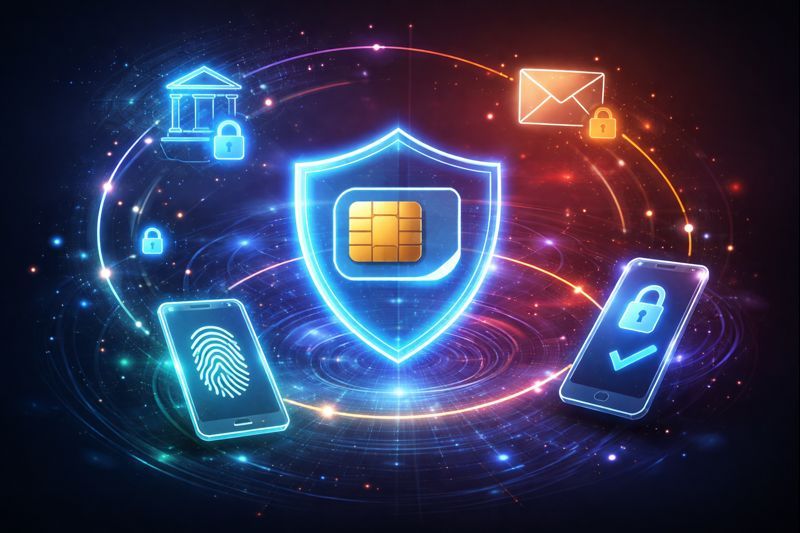
A SIM is not plastic. It is an identity handle.
Banks, wallets, WhatsApp, email resets, and one-time passwords all treat the phone number as proof of who you are. Lose the number, lose the identity.
So a SIM swap is not a customer service action. It is an identity state change.
Treating it lightly guarantees abuse.
Where the current model breaks
Most telcos verify identity using static facts:
- ID number
- Date of birth
- Last recharge amount
- Recent calls
These are low-entropy facts. They leak. They can be guessed, bought, or socially engineered.
Worse, the decision is often made by a single agent under pressure to close tickets quickly.
This creates a perfect storm:
- Weak signals
- One human gatekeeper
- No systemic memory of past behaviour
Fraud does not need sophistication. It needs patience.
A better way to think about identity
Identity is not a card. It is a pattern over time.
You are not defined by a number. You are defined by how you behave consistently.
This is the key shift.
Instead of asking, “Do these facts match?” ask, “Does this request fit the life of this SIM?”
Behaviour beats paperwork
Every SIM already produces a rich signal:
- Where it usually connects in the cell network
- When it is active during the day
- Which devices it pairs with
- Who it talks to and how often
This forms a behavioural fingerprint.
When a SIM swap request arrives, compare it to that fingerprint.
If the pattern holds, proceed smoothly. If the pattern snaps, slow everything down.
Security should scale with risk, automatically.
Why single-step swaps fail
A SIM swap today is often a one-key door.
One agent. One channel. One decision.
Real systems do not work like that. Airports, banks, and nuclear plants never rely on a single confirmation.
A SIM swap should require two independent keys:
- Confirmation from the existing SIM or device
- Confirmation from a separate, pre-registered channel
No confirmation means delay, not approval. Time is the fraudster’s enemy.
The power of waiting
Instant SIM swaps optimise convenience, not safety.
Most fraud losses happen within minutes of a swap.
A simple rule changes everything:
- High-risk swaps enter a 24–72 hour cooling-off period
- Low-risk swaps complete faster
- Extreme cases require physical biometric verification
Nothing breaks. Fraud collapses.
Bind the SIM to something real
A phone is not just a shell. It has secure hardware.
On first activation, generate a cryptographic key tied to the device’s secure enclave.
Now the SIM is bound to a physical object.
To move the SIM, you must either:
- Prove possession of the old device, or
- Reset identity in person with strong biometric checks
Social engineering cannot fake mathematics.
Stop hiding SIM swaps from banks
Telcos know instantly when a SIM changes hands. Banks usually learn after money is gone.
This is indefensible.
SIM swaps must trigger real-time alerts to:
- Banks
- Mobile wallets
- High-risk platforms
For 24–48 hours after a swap, transactions should slow, not fly.
Most fraud dies right there.
Reversibility matters more than prevention
No system is perfect. Recovery speed defines damage.
Victims need:
- One-tap identity freeze
- Automatic rollback to the last trusted state
- Investigation after containment, not before
Fast reversal turns catastrophe into inconvenience.
The uncomfortable organisational truth
Many SIM swaps succeed because:
- Call-centre speed is rewarded
- Sales KPIs override security judgement
- Fraud intelligence is fragmented
Identity decisions cannot sit with frontline agents alone. They must be system decisions, informed by history.
Why Africa can lead here
African markets already trust telcos with money, identity, and daily life.
This is an advantage.
With behaviour-first identity and shared telco–bank signals, Africa can leapfrog legacy systems built for a softer threat model.
SIM swap fraud is not inevitable. It is the result of confusing convenience with design.
Fix the design, and the fraud disappears.