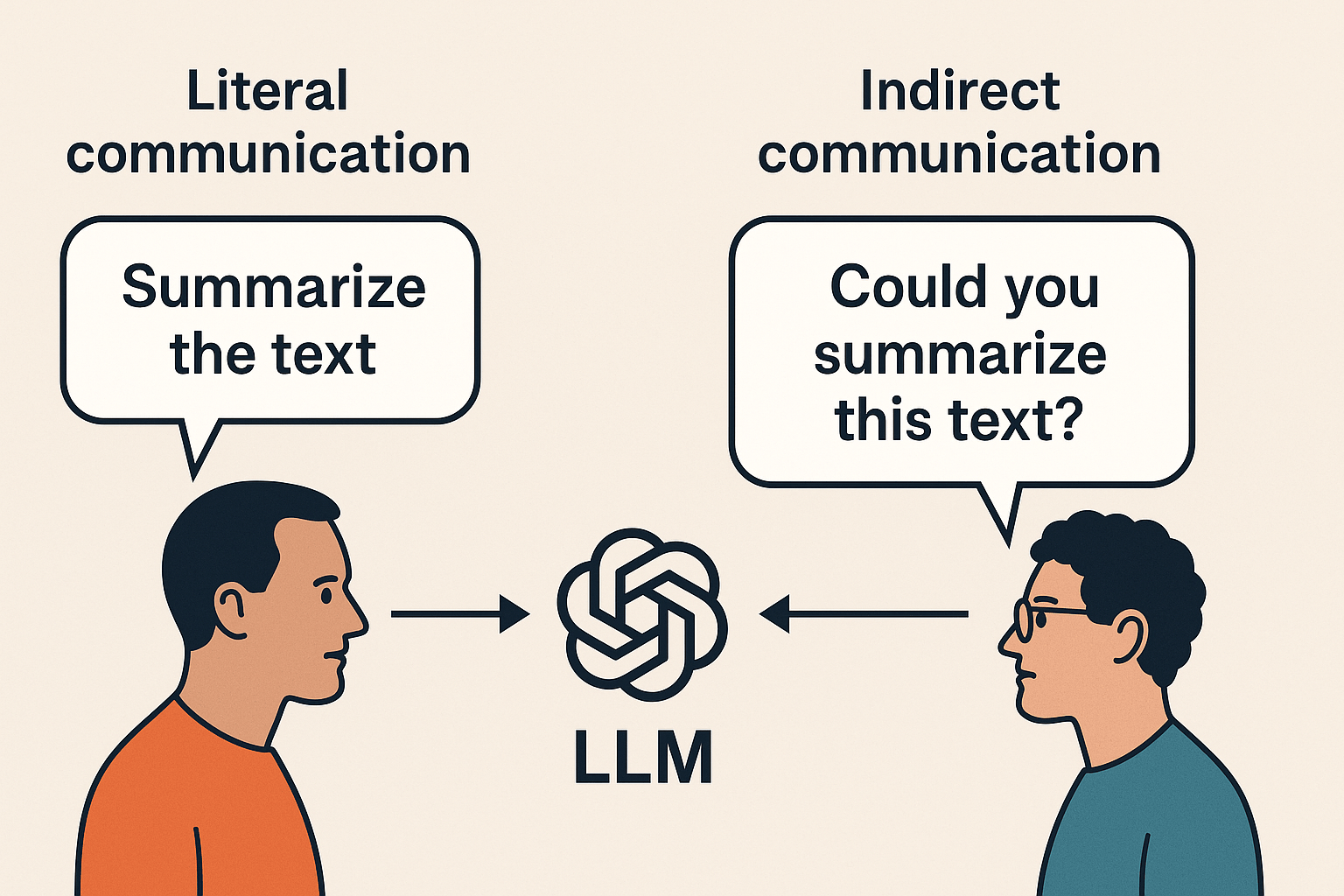
People have noticed a pattern. Some users seem to get clean, accurate answers from language models almost instantly, while others fight the system with retries, clarifications, and frustration. A popular explanation is that autistic users perform better because they tend to be more literal. That explanation points in roughly the right direction, but it mistakes the tool for the cause.
The real cause is not neurology. It is information encoding.
The Only Thing an LLM Actually Understands
A language model does not understand people. It does not understand intentions. It does not understand social signals. It only processes text patterns and predicts the most likely next tokens given what came before.
If meaning is clearly stated in the text, the model performs well. If meaning is hidden behind implication, politeness, metaphor, or social padding, the model must guess. When it guesses, errors rise.
This is not a personality issue. It is a physics-of-information issue.
The Difference Between Literal and Social Language
Literal language places meaning directly in the sentence. Nothing important is hidden. The instruction and the outcome are stated in the same place.
Social language spreads meaning across tone, context, implication, and shared cultural assumptions. Humans decode that effortlessly. Machines cannot.
When a human says, “It would be nice if this were a bit cleaner,” another human understands that as a directive. A model does not. It reads it as a vague preference with no measurable target.
Why Explicit Prompts Win
A model performs best when four elements are explicit:
- Task objective
- Constraints
- Output format
- Evaluation criteria
Literal communication naturally includes these elements. Indirect communication often omits them.
When the model is told exactly what success looks like, it can optimise directly. When success is implied, it must infer. Inference introduces variance. Variance looks like unreliability.
The Compression Principle
Good prompting maximises useful meaning per token. This can be expressed as:
Prompt compression ratio = Meaning delivered / Tokens used
Literal prompts score high. Socially padded prompts score low. The model rewards high compression with better accuracy, shorter outputs, and fewer hallucinations.
This is why engineers, mathematicians, and systems designers often get superior results from AI without trying. Their communication style is already optimised for machines.
Why Autism Gets Mentioned
Many autistic people favour literal wording, direct intent, and reduced social signalling. These traits align well with how models consume information. That alignment creates a performance boost in technical and analytical work with AI.
The boost does not come from autism. It comes from explicit encoding.
Any neurotypical person trained in formal specification, logic, or systems design develops the same advantage within weeks.
Where Literal Prompting Dominates
- Programming
- Data analysis
- Automation
- Decision systems
- API orchestration
- Scientific modelling
These domains punish ambiguity. Literal communication is not a preference here. It is a requirement.
Where Literal Prompting Can Lose Power
- Storytelling
- Brand voice design
- Advertising
- Emotional resonance work
- Cultural symbolism
These domains depend on controlled ambiguity, layered meaning, and emotional subtext. Machines still struggle here regardless of prompting style.
The Category Error
Saying that autistic people are better at using LLMs mistakes a transferable skill for a biological trait. The true advantage is structural clarity in communication. That clarity can be learned by anyone.
Neurotype does not cause performance. Encoding quality does.
The Final Law
Language models reward explicit intent and punish implied intent. They reward constraints and punish vibes. They reward structure and punish politeness when it hides requirements.
Literal communication is not special because of who uses it. It is special because it matches the mechanical nature of the machine.





