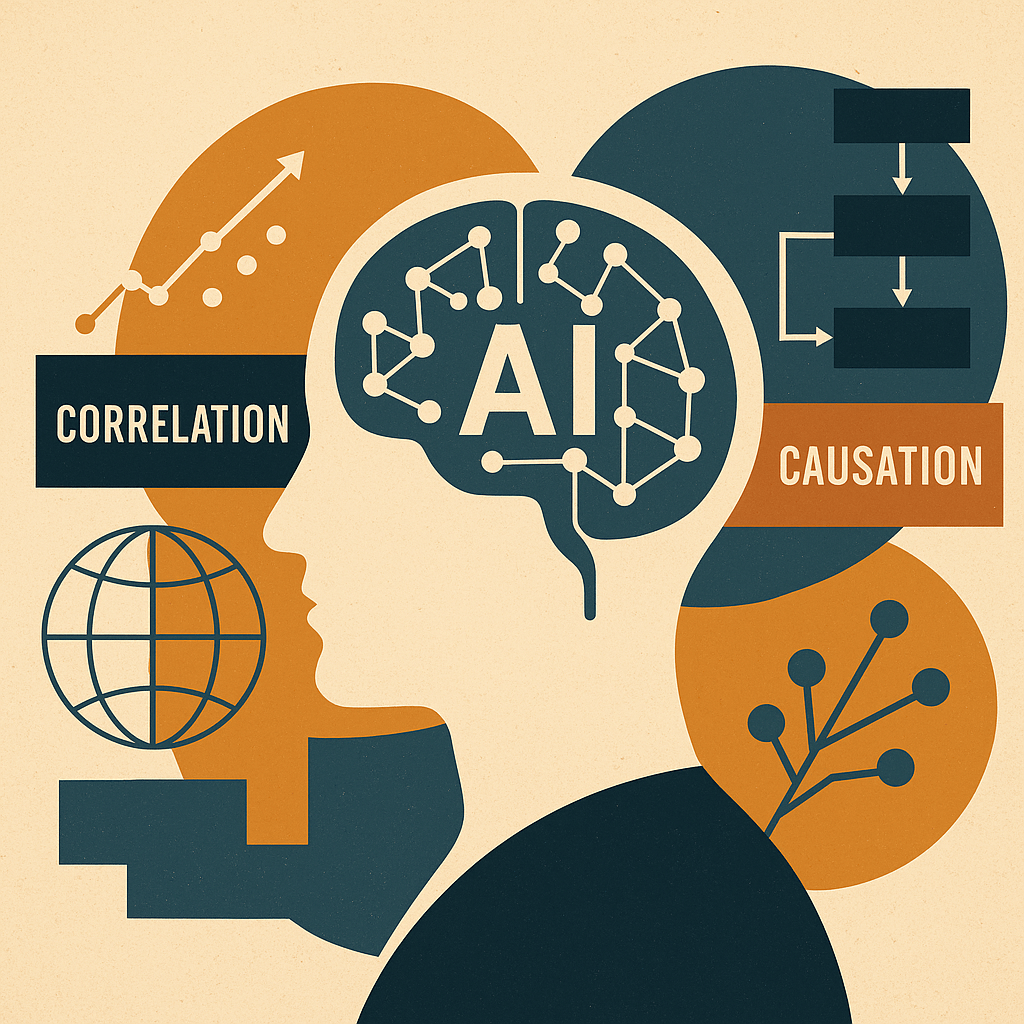
When Correlation Stumbled is not a book about algorithms. It is a book about decisions. Specifically, the political, institutional, and economic decisions that shaped artificial intelligence long before neural networks scaled and GPUs became dominant.
The book’s core argument is blunt: modern AI is not the natural outcome of better mathematics or inevitable progress. It is the outcome of what survived institutional selection. Certain mathematical approaches aligned with funding structures, evaluation regimes, and power incentives. Others did not.
Science Is Filtered Before It Is Proven
Zvobwo starts from a first principle that is often avoided in technical discourse: science is not neutral. Research directions are chosen, rewarded, standardised, or quietly abandoned. AI evolved inside universities, defence budgets, industrial labs, and publication systems that favoured speed, quantification, and scalability.
Methods that required rich domain modelling, human reasoning, or slow theoretical grounding struggled to justify themselves in environments that demanded numerical benchmarks and predictable returns.
The Fork That Shaped Everything
The book traces an early and decisive fork in AI research.
One path focused on symbolic reasoning, causality, and meaning. These approaches treated intelligence as structured understanding of the world. They were explicit, interpretable, and fragile to build.
The other path focused on statistical learning, optimisation, and correlation. These approaches treated intelligence as pattern extraction at scale. They were measurable, fundable, and easy to industrialise.
Cold War funding logic and later commercial incentives overwhelmingly favoured the second path. Not because it was truer, but because it was easier to manage institutionally.
Correlation Won by Fitting the System
Correlation-based AI thrived because it aligned with how success was measured. Performance curves replaced understanding. Benchmarks replaced explanation. Scale replaced structure.
The book makes clear that correlation was not a mistake. It was a rational response to the incentives in place. But it came with hidden costs that are now impossible to ignore.
The Structural Limits of Correlation
Zvobwo connects today’s AI weaknesses directly to this historical narrowing:
- models that predict without explaining,
- systems that fail under intervention,
- opaque decision-making with ethical consequences,
- brittle generalisation outside training distributions.
These are not implementation errors. They are outcomes of a paradigm that deprioritised causality and meaning by design.
Relearning What Was Set Aside
The resurgence of interest in causal inference, interpretability, reasoning models, and hybrid AI systems is framed not as innovation, but as recovery. The field is returning to ideas that were sidelined for institutional reasons, not scientific ones.
Correlation did not fail completely. It simply reached the boundary of what it can carry alone.
Why This Book Matters
When Correlation Stumbled is a corrective to the mythology of AI inevitability. It forces readers to confront how power, funding, and convenience shape what counts as intelligence.
For researchers, it offers historical clarity. For builders, it provides strategic orientation. For policymakers, it exposes why technical fixes alone cannot solve structural problems.
The book argues that the future of AI depends less on bigger models and more on restoring what was filtered out. Understanding cannot be scaled into existence if the system that selects ideas does not value it.
That is the uncomfortable thesis of the book, and precisely why it matters now.


