There is a peculiar honour in world rugby, and only a handful of coaches have ever earned it: forcing the lawmakers to change the rules because of you. Rassie Erasmus has done it repeatedly. The Springboks' director of rugby has become the game's most prolific exploiter of grey areas, and World Rugby has spent the better part of a decade playing catch-up, closing loopholes only after Rassie has already banked the advantage.
For business leaders staring down the disruption of artificial intelligence, this is not just a sports story. It is a masterclass in how to operate when the rulebook keeps shifting under your feet.
The Rassie playbook, briefly
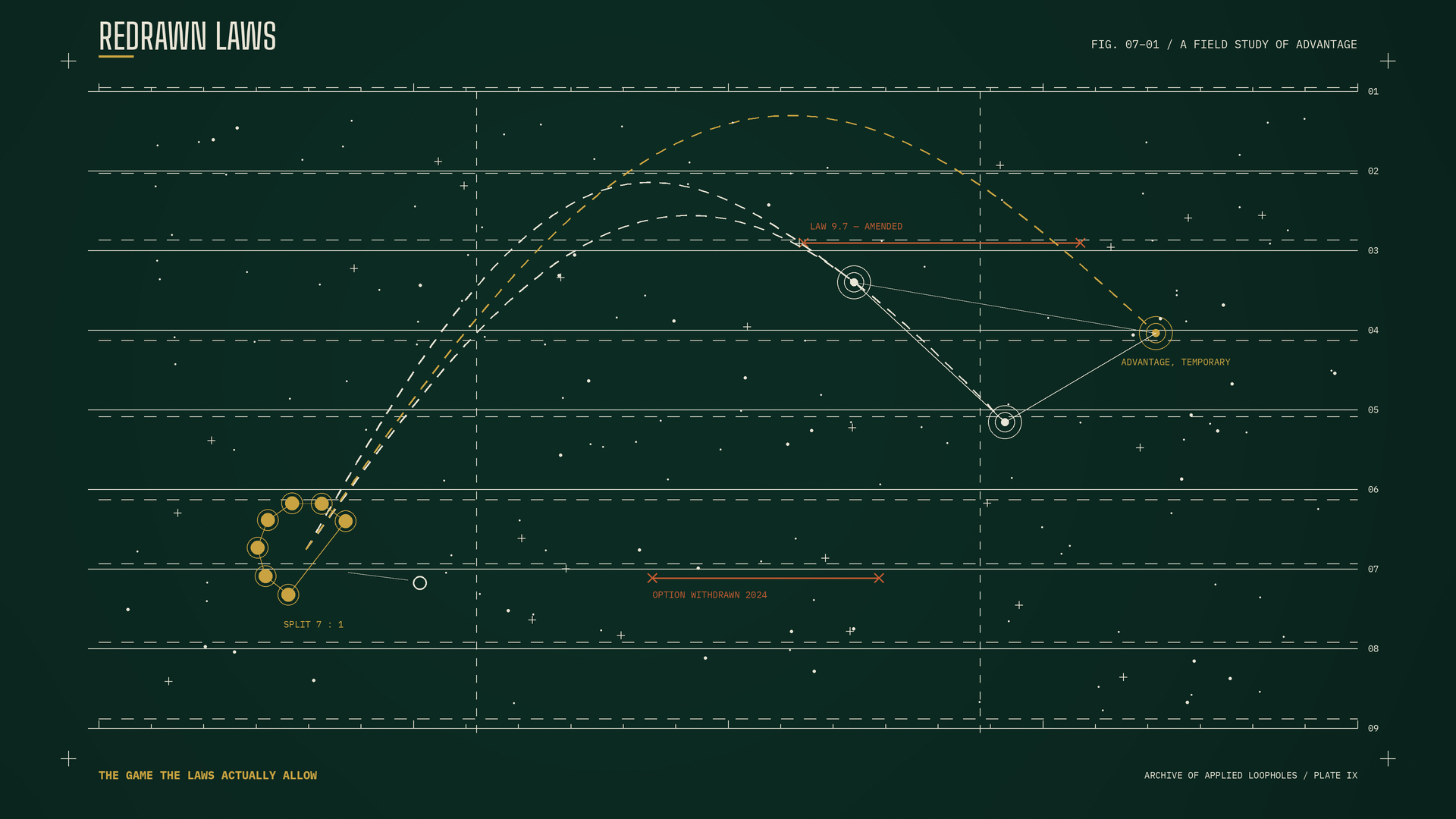
Consider the track record. When World Rugby allowed teams to choose a scrum from a free kick, most coaches saw an administrative footnote. Rassie saw a weapon, and the Boks began turning free kicks into scrums to squeeze penalties out of opponents with their dominant pack. The option was later removed from the laws.
When everyone else loaded their bench with a conventional five-three split of forwards and backs, Rassie unveiled the Bomb Squad, first six-two, then a radical seven-one, effectively fielding two Test-quality packs in one match. The rugby world howled, debated the spirit of the game, and then quietly started copying him.
When Cheslin Kolbe charged down Thomas Ramos's conversion in the 2023 World Cup quarterfinal against France, it was perfectly legal at the time. It is not anymore. When Rassie himself ran the touchline as a water carrier, relaying tactical instructions in a role nobody had thought to regulate, World Rugby soon restricted who could carry the water and when. Midfield lineout-style setups in open play, hybrid players trained to cover forwards and backs, kick-off routines designed to manufacture contestable chaos: the pattern repeats. Rassie reads the laws as they are written, not as they are assumed to be, and acts before consensus forms.
Lesson one: read the actual rules, not the conventional wisdom
Most organisations do not compete against the rules of their industry. They compete against the habits of their industry. The two are not the same thing.
Rassie's genius is a kind of ruthless literalism. He asks what the law actually permits, rather than what everyone has always done. Brands facing AI disruption should ask the same question. What does regulation actually say about how you may use customer data, generate content, or automate decisions? What do your contracts, your platforms and your licences actually allow? Somewhere in the gap between what is permitted and what is customary lies your seven-one bench split.
Right now, most companies are using AI the way most coaches used their bench in 2018: conservatively, conventionally, and identically to their competitors. The advantage will go to the brands willing to reconfigure the whole squad around the new possibility, not bolt it onto the old structure.
Lesson two: exploit the window before it closes
Every Rassie innovation had a shelf life. The scrum from the mark, the conversion charge-down, the unregulated water carrier: each worked brilliantly until the lawmakers responded. Rassie never treated any single trick as a permanent moat. He extracted maximum value while the window was open, and had the next idea loaded before the old one was outlawed.
AI advantages behave exactly the same way. Whatever edge you build today, whether it is a clever prompt-driven service, an automated workflow or an AI-assisted pricing model, will be commoditised, copied or regulated. Probably all three, probably faster than you would like. The strategic error is not that your innovation gets neutralised. That is inevitable. The error is having nothing in the pipeline when it happens. Build your organisation for a rolling series of temporary advantages rather than one defensible fortress. The laager mentality does not work when the terrain itself keeps moving.
Lesson three: weather the outrage
Almost every Rassie innovation was met with accusations that he was against the spirit of the game. The Bomb Squad was called dangerous. The tactical gimmicks were called cynical. Pundits, rival coaches and northern hemisphere columnists queued up to be offended. Rassie kept winning World Cups.
Genuine innovation almost always looks like cheating to incumbents, because incumbents have confused the current conventions with the eternal rules. Brands deploying AI aggressively will face the same chorus: it is not authentic, it is not how things are done, it undermines the craft. Some of that criticism deserves a serious hearing, particularly where real ethical lines exist around privacy, misinformation and job displacement. But a great deal of it is simply the sound of competitors who did not think of it first. Learn to tell the difference between a legitimate ethical objection and the discomfort of the disrupted.
Lesson four: innovation is a system, not a stunt
It is tempting to remember Rassie for the tricks, but the tricks sit on top of something far less glamorous: an obsessive analytical operation, transparent selection systems, alignment videos, data on every player, and a culture where a wild idea can be voiced, tested and either adopted or binned without ego. The seven-one split was not a thumbsuck. It rested on years of conditioning data, squad depth planning and honest conversations with players about their roles.
This is the part most brands skip. They want the viral AI stunt without building the boring machinery underneath: clean data, clear governance, teams that are trained and psychologically safe enough to experiment, and leadership that reviews failures without punishing the people who tried. Rassie's Springboks can attempt the outrageous precisely because the fundamentals, the scrum, the defence, the fitness, are world class. Your AI moonshots need the same foundation of operational excellence, or they are just gimmicks waiting to embarrass you.
Lesson five: make your people hybrids
One of the quieter Erasmus innovations is the hybrid player, athletes like Kwagga Smith or the utility backs deliberately developed to cover multiple positions, which is exactly what makes a seven-one bench survivable when a back goes down injured. Versatility is what turns a risky structure into a resilient one.
The AI era demands the same of your workforce. The brands that thrive will not be the ones that replace people with machines, but the ones that develop hybrid professionals: marketers who can interrogate a model's output, accountants who can automate their own workflows, creatives fluent in both craft and tooling. Rigid specialists in rigid structures are the five-three bench of the corporate world. Fine in stable conditions, fragile in chaos.
The final whistle
Rassie Erasmus has never had the luxury of a settled rulebook, and he has stopped wanting one. His whole method assumes the laws will change, often in direct response to his own success, and treats that churn as the game within the game.
That is precisely the posture the AI era demands of brands. The regulations will shift. The technology will leap. Competitors will copy you and lawmakers will occasionally legislate specifically against your cleverness. You can experience that as instability, or you can experience it the way Rassie does: as a permanent supply of fresh grey areas that reward whoever reads the rules most carefully, moves first, and has already planned the next move for the day this one gets banned.
The Boks did not win back-to-back World Cups by playing the game everyone agreed rugby was. They won by playing the game the laws actually allowed. Go and do likewise.





