Introduction: Empiricism Arrives in the AI Jobs Debate
For years, forecasts of artificial intelligence's effect on employment have oscillated between apocalyptic and dismissive, producing more heat than light. Economists estimated that anywhere from 10 to 47 percent of US jobs faced high automation risk, while technologists argued that AI would create more work than it destroyed. What was conspicuously absent from nearly all of this discourse was high-quality empirical data on what AI systems actually do in real workplaces, at scale.
Anthropic's research report, 'The Labor Market Impacts of AI: Evidence from Real-World Usage Patterns,' attempts to fill this gap in a way that prior studies have not. Rather than relying on theoretical task taxonomies or hypothetical exposure scores, the authors draw on a large corpus of genuine interactions between workers and Claude, Anthropic's AI assistant, mapping those interactions to the occupational categories defined by the US Department of Labor's O*NET database. The result is among the first studies to ground AI labor market analysis in observed behavior rather than inference.
This commentary evaluates the study's methodology, places its findings within the broader literature on automation and augmentation, and discusses what policymakers, employers, and workers should take away from it, as well as what the paper leaves unresolved.
| "Rather than relying on theoretical task taxonomies or hypothetical exposure scores, Anthropic's researchers draw on a large corpus of genuine human–AI interactions, producing among the first studies to ground AI labor market analysis in observed behavior." |
What the Study Does and Does Not Measure
The Analytical Architecture
The study's central innovation is to combine a large sample of Claude.ai conversations with the O*NET occupational task database. O*NET is the gold standard taxonomy for describing what workers actually do across roughly 1,000 US occupations, covering some 19,000 discrete tasks organised around dimensions such as knowledge requirements, work activities, and work context. By classifying AI interactions against these task descriptions, the authors can estimate which occupations' task portfolios most closely overlap with current AI capabilities.
This approach sidesteps a persistent methodological weakness of prior work. Studies such as Frey and Osborne (2013) relied on expert judgements about whole occupations; Acemoglu and Restrepo (2020) used robot adoption data from manufacturing settings; and Felten, Raj and Seamans' AI Occupational Exposure index inferred AI relevance from language model benchmark scores rather than real usage. Anthropic's methodology, by contrast, observes demand — the tasks users actually bring to an AI system — rather than supply-side capability estimates.
| The Occupational Information Network (O*NET) is maintained by the US Department of Labor and contains standardised descriptors for approximately 1,000 occupations. It covers knowledge requirements, skills, abilities, work activities, work context, and task statements. Researchers frequently use O*NET to construct 'routine task intensity' (RTI) measures and, more recently, AI exposure indices. Anthropic's study maps observed AI usage onto O*NET task descriptions, providing a demand-side complement to supply-side exposure scores. |
Strengths of the Empirical Design
Several methodological features deserve commendation. First, the sample size is substantial: the study draws on millions of interactions across a broad user base, providing statistical power that smaller academic surveys cannot match. Second, the analysis distinguishes between automation, instances where the AI system executes a task with minimal human involvement, and augmentation, instances where the user and AI work collaboratively, with the human retaining decision authority. This distinction is analytically critical, since the welfare and labour market implications of the two modes differ substantially.
Third, the study cross-tabulates AI task usage against wage levels and educational requirements associated with each occupation, enabling the researchers to characterise the income distribution of AI exposure. This goes beyond simple task counts to speak to the distributional question that ought to be at the centre of policy attention: is AI primarily affecting low-wage, routine workers (as earlier automation waves did), or is it concentrating on higher-wage, cognitive workers?
Limitations and Caveats
The study is not without limitations, and intellectual honesty requires acknowledging them. The population of Claude.ai users is not representative of the broader workforce: early adopters of AI tools tend to be younger, more educated, and concentrated in technology-adjacent industries. Usage patterns observed today may therefore exaggerate AI penetration in knowledge work and understate potential future adoption in sectors currently showing lower engagement. The study's authors acknowledge this selection effect, but it merits emphasis when extrapolating findings.
A second limitation concerns the gap between task completion in an AI session and the displacement of labour. Even if a user asks Claude to draft a legal memorandum or analyse a financial dataset, it does not follow that the time saved translates into workforce reduction rather than productivity gain. Task-level analysis cannot adjudicate between these outcomes without supplementary firm-level or individual-level labour market data — precisely the data that would be most difficult to collect.
Finally, the study is necessarily backward-looking in one important sense: it measures what current users do with current model capabilities. The trajectory of AI capability improvement means that the task coverage observed today is almost certainly a lower bound on future coverage, making point-in-time estimates a volatile basis for long-run policy.
Key Findings and Their Interpretation
Breadth of Occupational Exposure
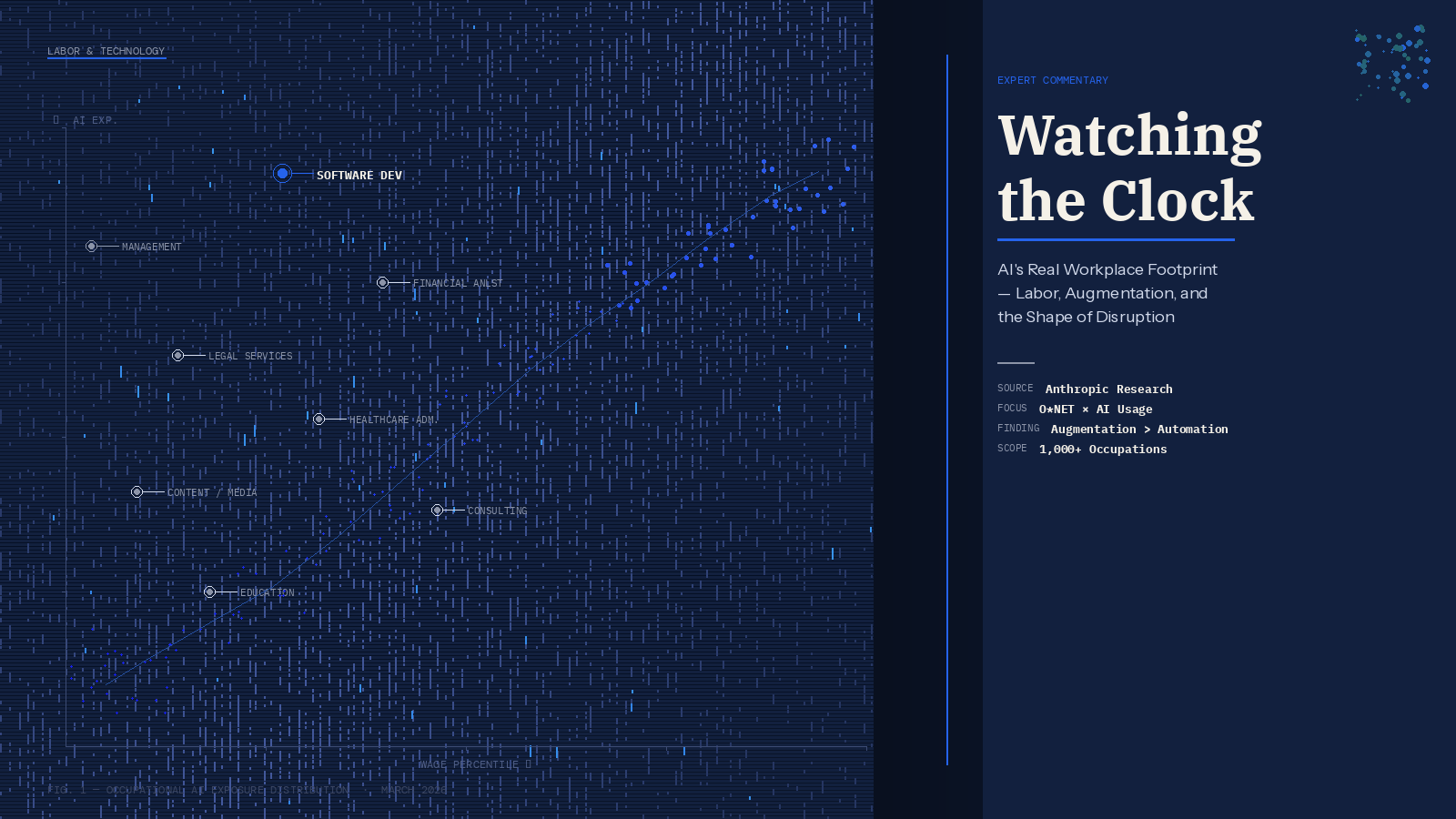
The study's headline finding is that AI assistance touches a wide range of occupational categories, far wider than the manufacturing and routine clerical work that dominated prior automation waves. Software developers, writers, financial analysts, lawyers, educators, healthcare administrators, and marketing professionals all appear prominently in the usage data. This reflects the general-purpose nature of large language models, which, unlike robotic process automation or narrow machine learning classifiers, can engage flexibly with unstructured language tasks across domains.
The breadth of occupational exposure has an important implication: the economic impact of AI will not be sequenced neatly by sector in the way that factory automation was. Multiple professional labour markets are experiencing AI adoption concurrently, which compresses the adjustment horizon and reduces the time available for workers, firms, and institutions to adapt.
| "The breadth of occupational exposure has a critical implication: the economic impact of AI will not be sequenced neatly by sector. Multiple professional labour markets are experiencing adoption concurrently, compressing the adjustment horizon." |
Augmentation Dominates Automation, For Now
One of the most important empirical findings is that augmentation substantially predominates over full automation in observed interactions. Users most commonly engage AI to assist with drafting, editing, summarising, researching, and brainstorming, tasks that keep a human in the loop, rather than delegating tasks end-to-end. This accords with the view that current AI systems function primarily as productivity amplifiers rather than autonomous labour substitutes.
This finding should be interpreted cautiously, however. The augmentation/automation balance is not fixed. As AI agents become capable of multi-step task execution, scheduling, code deployment, document management, the balance will shift. The Anthropic study captures a snapshot in a rapidly evolving technological landscape. What is today a collaborative interaction may in two years be a fully automated workflow. Policymakers would be ill-served by treating the current augmentation-heavy profile as a permanent equilibrium.
Higher-Wage Occupations Show Disproportionate Exposure
Among the study's most significant distributional findings is that occupations with above-median wages, particularly those requiring post-secondary education and involving substantial cognitive, analytical, or communicative task content, show the highest intensity of AI engagement. This contrasts sharply with the pattern of earlier automation, which concentrated on middle-wage, routine-task-intensive occupations and contributed to the labour market polarisation documented by Autor, Levy and Murnane (2003) and subsequent researchers.
If the Anthropic findings are generalised, the current wave of AI may reduce, or even reverse, prior polarisation by introducing competitive pressure on high-wage knowledge workers who had previously been insulated from automation. This has complex welfare implications. On one reading, productivity gains among high-skill workers benefit the broader economy; on another, downward wage pressure on professional workers could widen inequality between capital owners and labour. The study does not resolve this ambiguity, though it usefully reframes the distributional question.
| Robotic process automation (1980s–2000s) primarily displaced middle-wage, routine manual and cognitive jobs, contributing to a 'hollowing out' of the wage distribution. Current AI systems show a different profile: highest usage intensity is observed in high-wage, cognitively demanding occupations such as software development, legal services, financial analysis, and creative professions. Whether this translates into wage compression or productivity-driven wage growth in those fields remains an open empirical question. |
Software Development and Writing as Leading Indicators
The study finds that coding and software development tasks represent an especially high share of AI interactions. This is consistent with the rapid adoption of AI coding assistants documented in Microsoft's GitHub Copilot research and in surveys of software development teams. The finding suggests that software development is a useful sentinel sector: the changes occurring there, in productivity, in required skill mix, in employment structures, are likely to propagate to other professional sectors with a lag.
Writing-intensive tasks, document drafting, content creation, correspondence, and summarisation, similarly account for a large share of observed interactions across multiple occupational categories. This creates exposure across a wide range of professions where writing is an instrumental rather than primary skill: law, consulting, academia, public affairs, and management.
Situating the Findings in the Broader Literature
The Productivity-vs-Displacement Debate
A foundational tension in AI economics is whether productivity gains lead to higher wages and employment (through output expansion and consumer surplus) or to labour displacement (through cost reduction that substitutes capital for labour). The Anthropic study does not, and perhaps cannot, resolve this debate with its methodology, since task-level usage data cannot be linked directly to employment or wage outcomes. However, it does provide inputs that help sharpen the theoretical debate.
If augmentation is the dominant mode of AI use, the productivity-channel story gains plausibility: workers who use AI effectively may become more productive and thus more valuable, at least in the short run. The frequently cited finding from Brynjolfsson, Li and Raymond (2023), that call centre workers using AI showed productivity gains of roughly 14 percent, aligns with this view. However, the same study also found a compression of the skill premium: experienced workers benefited less than novices, suggesting AI may be substituting for accumulated tacit knowledge in ways that erode returns to experience.
The Role of Firm Organisation and Task Bundling
Labour economists have long emphasised that employment is not simply the aggregation of individual tasks, it is the bundling of tasks into jobs, and jobs into organisations. Even if AI automates or augments specific tasks, employment effects depend heavily on whether those tasks can be unbundled from jobs, whether firms reorganise job descriptions, and whether task completion rates rise in ways that change headcount decisions.
The Anthropic study, by focusing on task-level interactions, necessarily abstracts from these organisational dynamics. Future research connecting AI usage data to firm-level employment and compensation data would substantially advance the field's understanding. Notably, Anthropic's methodology, linking AI session data to O*NET occupational categories, could in principle be extended to such linkages if appropriate data partnerships were established.
International and Sectoral Variation
The study draws primarily on usage data that likely skews toward English-speaking, technology-forward users in high-income countries. The labour market implications of AI adoption may look quite different in middle-income countries where AI-exposed sectors, particularly services and knowledge work, are both important engines of employment growth and potentially significant sources of vulnerability. The offshoring of business process work, which generated substantial employment in countries such as India and the Philippines, may face renewed competitive pressure as AI reduces the cost advantage of labour arbitrage.
| "The offshoring of business process work, which generated substantial employment in developing economies, may face renewed competitive pressure as AI reduces the cost advantage of labour arbitrage. International dimensions deserve much greater research attention." |
Policy Implications
Rethinking Workforce Development
If the Anthropic study's findings are even approximately correct in their directional implications, workforce development policy faces a challenge quite different from prior technology transitions. Prior automation concentrated on identifiable occupational categories, assembly workers, bank tellers, data entry clerks, enabling targeted retraining programmes. The current wave of AI, by contrast, imposes diffuse exposure across knowledge work, making it harder to identify which workers will be affected and in what way.
This suggests a shift from occupation-specific retraining toward developing durable, cross-occupational competencies: critical evaluation of AI-generated outputs, complex problem framing, relationship-intensive service delivery, and ethical judgement, capabilities that are difficult to automate and that enable workers to use AI as a productivity tool rather than being displaced by it. Educational institutions will need to integrate AI literacy into curricula across fields, not just in computer science.
Labour Market Data Infrastructure
The Anthropic study exposes a significant gap in official labour market data infrastructure. Current data sources, the US Current Population Survey, O*NET, and the Bureau of Labor Statistics' Occupational Employment and Wage Statistics, were not designed to capture the texture of human-AI task sharing. The fact that a private AI company's interaction logs are, for now, among the most informative data sources for this question points to a need for public investment in new data collection.
Statistical agencies should consider designing surveys and administrative data collection that directly measure AI tool adoption at the worker and firm level, capturing both frequency of use and the nature of tasks delegated to AI systems. This would enable longitudinal analysis of the productivity and employment effects that cross-sectional task taxonomies cannot provide.
The Complementarity Policy Lever
Perhaps the most actionable policy insight from the study's augmentation-dominant finding is that the complementarity of human and AI labour is not automatic, it depends on organisational design, worker training, and institutional support. Firms that adopt AI tools without investing in worker skills to use them effectively may fail to realise productivity gains while inadvertently reducing workforce morale and quality. Governments can encourage complementarity through tax incentives for employer-provided AI training, support for worker-led experimentation with AI tools, and the development of industry standards for responsible AI deployment in workplace settings.
Conclusion: An Important Contribution, with Important Caveats
Anthropic's labor market impacts study represents a genuine methodological advance in a field too often characterised by theoretical speculation and selection-biased surveys. By grounding analysis in large-scale observed usage rather than capability assessments or expert judgements, the authors move the empirical frontier in a valuable direction. The finding that AI exposure is broad, that augmentation currently dominates automation, and that higher-wage knowledge work bears disproportionate exposure are all substantively important results that should inform both academic research and policy deliberation.
At the same time, the study's limitations counsel against over-interpretation. Selection effects in the user population, the inherent difficulty of inferring employment outcomes from task-level data, and the rapidly evolving capability frontier all introduce significant uncertainty. The finding that augmentation predominates today is not a guarantee that displacement will not dominate tomorrow; it is a description of a technological moment that will not hold still.
What the study does most effectively is shift the burden of proof. Prior to empirical evidence of this kind, advocates for aggressive policy intervention faced the objection that AI's labour market impact remained too speculative to warrant major disruption to training systems, social insurance, or data infrastructure. The Anthropic findings, alongside a growing body of complementary research, make it harder to sustain that position. The question is no longer whether AI is reshaping the occupational structure of work, but how fast, in which directions, and with what distributional consequences.
Those are questions that no single study can answer definitively. But Anthropic's contribution establishes a useful methodological template, one that should be extended, replicated by independent researchers with access to comparable data, and ultimately embedded in official data systems capable of tracking these dynamics in real time. The clock, as the usage data makes clear, is already running.
| This expert commentary analyses Anthropic's research report 'Labor Market Impacts' (anthropic.com/research/labor-market-impacts). It evaluates the study's methodology, situates findings within the academic literature on automation and augmentation, and draws out policy implications. The commentary represents independent scholarly analysis and does not reflect the views of Anthropic or any affiliated institution. All references to findings from the underlying study are drawn from the publicly available research report. |