For decades, the question "what's actually happening in African consumer markets?" has been answered with some combination of a NielsenIQ retail audit, a Euromonitor PDF, a McKinsey deck, and a phone call to someone who used to live in Lagos. That stack is breaking down, not because any one piece of it failed, but because the buyers it was built for have changed faster than the industry serving them.
The market that built the industry
African consumer intelligence exists because Africa is uniquely difficult to research. Census data is often a decade old. More than 70% of FMCG volume in many countries moves through informal channels, kiosks, open markets, spaza shops, that traditional retail audits cannot see. Currencies revalue overnight. Lagos and Cairo have less in common than Frankfurt and Tokyo. The phrase "54 countries, not one market" is a cliché because it remains, stubbornly, true.
This difficulty has supported a stable industry structure for thirty years: global incumbents (NielsenIQ, Kantar, Ipsos, Euromonitor) at the top, pan-African specialists in the middle (Sagaci Research, KASI Insight, Asoko Insight, Stears), and a long tail of country-specific firms doing the actual fieldwork. Money has flowed from four buyer types: multinationals, regional brands, investors, and consultancies, into a mix of subscription products, syndicated trackers, and bespoke research. The economics work because the data is hard enough to gather that someone, somewhere, has to be paid to gather it.
What's changing
Three shifts are reshaping the industry simultaneously, and each is significant on its own.
The first is the terminal model. New entrants like AFRIQ Terminal in consumer markets and Mansa Markets in capital markets are explicitly positioning against the PDF-report era, single login, queryable data, structured outputs, real-time-ish updates. This is a generational repositioning of what an intelligence product looks like, borrowing from how Bloomberg reshaped financial data in the 1980s. Whether it works at African scale is unproven, but the framing is already pulling buyer expectations forward.
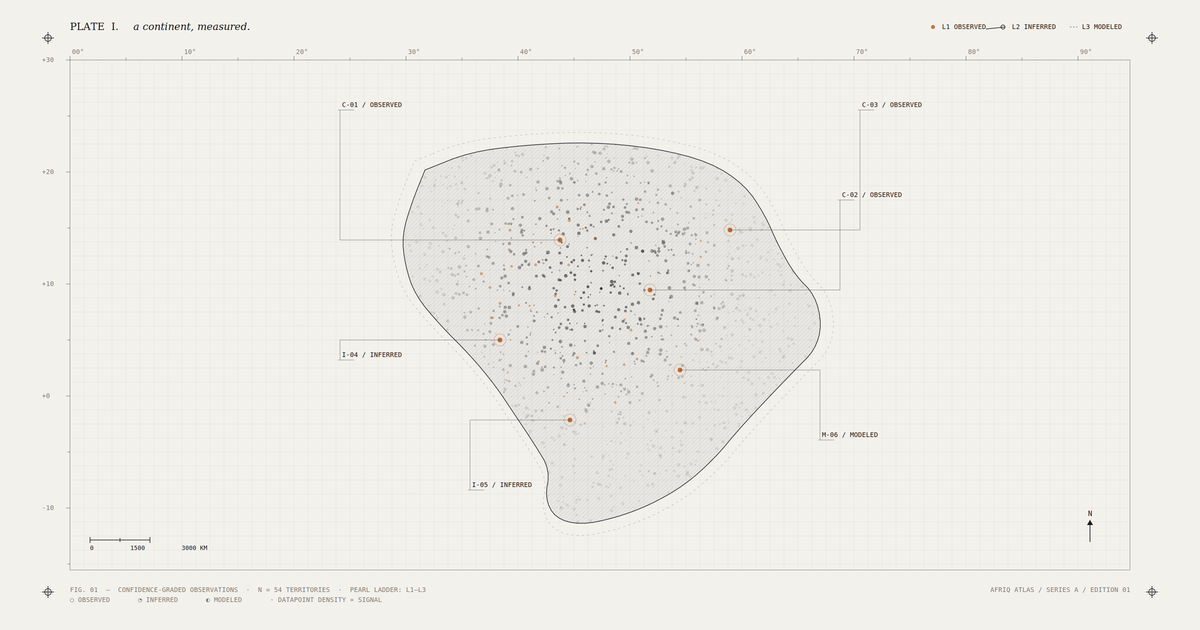
The second is methodological transparency as a feature. Older intelligence products treated rigour as something the brand stood for; the buyer was meant to trust the methodology because they trusted the firm. Newer products are surfacing methodology directly, confidence scores on individual claims, source provenance, explicit separation between what's observed, what's inferred, and what's modelled. As AI floods the market with plausible-sounding analysis, the firms that can show their work will pull away from those that can only assert it.
The third is WhatsApp-native data collection. Tools like Yazi have demonstrated that primary research at meaningful sample sizes can run through the messaging channel that already dominates African digital life. This compresses the cost of data collection by an order of magnitude and changes what is economically feasible to measure.
Where this is heading
Two forces will define the next five years. AI will hollow out the middle of the industry, the firms whose product is essentially repackaged desk research are in genuine trouble, while firms with proprietary primary data or strong methodological reputations will gain pricing power. And the buyer mix will shift: brand-strategy budgets are under pressure as multinationals scale back African expansion, but investor demand for diligence-grade intelligence is growing as Africa-focused PE and VC capital continues to deploy.
The honest summary is that this is a maturing industry that has finally become interesting again. The old players still have the data and the relationships. The new players have the product instincts and the willingness to make rigour visible. Buyers, for the first time in a long time, have real choice and the firms that win the next decade will be the ones that treat African market complexity as a feature to surface rather than a problem to smooth over.





