
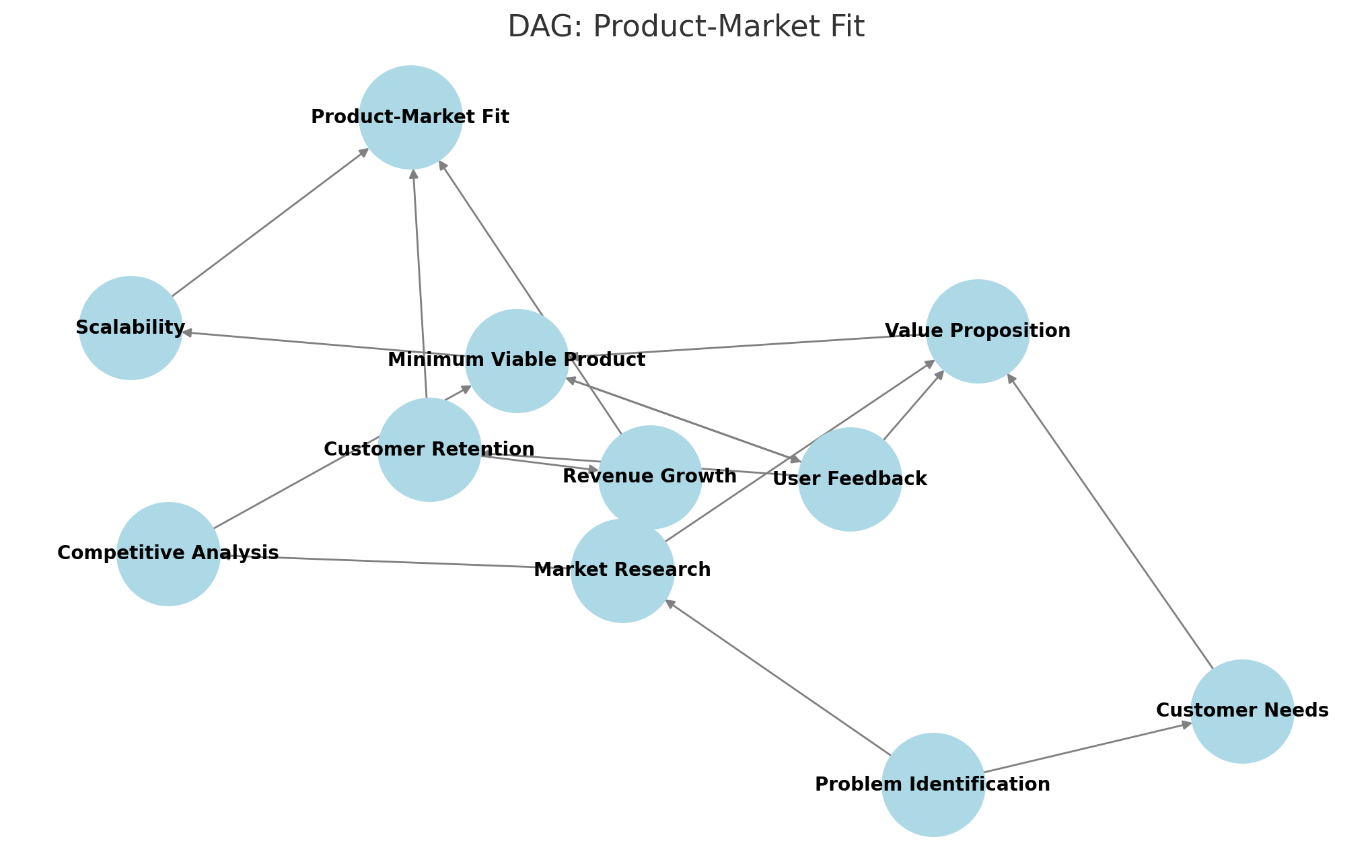
Imagine you're an explorer searching for a lost city—a place rumored to have everything its inhabitants need to thrive. You have a map, but the terrain is rough, the rivers shift, and the landmarks change. In business, that lost city is Product-Market Fit (PMF)—the elusive moment when your product finds its perfect audience, and growth becomes inevitable.
Now, how do you reach it? You need a system, a process, a map. Let’s break it down with the same clarity and precision that we use to understand the natural world. We'll think in terms of cause and effect, like a chain reaction. Enter the Directed Acyclic Graph (DAG)—a model that helps us visualize the forces leading to PMF. This isn’t just theory; it’s the blueprint for making it real.
Step 1: Identifying the Problem
Before building anything, you need to find the right problem. Businesses fail because they try to sell solutions to problems people don’t care about. This is the first node in our graph: Problem Identification.
- What is broken in the world?
- Who suffers because of it?
- How urgent is it to solve?
Think of this as the gravitational pull that determines everything else. If this step is weak, nothing downstream can compensate for it.
Step 2: Understanding Customer Needs
Once you have a problem, you must deeply understand the people experiencing it. Enter Customer Needs.
- What do they currently do to solve the problem?
- What frustrates them about the current solutions?
- What outcomes do they dream of?
This isn’t guesswork—it’s fieldwork. You observe, you ask, you listen. A scientist doesn’t assume results; they test and refine their hypotheses.
Step 3: Market Research & Competitive Analysis
You’ve identified a problem and who has it. Now, you need to scan the landscape. That’s Market Research and Competitive Analysis.
- Who else is trying to solve this problem?
- How well are they doing?
- Where are the gaps in their solutions?
You’re looking for white space—a territory unclaimed or poorly served. No one needs another generic product. They need something better, faster, cheaper, or completely different.
Step 4: Crafting the Value Proposition
Now, you take everything you’ve learned and forge the Value Proposition. This is the beating heart of your business. It must be clear, strong, and undeniable.
- What makes your solution unique?
- Why should people care?
- Can you articulate this in one sentence?
If you can’t explain it simply, you don’t understand it well enough yet.
Step 5: Building the Minimum Viable Product (MVP)
Forget perfection. The goal is to build just enough to test whether people care. This is the Minimum Viable Product (MVP).
- What is the simplest version of your product that delivers the core value?
- Can you build it quickly?
- How will you test it?
Speed matters. The market won’t wait, and you’re not here to admire your prototype—you’re here to learn.
Step 6: User Feedback & Iteration
Once your MVP is in people’s hands, everything changes. They use it in ways you didn’t expect. They complain about things you thought were fine. They ignore features you thought were brilliant.
- Listen. Hard.
- Measure usage patterns, not just opinions.
- Iterate fast—improve what works, kill what doesn’t.
Every piece of feedback is an equation waiting to be solved.
Step 7: Scalability & Growth Potential
Now comes the turning point: Scalability. Can your product handle more users, more demand, more complexity?
- Can you deliver your value at scale?
- What bottlenecks appear as you grow?
- Is your pricing model sustainable?
If the answer to these is "yes," you are approaching the final gate to Product-Market Fit.
Step 8: Customer Retention & Revenue Growth
The ultimate test of PMF? People keep using your product. They don’t just try it; they rely on it.
- Are customers coming back?
- Do they tell others?
- Does your revenue grow in a predictable way?
This is where the graph converges. If everything has aligned correctly, Product-Market Fit emerges naturally. It’s not a magic moment; it’s a series of cause-and-effect relationships, each leading to the next.
The Grand Synthesis
The beauty of this approach is that it removes the mystery. PMF is not luck. It is the natural result of getting the right things right, in the right order.
If you try to scale before nailing your value proposition, you fail. If you ignore feedback, you miss the mark. If you build for the wrong problem, nothing else matters.
Follow the DAG. Think clearly. Move methodically. And before you know it, you’ll find yourself in the lost city—the place where customers demand your product, where growth is natural, and where your business finally makes sense.





