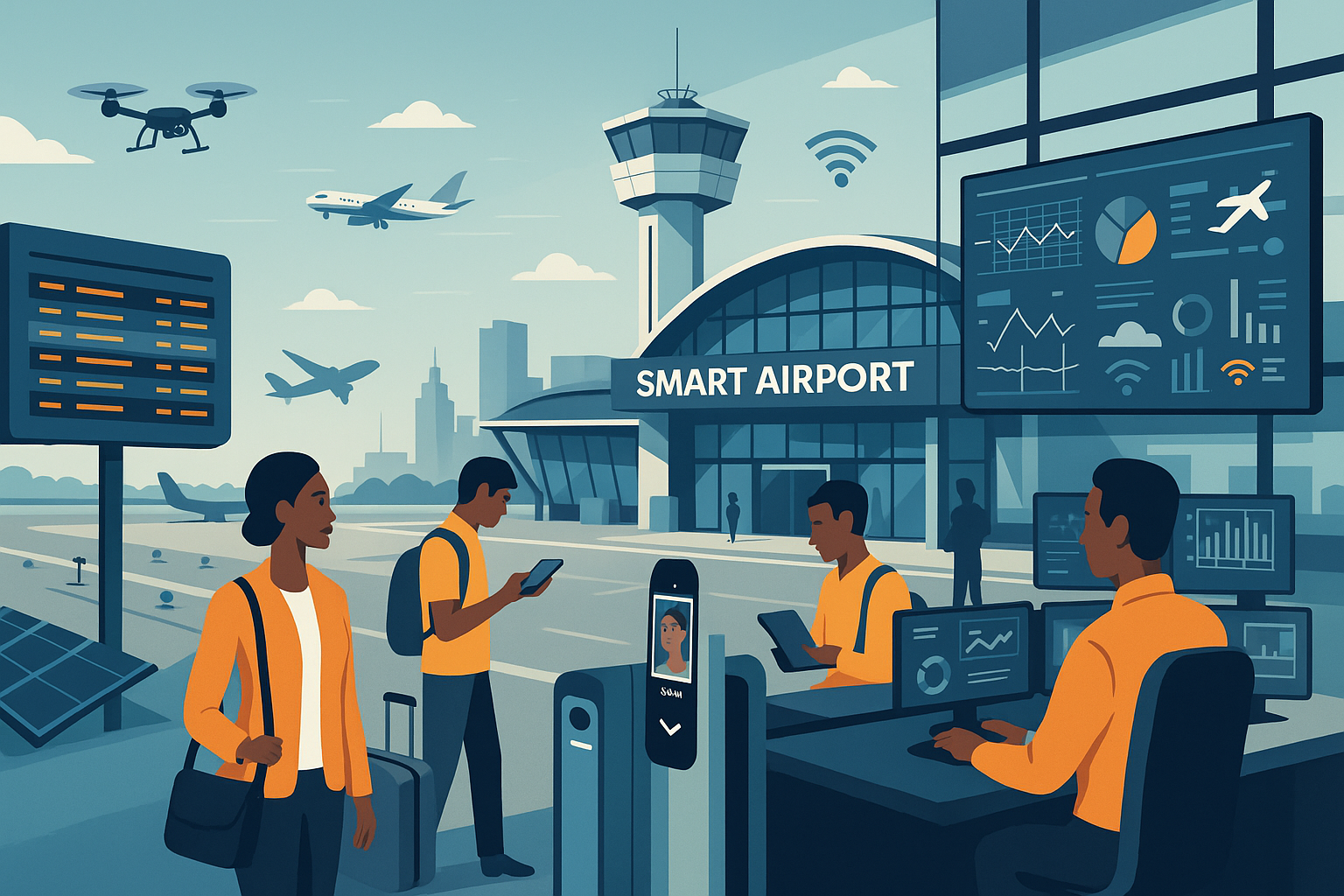
As Africa accelerates toward smart urban and transport infrastructure, aviation hubs like Lanseria International Airport have a critical opportunity to lead by example. Artificial Intelligence (AI) and digital infrastructure are not just enablers of operational efficiency—they are foundational to resilience, safety, sustainability, and inclusive economic development. This article explores how AI can transform airport ecosystems and adjacent communities, positioning them as anchors of smart cities.
From Runways to Smart Gateways
Historically, airports were treated as transit zones. Today, they are multi-modal nodes in the digital economy. In the context of Lanseria Smart City, the airport becomes the testbed for real-time intelligence, edge-based automation, and data-driven community services.
AI-infused aviation hubs can:
- Predict and manage risks (weather disruptions, delays, crowd flows).
- Personalize traveler experiences via facial recognition, chatbots, and real-time updates.
- Optimize energy and asset usage through intelligent resource scheduling.
- Support urban planning with mobility data from passenger flows.
A Digital Infrastructure Layer for Smart Aviation
To fully harness AI, airports require robust, interoperable digital infrastructure. This includes:
1. Edge Computing and IoT Meshes
- Smart cameras, drones, and embedded sensors to monitor tarmac, airspace, and facilities.
- AI models deployed at the edge for latency-sensitive applications like safety alerts.
2. Digital Twin Models
- Real-time simulation of the airport's infrastructure, enabling proactive maintenance, emergency drills, and capacity forecasting.
3. Open APIs for Ecosystem Integration
- Seamless data exchange between airport systems, airlines, emergency services, and city transport networks.
- Opportunities for local startups to build apps and services on top of airport data streams.
4. Cybersecurity and Trust Layers
- AI must be ethically governed, privacy-preserving, and secured by design.
Unlocking Economic Spillovers
A smart airport is a platform for regional growth, not a siloed asset. With the right data infrastructure and policies, Lanseria could:
- Incubate aviation-adjacent startups (drone logistics, agritech delivery, AI safety compliance).
- Serve as a training ground for digital skills in aviation, AI, and cybersecurity.
- Enable township entrepreneurs to plug into airport-linked markets (e.g., smart tourism services, food logistics).
What This Means for Policymakers and Airport Operators
- Embed AI into airport masterplans, not as a bolt-on, but as a strategic core.
- Open up procurement and integration frameworks to African SMEs and innovators.
- Promote cross-sector AI talent development—aviation, data science, infrastructure, and governance.
Conclusion
Africa’s aviation hubs are uniquely positioned to model what resilient, digitally inclusive infrastructure looks like. With Lanseria at the forefront, we can demonstrate how airports are not just gateways to cities—they are gateways to a smarter, more connected, and economically vibrant Africa.





