Every technology you use today exists because someone, somewhere, made a choice. In 1985, engineers chose how computers would represent numbers. In 1986, researchers chose how neural networks would learn. In 2017, a team at Google chose to bet on something called "attention mechanisms", a decision that would eventually give us ChatGPT and the generative AI revolution.
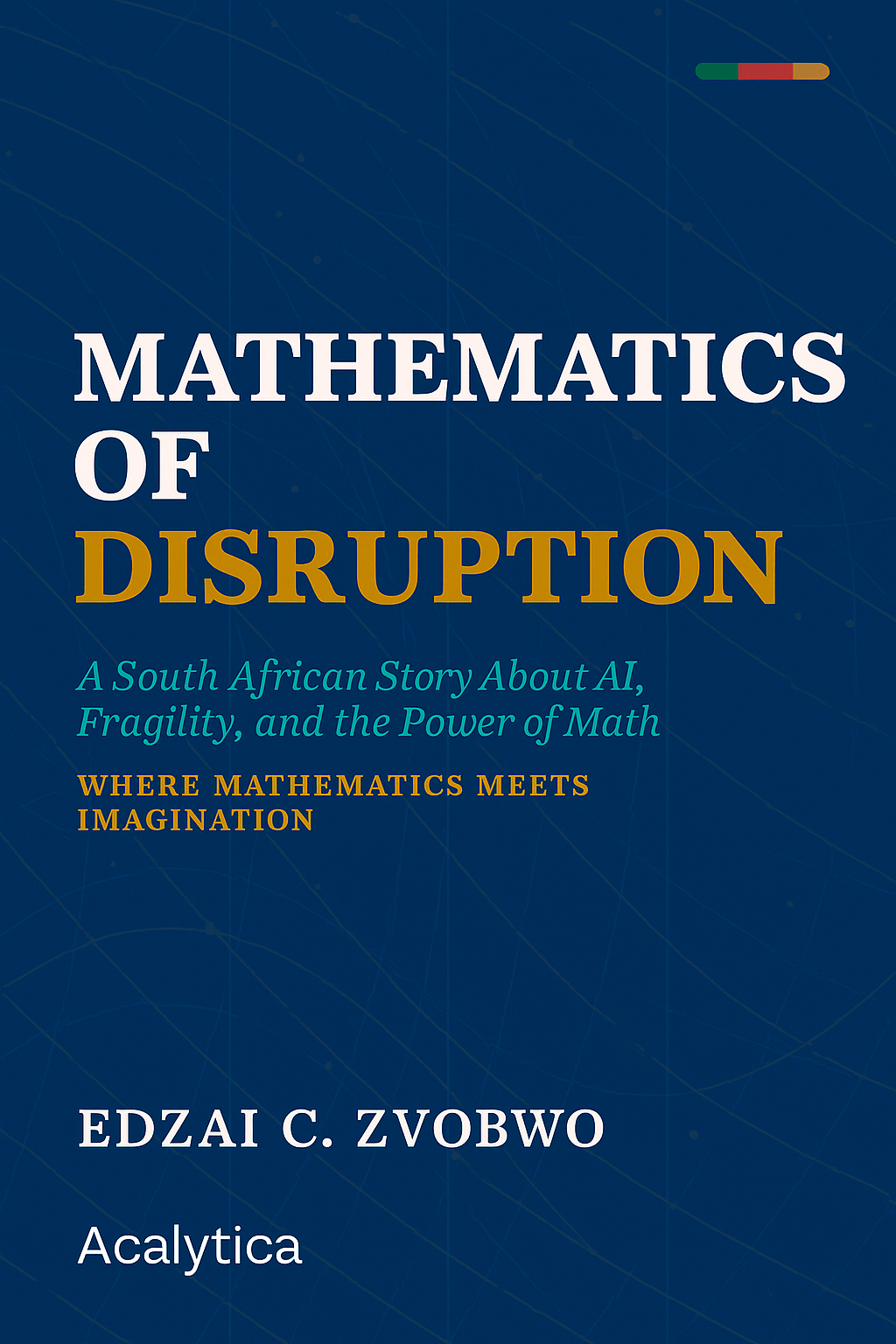
These weren't inevitable outcomes. They were choices. And according to Edzai Conilias Zvobwo, founder and CEO of Acalytica, Africa is running out of time to make its own.
"The foundations are being poured," Zvobwo declared in his new book Mathematics of Disruption: Building Africa's AI Age from First Principles. "Africa is not in the room."
But his message isn't one of despair. It was a provocation, and a blueprint.
The Fragile Foundations
Zvobwo's argument begins with an uncomfortable truth: the AI systems the world depends on are built on surprisingly shaky mathematical ground.
Consider something as basic as addition. In pure mathematics, (a + b) + c always equals a + (b + c). This is the associative property, a foundation of arithmetic that every schoolchild learns. But ask a computer to calculate (0.1 + 10²⁰) − 10²⁰, and you'll get 0.0. Reverse the order of operations to 0.1 + (10²⁰ − 10²⁰), and you'll get 0.1.
Same numbers. Different answers.
"Computers live in a cramped, rented apartment version of real numbers," Zvobwo writes. When GPUs process billions of these operations during AI training, tiny rounding errors compound unpredictably. The result? Models that behave erratically, consume excessive energy, and require constant retraining.
This isn't a minor technical footnote. It's a vulnerability, and potentially an opportunity. Alternative number systems like "posit arithmetic" could deliver more reliable AI with less computational overhead. For a continent where electricity is expensive and unreliable, this isn't abstract mathematics. It's a competitive edge waiting to be seized.
Six Choices That Could Change Everything
Mathematics of Disruption identifies nine "pillars" of mathematical knowledge that underpin modern AI, but six choices stand out as particularly consequential for African innovation:
The Optimisation Hike. Training an AI model is like hiking the Drakensberg mountains blindfolded, trying to find the lowest valley. Current methods, gradient descent and its variants, often get stuck in local minima or waste energy circling saddle points. Better optimisation algorithms could compress training times from weeks to days, letting African startups compete with Silicon Valley giants despite having a fraction of the compute budget.
Parrot or Scientist? Today's AI systems are sophisticated pattern-matchers. They can tell you that ambulances appear at accidents, but they can't reason about what would happen if you added more ambulances. The distinction between correlation and causality, captured in the equation P(Y|X) ≠ P(Y|do(X)), represents the frontier between AI that mimics understanding and AI that actually understands. For African policymakers grappling with complex questions about healthcare, energy, and agriculture, this isn't academic. It's essential.
Dignity Through Compression. The largest AI models contain hundreds of billions of parameters and require data centres to run. But information theory, Shannon's entropy equations, tells us that learning and compression are fundamentally the same thing. Models can be shrunk dramatically while retaining their capabilities. A Zulu language tutor that runs offline on a R1,000 phone. A crop disease identifier that works without cellular coverage. A legal aid chatbot accessible to anyone. Compression isn't just efficiency; it's dignity.
The City of Shapes. Data doesn't live in flat spreadsheets, it curves through high-dimensional spaces with complex geometries. Understanding these shapes through differential geometry and topology opens doors to drug discovery, protein folding, and problems that matter to African health systems.
The Arena of Agents. When multiple AI systems interact, whether trading on the JSE, managing Eskom's grid, or optimising taxi routes, game theory becomes essential. Understanding Nash equilibria and multi-agent dynamics lets you build systems that remain stable when deployed in messy, competitive, real-world environments.
The Advantages of Disadvantage
Here's where Zvobwo's argument takes an unexpected turn. The very challenges that have held Africa back, load-shedding, data scarcity, limited computational resources, might actually be advantages in disguise.
"Silicon Valley builds for stability," he argues. "We build for the real world."
Consider what the global market increasingly needs: AI that functions when power is intermittent. AI that learns from sparse, noisy data. AI that runs on cheap hardware. AI that serves the five billion people who don't live in wealthy, stable, well-connected societies.
African researchers and engineers have been solving these problems out of necessity. The question is whether they'll package those solutions for export, or continue importing AI systems designed for conditions that don't exist on the continent.
South Africa, Zvobwo suggests, is uniquely positioned to lead. It has research institutions capable of fundamental work. It has eleven official languages that demand multilingual AI approaches. It has hard problems, in energy, healthcare, finance, and governance, that could drive innovation. It has a startup ecosystem, however nascent. And it has something else: a philosophical tradition that might prove unexpectedly valuable.
Ubuntu AI: Ethics as Competitive Advantage
The book's ninth pillar is perhaps its most provocative: Ubuntu AI.
"I am because we are." The Southern African philosophy of ubuntu emphasises collective benefit, transparency, inclusivity, dignity, and sustainability. To Western ears, this might sound like corporate social responsibility, nice to have, but peripheral to the real work of building AI.
Zvobwo disagrees. He points to the regulatory tsunami building in Europe, the UK, and increasingly the United States. Governments are demanding exactly what ubuntu provides: AI systems that benefit communities rather than just shareholders, that operate transparently rather than as black boxes, that include rather than exclude, that preserve human dignity rather than eroding it.
"Ubuntu values align with what EU, UK, and US regulators now demand," he writes. "This isn't just ethics, it's a competitive advantage."
African AI companies that embed these values from the start won't need to retrofit them later to satisfy regulators. They'll be ahead of the curve, not scrambling to catch up.
The Call to Action
Mathematics of Disruption ends not with abstract theorising but with concrete demands.
For business leaders: Partner with universities. Invest in local talent. Build for Africa first, then export. "Don't buy AI," Zvobwo urges. "Build it."
For researchers: Study mathematics deeply. Work on African problems. Collaborate across disciplines. And critically: "Publish AND implement." Papers that sit in journals don't change anything.
For policymakers: Fund mathematics education at every level. Support foundational research, not just applied projects. Create conditions that retain talent rather than exporting it. And regulate with values, specifically, African values.
"We have the minds," Zvobwo concludes. "We have the problems. We have the values. Now we need the will."
The Fork in the Road
There's a stark image near the end of the presentation: a fork in the road. One path leads to being "on the menu", a passive consumer of AI systems designed elsewhere, for others, encoding others' values and priorities. The other path leads to being "at the table", an active participant in shaping the technology that will define the 21st century.
The mathematics, Zvobwo insists, doesn't care where you're from. The theorems work the same in Stellenbosch as in Stanford, in Lagos as in London, in Nairobi as in New York. The question isn't whether Africans can master these ideas, history suggests they can and will, but whether they'll choose to do so in time to matter.
Every great technology was once a choice someone made. The AI that will transform healthcare, agriculture, education, and governance across Africa over the coming decades doesn't exist yet. Its foundations are being poured right now, in research labs and startups and policy offices around the world.
The question is whether Africa will be in the room when those choices are made, or left to live with the consequences of choices made by others.
Mathematics, Zvobwo argues, gives Africa the power to choose.
The rest is up to Africans.
Mathematics of Disruption: Building Africa's AI Age from First Principles by Edzai Conilias Zvobwo is available now.





