You can join the livestream on the 30th of June 2026 at 15:00 SAST on these links:
YouTube: https://youtu.be/0WH-G7vhQU0
FaceBook: https://www.facebook.com/events/1173578648268646
LinkedIn: https://www.linkedin.com/event/manage/7477608130378502144/
There is a story we keep being told about artificial intelligence. It goes like this: the future is already written. Models will get bigger, compute will get more expensive, the leaders will keep leading, and the rest of us, especially those of us in the Global South, will adapt, consume, and try to keep up. AI, in this telling, is less a set of decisions than a force of nature. Something happening to us.
I don't believe that story. And the more time I spend with the mathematics underneath these machines, the more convinced I am that it is not just wrong. It is the most disempowering thing we could possibly believe about technology.
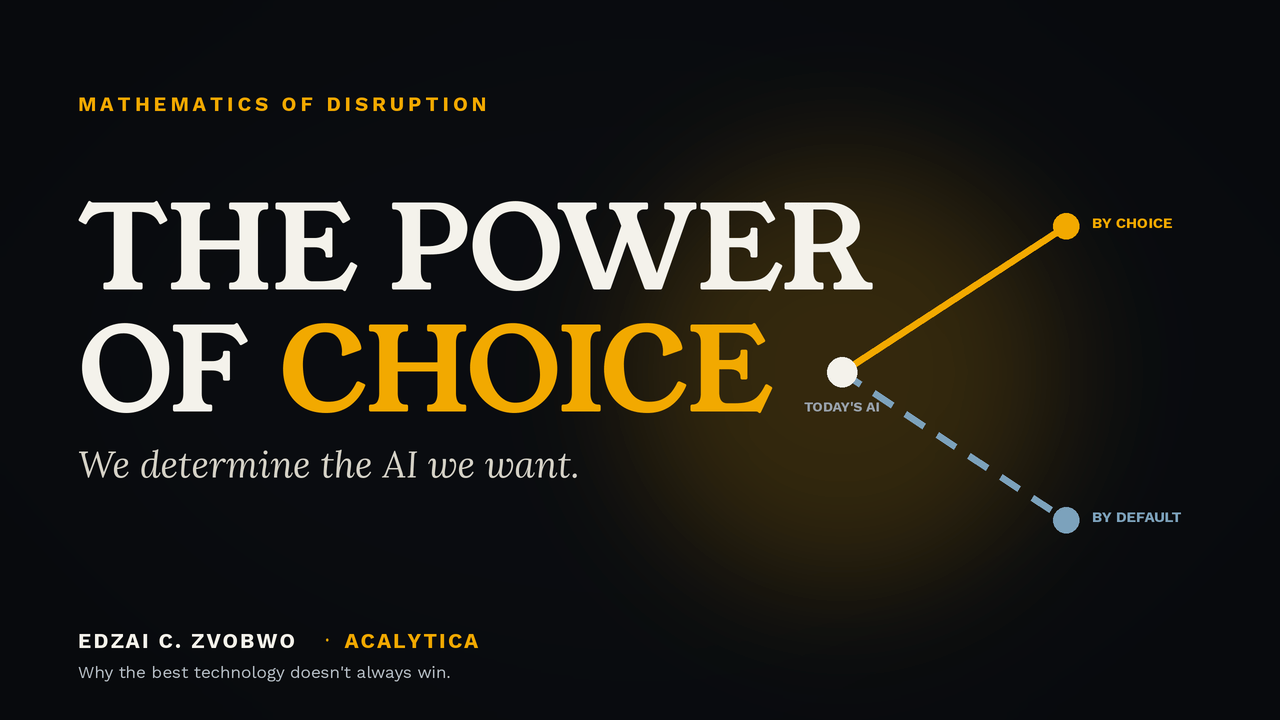
This is the argument I make in my book Mathematics of Disruption, and it is the heart of a talk I have been giving under a deliberately stubborn title: The Power of Choice, We Determine the AI We Want.
The fallacy of inevitability
Watch how today's AI gets discussed and you will notice the language of destiny everywhere. "It's just progress." "Bigger is always better." "Resistance is futile." Each phrase quietly converts a series of human choices into a law of nature. And once something feels inevitable, you stop asking who decided, who benefits, and whether it could have gone another way.
But every "inevitable" technology was once a contested choice. The winners did not always win because they were best. They won because they were better funded, better marketed, better connected, because the ecosystem, the capital, and the politics lined up behind them. If "the best wins" were actually true, the history of technology would be a much shorter and stranger book.
When the better technology lost
Consider the War of the Currents. In the late 1800s, Thomas Edison, the most famous inventor alive and backed by serious money, championed direct current. Nikola Tesla and George Westinghouse backed alternating current, which could be stepped up through transformers and carried over long distances. AC genuinely suited the grid of the era. But the fight was not settled by a calm comparison of physics. Edison ran a fear campaign, staging public electrocutions and promoting the AC-powered electric chair to brand his rival's technology as deadly. The "settled" verdict was decided as much by showmanship and capital as by engineering.
And here is the twist that should unsettle anyone who thinks these matters are ever truly closed: direct current never went away. Today it powers data centres, solar arrays, batteries, USB, and electric cars, and high-voltage DC now carries electricity further than AC ever could. The "loser" was never wrong. It was just outspent at the moment that mattered.
The pattern repeats. Sony's Betamax had the sharper picture and the better build, but JVC's VHS won the home-video war with longer recording time, lower prices, and open licensing. The ecosystem beat the engineering. Two decades later, Blu-ray defeated the technically comparable HD-DVD, not on disc quality but on the back of the PlayStation 3's install base and a single studio's decision to switch sides. And you are almost certainly reading this on a QWERTY keyboard, a layout originally arranged to slow typists down and stop mechanical typebars from jamming. The reason for it vanished generations ago. We kept it anyway, because everyone had already learned it. That is not merit. That is lock-in.
Even science has its orthodoxies
It would be comforting to think that science, at least, is immune, that research follows evidence wherever it leads. It mostly does, eventually. But it has fashions and orthodoxies too, and they can suppress the right answer for a long time.
The neural networks behind today's AI boom were once the heresy. Early excitement in the late 1950s gave way, by the end of the 1960s, to an influential critique that helped freeze funding and ushered in an "AI winter". The respectable, well-resourced science of the day moved on to other approaches. Neural networks survived for years on the stubbornness of a handful of researchers who refused to accept that the door was closed. Then backpropagation revived them in the 1980s, and by 2012 deep learning had won decisively. The "dead end" became the mainstream.
The lesson is uncomfortable and liberating in equal measure: consensus is not the same as correctness. The future often hides inside the idea the field has dismissed.
So what about AI today?
Here is where the historical argument stops being a history lesson and starts being a provocation. If the technologies we treat as permanent were really contingent choices, why would today's AI be any different?
It isn't. The machines we use now rest on decisions made under commercial pressure: efficient, profitable, entrenched, and far too rarely questioned. Take two foundations we treat as bedrock.
The first is floating-point arithmetic. To gain speed, computers abandoned the exactness of real numbers and accepted that they can only land on certain values, leaving gaps in between. A consequence is that even basic arithmetic stops being reliably associative. Group a long sum one way and you get one answer, group it another way and you get a slightly different one. Stack billions of these operations, batch many users' requests together for efficiency, and even a model set to "temperature zero" can drift to a different word a hundred tokens in. That is not the machine being creative or mysterious. It is the shadow of a trade-off we chose for performance, not a property of the universe.
The second is how we train models at all. Gradient descent is, in plain terms, stumbling downhill through a rugged landscape while blindfolded, feeling for the steepest direction one cautious step at a time. The tricks that make it work, like momentum and adaptive learning rates, are, as I argue in the book, heuristics without guarantees. Modern AI is, to put it bluntly, balanced on hacks. Useful hacks, brilliant hacks even, but hacks we have simply stopped interrogating.
And the moment you see these as choices rather than laws, the alternatives come into view. Posit arithmetic and resilient, low-power computation instead of fragile floating-point. Second-order methods and convex reformulations instead of guesswork. Causal inference, reasoning about interventions, instead of models that merely predict from correlations and break the moment the world shifts. Compression and minimum-description-length thinking instead of bloated models that memorise, so that powerful AI could run on a modest phone.
Geometry and topology to make models robust by design. Category theory to replace a patchwork of heuristics with compositional blueprints. None of these is science fiction. They are roads the mathematics already offers, roads we are told do not exist.
Why this is the Global South's opening
This is the part that matters most to me as a South African. You cannot out-spend Silicon Valley on compute. If AI's future is only about who can buy the most chips, then the contest is over before it begins and we should all go home.
But disruption does not live in the hardware. It lives in the mathematics. A single breakthrough in optimisation or compression rewrites the economics of AI overnight, and a mathematical idea is available to anyone who understands the foundations. Chips age, prices shift, vendors rise and fall. Mathematics is permanent. A startup in Khayelitsha that masters the principles could, in time, train models as efficiently as a giant in California.
That is what I mean by mathematical sovereignty: those who understand the foundations of AI get to shape its future, while those who only consume it stay dependent. And South Africa is not short of the ingredients. We have world-class mathematics and physics at Wits, UCT, Stellenbosch and beyond. We have the Square Kilometre Array in the Karoo, a frontier-science project demanding computation at the very edge. We have eleven official languages, a natural laboratory for language AI that no other country can replicate. We have urgent, real problems like load-shedding, water, health and transport that turn our constraints into research advantages, because the AI that works when the power is out and the data is scarce is exactly the AI most of the world actually needs.
A different compass
There is one more choice, and it sits beneath all the technical ones: what we want this technology to be for. How AI should serve people is not a default that ships in the box. It is decided.
I believe it should be decided with Ubuntu in mind: I am because we are. That means collective benefit over pure extraction, transparency so communities can understand the decisions made about them, inclusivity across every language and income level, dignity that empowers people rather than replacing them, and sustainability that respects real energy limits. While others build AI for extraction, we can choose to build it for flourishing. That is not only an ethic. In a world hungry for trustworthy technology, it is a competitive advantage.
The question I will leave you with
In the book, the AI itself, "The Machine", gets the last word, and it is a question rather than an answer: Will you build me with wisdom, or will you let others build me for you?
The future of AI does not have to be written elsewhere. We have the minds. We have the problems. We have the values. What remains is the will, and the choice. The story of inevitability only holds power for as long as we agree to believe it. I, for one, do not.
Edzai C. Zvobwo is a mathematician, data scientist and the founder of Acalytica. His book Mathematics of Disruption: A South African Story About AI, Fragility, and the Power of Math is out now. Follow @edzaizv for more on AI, mathematics and the economy of ideas.





