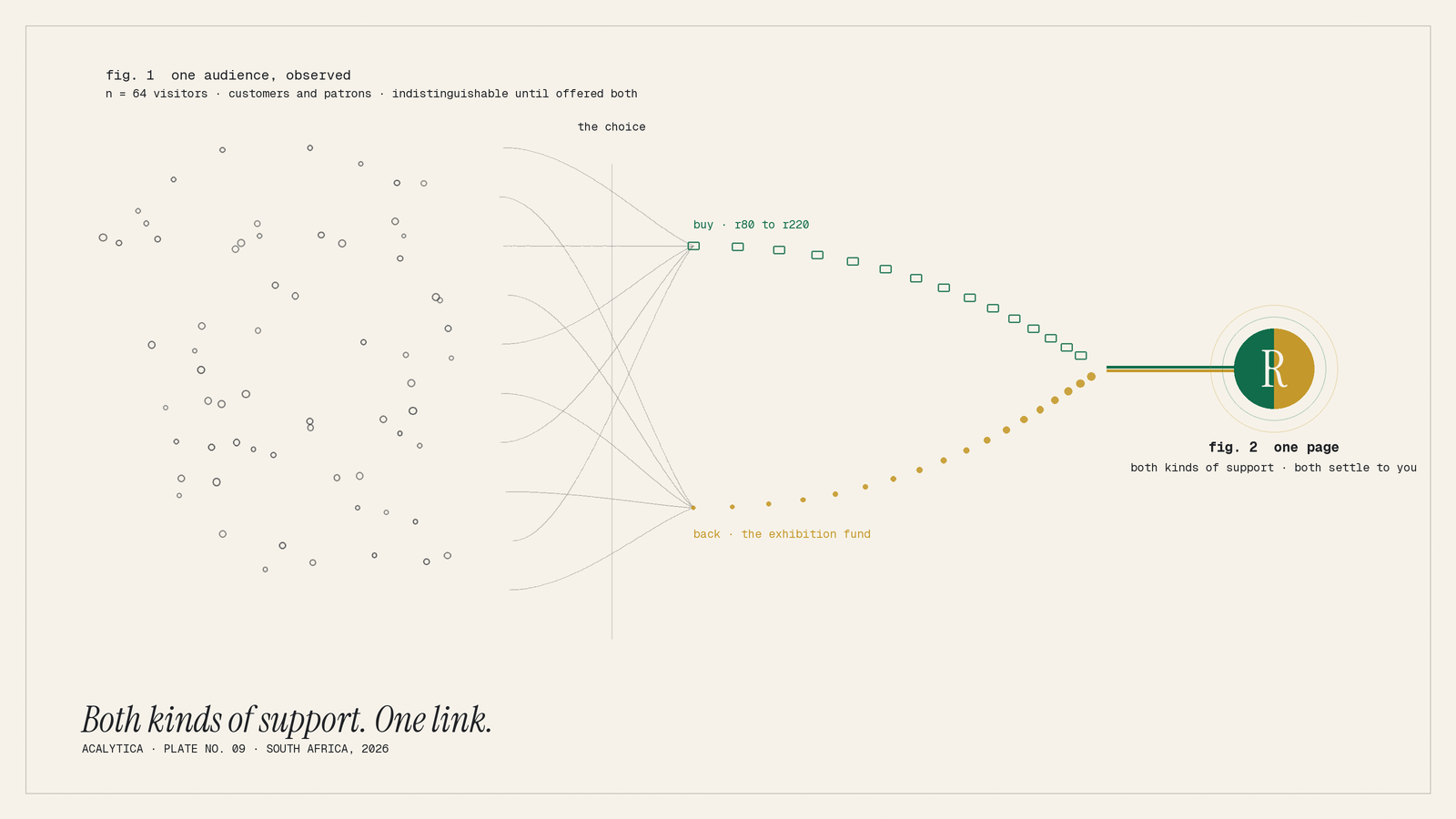
Every working creator knows the two audiences. There are the customers, the people who want the thing: the print, the preset pack, the beat, the pattern. And there are the patrons, the people who want you to keep going: the aunt who shares every post, the follower who has bought nothing but comments on everything, the fan who would happily chip in for your next exhibition if you ever gave them a way to.
Most creators build for the first audience and quietly starve the second. The bio link goes to a shop, the shop speaks only to buyers, and the person who just wanted to back you stands in a store with nothing to do. Meanwhile, the creators who go the other way and run a pure fundraiser leave the opposite money on the table: the visitor who does not want to donate but would gladly have paid R120 for the wallpaper pack, if only it existed.
The hybrid page serves both, from the same link, without either audience feeling like they walked into the wrong room. It is the thing a plain shop cannot do, a donation platform cannot do, and a standard link-in-bio cannot do, and it is the single most Acalytica-shaped idea in this whole series.
What a hybrid page looks like
Picture an illustrator's page at acalytica.com/naledidraws. At the top, her name, her face, three lines about her work. Then a fundraising block: "Help me stage my first solo exhibition — R18,000 for framing, printing and venue," with a live progress bar sitting at R11,340. Below it, her shop: the prompt guide at R150, the phone wallpaper pack at R80, three print files at R220 each. Then her socials and a mailing list signup.
A visitor arrives from her TikTok and self-selects in seconds. The buyer scrolls to the prints. The patron taps donate. The undecided sees that R80 is a way to get something and help, because every sale funds the same artist the fundraiser is for. Nobody is asked to be someone they are not, and both kinds of support settle into the same bank account through her own payment gateway.
The same shape works across creative fields. A musician sells beats and licences while funding studio time for the album. A crafter sells PDF patterns while sponsoring materials for her community workshop. A photographer sells presets while raising for a documentary project. A writer sells the first novella while funding the print run of the second. In every case the formula is identical: products for the customers, a project for the patrons, one page for both.
Why it works: supporters self-select
The deep reason the hybrid page outperforms is psychological, not technical. Asking a customer to donate feels like a tip jar shoved forward, and asking a patron to buy feels like a toll gate on their goodwill. Each request lands wrong on the wrong person. But offering both, side by side, converts the ask into a choice, and choices flatter people rather than pressuring them. The patron gets to be a patron. The customer gets to be a customer. The fence-sitter gets the R80 option that is a little of each.
There is a second effect that surprises creators the first time they see it: the fundraiser sells products. A visible project ("the exhibition is at 63%") tells every shop visitor that this is a working artist mid-journey, not a faceless store, and people buy more from journeys than from catalogues. The progress bar is social proof for the whole page.
Setting up your hybrid page
Lead with whichever ask is live. If the exhibition fund is the campaign of the season, the fundraising block goes above the shop. Between campaigns, the shop leads and a quieter "support my work" block sits below it. The page reorders in a minute, so match it to the moment.
Frame the fund as a project, not a plea. "Fund my next body of work" outperforms "support me" because patrons back outcomes. Name the project, the number and what it unlocks: "R18,000 stages the exhibition; anything past it prints the catalogue." Specificity is what patrons repeat when they share.
Price the bridge product deliberately. Have one item at pocket-money level, R50 to R100, that fence-sitters can buy as a de facto donation with a souvenir attached. Wallpapers, a mini print file, a sample pack. It will quietly become one of your best sellers.
Let donors leave with something. Attach a small digital thank-you to donations: a wallpaper, a voice note, a behind-the-scenes PDF, work-in-progress shots from the very project they funded. It costs nothing per donor and closes the loop between giving and getting. We cover this mechanic fully in its own guide.
Update the page like it is alive. When the bar moves, post. When a product funds a milestone, say so: "This week's print sales covered the framing." Connecting the shop to the project in public is what makes the hybrid feel like one story instead of two blocks.
The caption formula that carries both
Your content does not need to split in two. One caption structure carries the whole page: the work, the project, the path. "New print just went up (link in bio). Every sale gets the exhibition closer — we're at 63%." One sentence sells, one sentence funds, one link serves both. On Stories, alternate the framing: some days the sticker points at the product, some days at the bar, always at the same page.
When not to hybrid
Honesty requires the caveat: if you run a registered NPO where donations may have tax or governance implications, keep the organisation's fundraising page separate from any personal selling, and take advice on receipting. And if you have no live project, do not manufacture one; a shop with a vague "support me" block outperforms a fake campaign. The hybrid earns its power from a real project with a real number, so run it when you have one and rest it when you do not.
One link, both kinds of support
You already have both audiences; your comments prove it every week. The only question is whether your one link gives each of them something to do. Set up the shop, name the project, put the bar on the page, and let your people choose how they carry you.
Create your free page on Acalytica, add your products and a fundraising block, and share one link that works for customers and patrons alike. For pricing your products, see our guide to pricing in Rands; for running the campaign side well, see the complete guide to crowdfunding in South Africa.





