Introduction
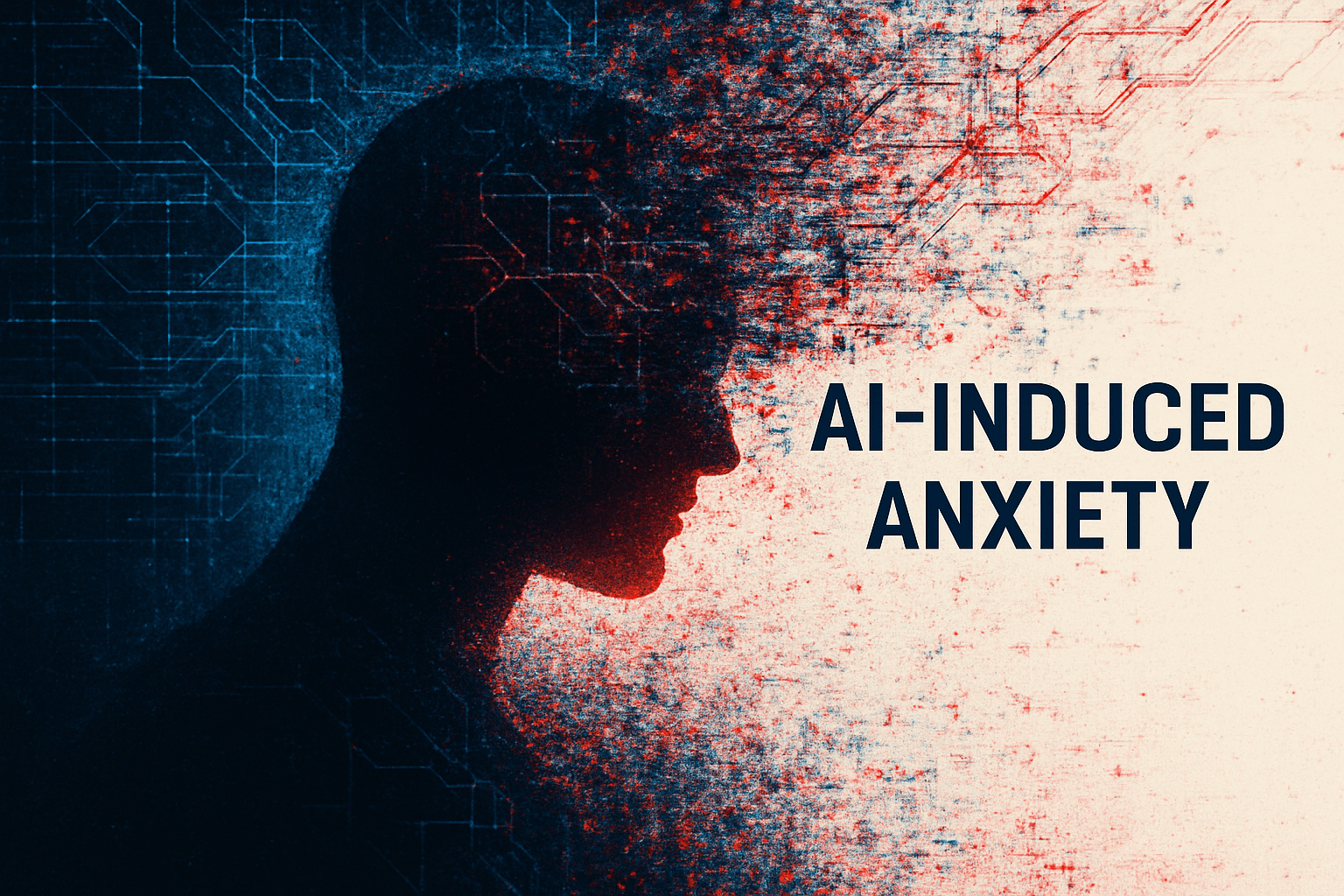
The world's most underestimated side effect of artificial intelligence isn't job loss, it's psychological erosion. AI-induced anxiety is spreading through professional circles faster than automation itself. It's the quiet tension behind every "learn AI or get left behind" headline, the sleeplessness of those unsure whether their skills, or their sense of worth, will survive the algorithmic century.
The Cognitive Disruption
Human brains evolved for pattern stability. We function best when we can map cause to effect and feel that our choices influence outcomes. AI dismantles this symmetry. Its decisions emerge from hidden layers no one fully interprets. The result is cognitive vertigo: the mind loses grip on predictability.
People start to overcompensate, refreshing feeds, chasing tutorials, hoarding tools. Anxiety doesn't stem from AI's power but from its opacity. The less we understand why it acts, the more we fear what it might replace. When comprehension declines, control collapses.
The Emotional Undercurrent
Beneath the intellectual fear lies a deeper emotional one: am I still relevant? AI-induced anxiety isn't just fear of job loss, it's fear of identity loss. For decades, professional pride has been tethered to human advantage: memory, pattern recognition, writing, analysis. AI now mirrors and scales these abilities, triggering subtle identity dislocation.
The emotional sequence follows a consistent pattern: exposure to AI → comparison → inadequacy → compulsive upskilling → exhaustion. This is not progress; it’s panic disguised as productivity. Women, minorities, and emerging-market professionals experience this more acutely, where competence has historically required over-performance just to achieve parity.
The Social Amplifier
Anxiety compounds through social channels. Every week, a new "AI success story" circulates on LinkedIn: someone automating workflows, generating clients, writing books overnight. Social media now functions as an anxiety multiplier, glorifying technological fluency while quietly shaming those who haven't caught up.
This creates a behavioural paradox: individuals feel pressured to adopt AI but paralysed by the pace of change. Communities lack shared psychological safety norms for discussing AI uncertainty. Instead of collaborative adaptation, we get silent comparison loops.
The Economic Illusion
Economically, the fear of automation exceeds the actual displacement rate. Yet fear operates on perceived risk, not empirical probability. The more automation promises efficiency, the more individuals anticipate redundancy. The survival instinct shifts from improving at one's craft to staying ahead of the algorithm.
This leads to what economists call defensive learning, rapid, unstrategic skill accumulation without coherence or mastery. People enrol in AI courses they'll never finish, experiment with tools they don't integrate, and confuse adaptation with panic.
The Structural Solution: Cognitive Hygiene
AI anxiety won't be cured by motivational slogans about "embracing the future." The antidote is cognitive hygiene, the discipline of restoring causal understanding. Professionals must learn not only how to use AI but how it reasons, fails, and optimises.
Key shifts:
- From tool fluency to AI fluency: understanding objectives, data sources, and bias mechanics.
- From automation addiction to agency discipline: using AI to amplify judgment, not outsource it.
- From comparison culture to collaborative learning: building peer groups that discuss uncertainty without stigma.
This is where responsible platforms and employers must intervene. Embed explainability into every interface. Make "why" as visible as "what." Reward comprehension, not speed.
The Philosophical Core
AI-induced anxiety exposes a timeless truth: humans need to understand the systems that govern their lives. When knowledge becomes probabilistic and opaque, anxiety becomes rational. Our emotional architecture wasn't built for stochastic governance; it was built for cause and effect.
To adapt, society must treat mental stability as infrastructure. AI literacy is not just a career skill, it's a civic defence mechanism. Emotional safety is the new cybersecurity.
The Final Equation
Anxiety = Uncertainty ÷ Perceived Control.
AI accelerates uncertainty exponentially, but control hasn't scaled with it. Until we rebuild cognitive transparency and restore human agency within the loop, anxiety will shadow every breakthrough.
Conclusion
AI isn't making humans anxious because it's powerful. It's making us anxious because it's opaque, fast, and indifferent to meaning. The solution is not to slow AI but to deepen human understanding. Clarity, not comfort, is the real therapy.





