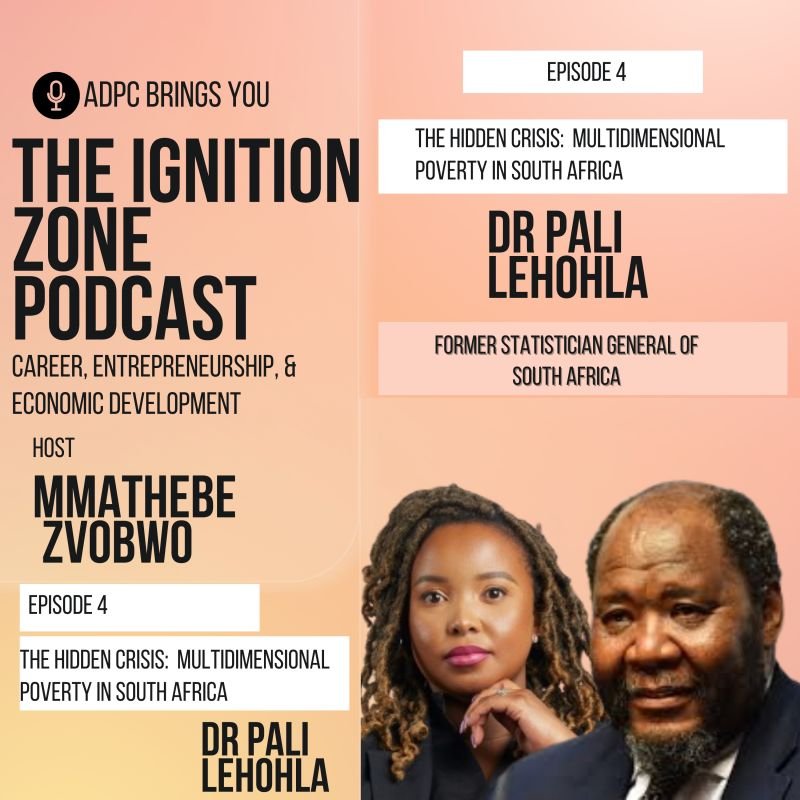
Welcome to a problem so big, yet so ignored, that it might as well be the elephant in the room—except this one is invisible unless you know how to look. Poverty isn’t just about money. It’s about being trapped. It’s about having no way out. And it’s not just about individuals—it’s about the entire system that keeps people locked in place. That’s what Dr. Pali Lehohla, former Statistician-General of South Africa, lays out in his discussion on The Ignition Zone Podcast. And if you think it’s just about a lack of jobs, well, sit tight. The rabbit hole goes much deeper.
What Is Multidimensional Poverty Anyway?
Most people think about poverty in one way: not having enough money. That’s easy to measure, easy to think about, and easy to ignore. But Dr. Lehohla argues that this perspective is about as useful as measuring intelligence by how well someone plays chess. The real problem is bigger. It’s messier. And it doesn’t fit neatly into one number.
Instead of just looking at income, multidimensional poverty looks at what a lack of money actually does to a person’s life. It includes four key dimensions in South Africa:
- Employment – No job, no economic mobility. Simple, right? Not so fast.
- Social indicators – No access to clean water, electricity, or sanitation. Imagine waking up every day with no running water and then being expected to compete in a modern economy.
- Health – If kids under five years old in a household keep dying, something is fundamentally broken.
- Education – If you don’t have education, you don’t get skills. If you don’t get skills, you don’t get jobs. And if you don’t get jobs, well, see point #1.
Now, here’s where things get really interesting. When South Africans were asked what they thought the biggest problems were, education ranked number 15. That’s right. Not even in the top ten. But when statisticians actually measured the data, they found that education is the second biggest driver of poverty, right after unemployment. This means that what people think the problem is and what the data shows don’t match up. And that’s a serious problem.
The Disconnection: Perceived Needs vs. Reality
Dr. Lehohla lays out an uncomfortable truth: People tend to focus on immediate problems—things like the cost of electricity and unreliable water—while the biggest long-term problems, like education, get ignored. And when politicians campaign, they don’t talk about education, because people don’t demand it. This cycle ensures that the very thing that could pull people out of poverty remains broken.
Consider this: In the early 1950s, a South African Parliament member asked, “What is the use of teaching a Bantu child mathematics?” That single question set the tone for decades of systemic educational neglect. But here’s the kicker—Indians in South Africa reacted differently to this environment. They prioritised education and built strong community support structures. And guess what? Today, 80% of Indian South Africans move on to tertiary education. For Black South Africans? Less than 12%. That’s not a coincidence. That’s a policy consequence.
The System is Rigged—And It’s Rigged in Plain Sight
Let’s talk money. South Africa has massive inequality, and it shows up in income distribution:
- 73% of white South Africans are in the top 10% of income earners.
- 40% of Indian South Africans make it into that category.
- 20% of Coloured South Africans.
- And only 15% of Black South Africans.
It gets worse. Even though Black South Africans now hold more total buying power than White South Africans (62% vs. 38%), that money flows right back into white-owned businesses. The big chain stores, the private service providers, and the entire economic infrastructure are designed in a way that wealth does not circulate within Black communities.
What does this mean? It means that even when people spend money, they’re reinforcing the same inequalities that keep them in poverty. It’s a closed-loop system.
How Do We Fix This?
Dr. Lehohla doesn’t just point out the problem—he suggests solutions. One of the boldest ideas? Turn government grants into investment capital. Right now, social grants prop up households, but they don’t build wealth. If that money was structured to support businesses and entrepreneurship, it could create a cycle of reinvestment instead of dependency.
Another solution? Stop pretending GDP is the answer. South Africa’s finance ministers love to talk about GDP, but GDP doesn’t measure who benefits from economic growth. If a country’s GDP goes up, but unemployment and poverty get worse, what’s the point? If we don’t start measuring things like multidimensional poverty reduction, we’ll just keep playing an economic shell game where everything looks fine on paper but is broken in reality.
Final Thoughts: A Wicked Problem Needs a Smart Solution
South Africa isn’t failing because of a lack of resources. It’s failing because of how those resources are distributed and utilised. Education is neglected. Employment is unattainable. Money is spent but not reinvested. And most importantly, people’s perceptions don’t match reality.
Dr. Lehohla’s conversation is a wake-up call. If we want to solve poverty, we need to stop looking at it as a simple income issue and start tackling the multidimensional system that sustains it. We need policies that reflect reality, not political talking points. And most of all, we need to stop pretending that we can fix a problem if we refuse to understand what it really is. The numbers don’t lie. The question is—will we listen?





