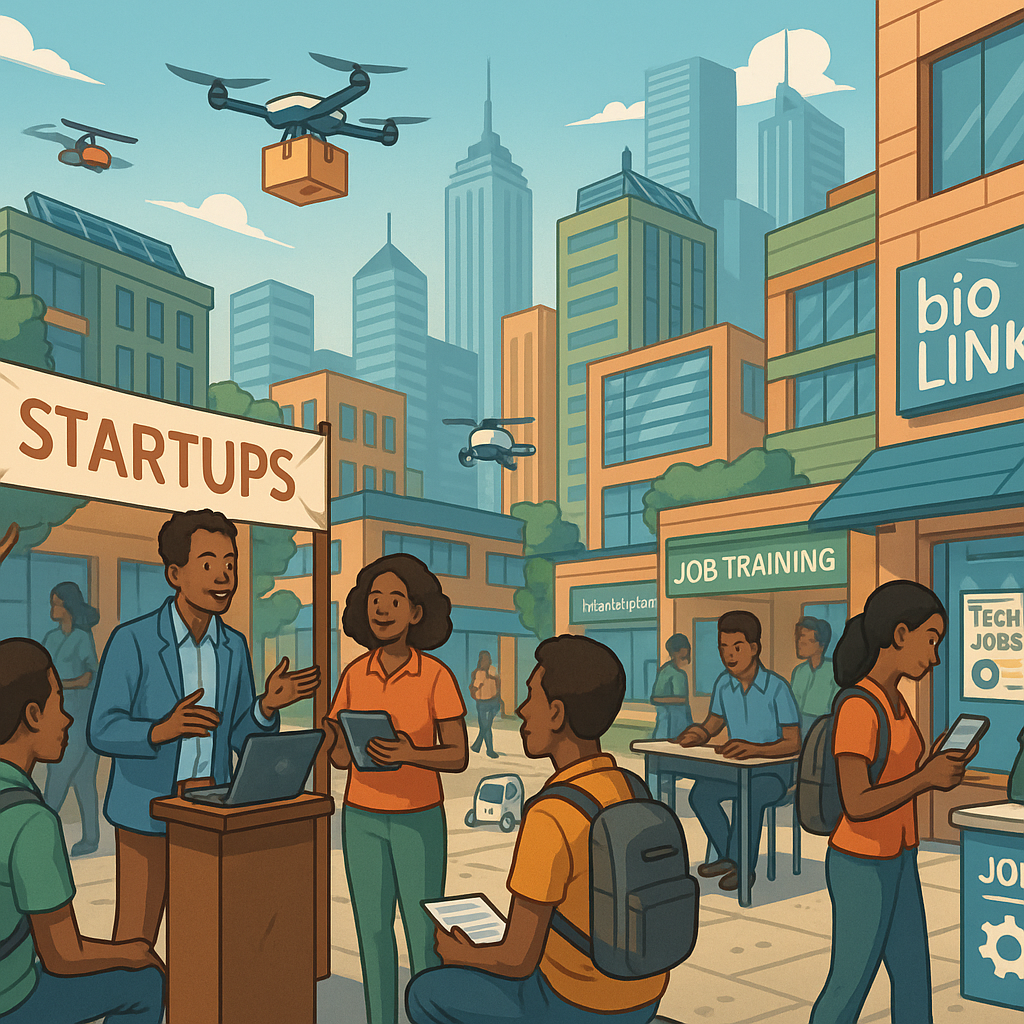
In Africa, urbanization and digital transformation are converging. As cities like Lanseria evolve into smart, tech-enabled ecosystems, they hold the potential to become economic accelerators—platforms for job creation, entrepreneurship, and inclusive growth. The smart city conversation must therefore go beyond efficiency and connectivity to focus on how these cities can generate livelihoods, support microenterprises, and catalyze startup ecosystems at scale.
Smart Cities as Engines of Economic Growth
Too often, smart cities are treated as infrastructure projects rather than economic systems. Fiber, 5G, and sensors are enablers—but they do not create value on their own. Value emerges when infrastructure unlocks new markets, entrepreneurial opportunities, and employment pathways for ordinary people.
A truly smart city must:
- Enable small businesses and informal traders to digitize operations.
- Connect startups to municipal procurement and data.
- Support the rise of entirely new job categories across transport, energy, health, and governance sectors.
Nurturing Startup Ecosystems in Smart Cities
Each sector of the smart city—transport, housing, energy, sanitation—presents unmet needs that local startups are best positioned to solve. Cities must move from being service providers to platform builders, enabling innovators to create value on top of public systems.
To support this, cities like Lanseria should:
- Provide access to open municipal datasets to fuel local innovation.
- Build digital marketplaces where township businesses can transact with broader audiences.
- Establish urban innovation zones that serve as living labs for tech startups.
- Offer catalytic grants or microfinance linked to solving urban problems.
Startups thrive not just on capital, but on access to real users, feedback loops, and integration with public services. The smart city must be their proving ground.
Jobs of the Urban Digital Future
Smart cities are already generating a new breed of jobs that blend physical and digital work. For instance, drone operators are needed for deliveries and inspections, IoT technicians for maintaining connected infrastructure, and data analysts to interpret smart grid or mobility data.
Less obvious but equally vital are platform sellers who build digital storefronts, content creators for civic education apps, and AI compliance professionals ensuring ethical use of data. These roles require hybrid skills across technology, local context, and service delivery.
To meet demand, cities must invest in digital upskilling—through TVET institutions, community learning hubs, and online credentialing tied to smart city sectors. Employment in smart cities must not be an afterthought—it must be a design principle.
Lanseria: A Testbed for Aviation-Driven Economic Models
With Lanseria International Airport as its nucleus, this smart city can evolve into a regional economic engine. Opportunities abound to:
- Build drone logistics corridors that serve both urban and rural markets.
- Foster tourism-based microenterprises supported by digital booking and payment systems.
- Attract aerospace and transport startups to co-locate in innovation zones.
- Use airport-linked vocational programs to train technicians, engineers, and digital platform workers.
Lanseria’s model can pioneer a fusion of physical infrastructure and digital opportunity that few cities globally have managed to achieve.
What Policymakers Must Do
For smart cities to reach their economic potential, governments and municipalities must:
- Integrate job creation goals into every infrastructure rollout.
- Fund innovation hubs and co-working spaces within new urban districts.
- Create incentives for public procurement to include startups and township-based SMEs.
- Build strong public-private training programs to align talent pipelines with smart city needs.
Conclusion
A smart city without inclusive economic development is a missed opportunity. Africa must seize the smart city wave not just to connect people—but to employ, empower, and uplift them. Cities like Lanseria can lead the way, not by copying the West, but by showing the world how to build cities of dignity, creativity, and opportunity.





