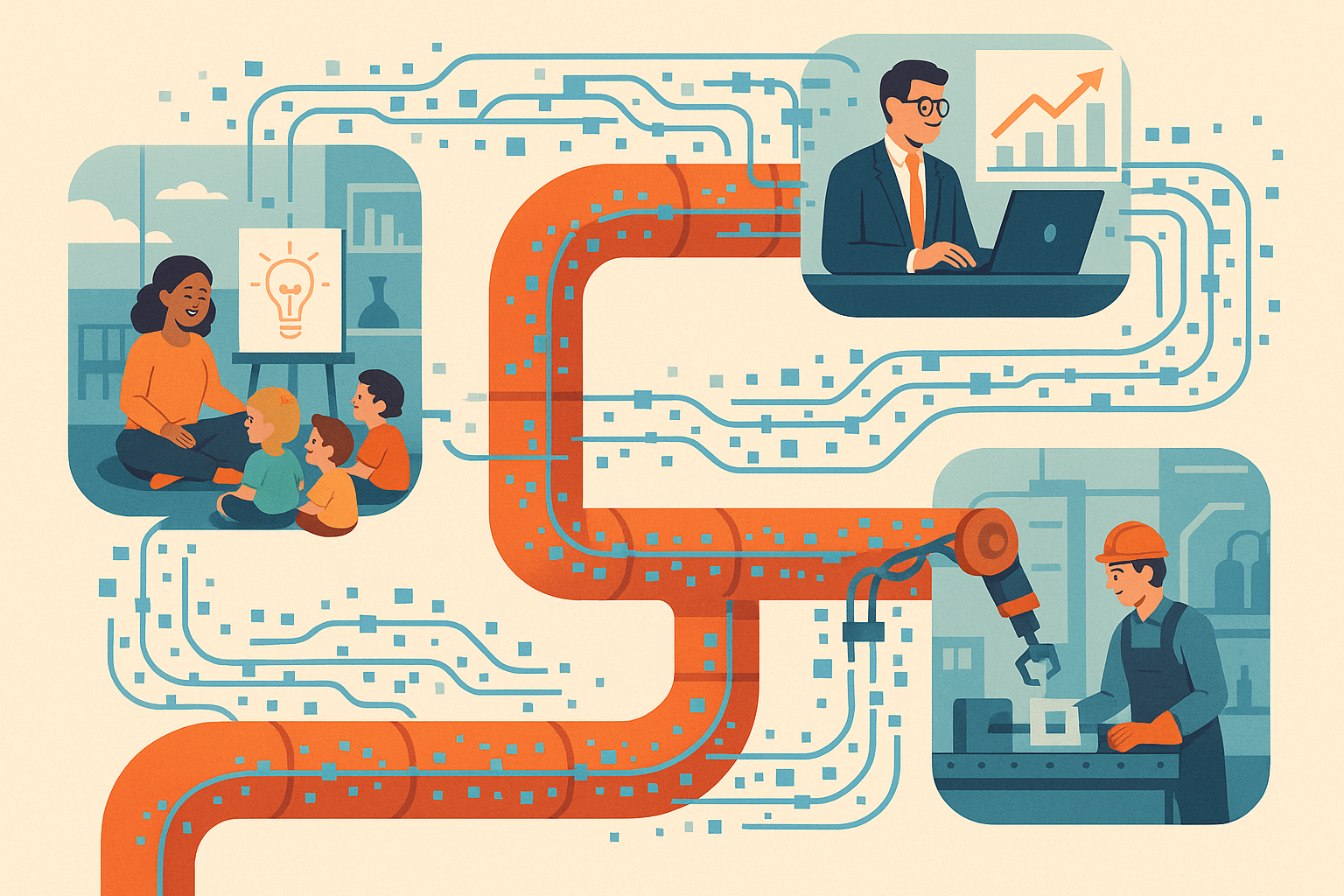
The modern economy is built not just on ideas, but on the infrastructure that moves them from conception to creation, from prototype to production, from lab bench to bustling assembly line. While digital innovation dazzles headlines, the real work of technological transformation lies in the quieter, deeper mechanics of society’s techno-industrial pipeline. In this context, Digital Public Infrastructure (DPI) is not merely an enabler—it is the bedrock.
The pipeline is leaking at every joint. Inventors struggle to secure data, connect with collaborators, or test their tools across regulatory domains. Startups flounder in pilot purgatory, unable to scale beyond a demo day. Skilled immigrants face Kafkaesque visa systems, and students in early childhood development (ECD) programs lack exposure to the foundational digital and technical literacies that will shape tomorrow’s labor markets. Even successful breakthroughs get stuck in bureaucratic molasses, unable to translate into real factories, real jobs, and real output.
The repair begins with DPI.
Stage One: Invention — A Publicly Interoperable Substrate
Invention does not happen in isolation. Whether it is AI, biotech, or advanced materials, the first step is access to public digital building blocks: open data repositories, interoperable APIs, simulation sandboxes, and shared compute infrastructure. DPI lays the groundwork here, offering foundational tools and protocols that reduce time to ideation and democratize participation.
These are not luxuries. They are what roads and bridges were to the Industrial Age—enablers of economic mobility and innovation at scale. Without DPI, invention is slower, more unequal, and overly dependent on private platforms that gatekeep access and extract tolls.
Stage Two: Translation — From Lab Bench to Field Test
Transforming discovery into deployable technology requires tight feedback loops between researchers, entrepreneurs, and early users. Here, DPI acts as connective tissue: facilitating secure data exchange, dynamic licensing of intellectual property, and digital credentialing to verify the skills of collaborators and testers.
Crucially, DPI also enables real-time monitoring of early deployments, allowing society to learn not just whether something works, but for whom, in what context, and under what conditions. This is the realm of causality, not just correlation—a public function that private players seldom have the incentive to pursue rigorously.
Stage Three: Commercialization — From Pilot to Platform
No technology scales without the scaffolding of commerce: payment systems, tax identification, procurement integration, and market regulation. Yet, today’s innovators must navigate a fractured maze of portals and incompatible rules. DPI offers a coherent digital spine for business formation, e-invoicing, cross-border compliance, and government contracting.
For small firms, especially those in underserved regions or sectors, this is the difference between stagnation and scale. DPI lowers the transaction costs of formality, making entrepreneurship less risky and more rewarding. The ability to plug into national and continental digital rails—identity, payments, records, marketplaces—is what allows innovations to become industries.
Stage Four: Deployment — Real Factories, Not Just Slide Decks
Reindustrialization demands more than buzzwords. It requires the construction of actual physical infrastructure—factories, cleanrooms, foundries—coordinated with logistics, power grids, and labor supply. DPI is vital here, too.
By integrating digital twin technologies, predictive analytics, and geospatial planning tools into the permitting, zoning, and financing processes, DPI transforms opaque bureaucratic workflows into responsive, data-driven engines. When supply chain visibility is a public good, not a private premium, industries can de-risk location decisions, optimize resource use, and respond to global shocks in real time.
The Full Circuit: From ECD to Immigration to Deregulation
If we see the techno-industrial pipeline as a national imperative, then education is not a soft sector—it is the ignition switch. DPI in early childhood education enables adaptive learning platforms, standardized developmental assessments, and longitudinal learner records that align future training with actual potential, not just privilege.
Skilled immigration, long a source of economic renewal, becomes viable again when DPI is used to pre-certify credentials, streamline visa adjudication, and match talent with strategic sectors. DPI turns immigration from a security risk to a productivity strategy.
Even deregulation—often invoked as a blunt instrument—becomes smarter with DPI. When agencies have real-time data, AI-enabled rulemaking tools, and dynamic compliance dashboards, they can shift from static, prescriptive rules to agile, outcome-based oversight. The result is a system that welcomes innovation without surrendering the public interest.
Conclusion: DPI as Strategic Capacity
Rebuilding the techno-industrial capacity of a society is not a nostalgic project. It is a generational strategy that starts not with rhetoric but with infrastructure—digital infrastructure. Not the infrastructure of apps and ads, but of trust, interoperability, and resilience. DPI is the new commons upon which the next wave of invention, production, and equitable prosperity must rest.
Without it, we are merely digitizing dysfunction. With it, we unlock the full length of the pipeline—from the scribble of a student in an underfunded school to the controlled hum of a precision robotics line bringing that student’s idea to life.





