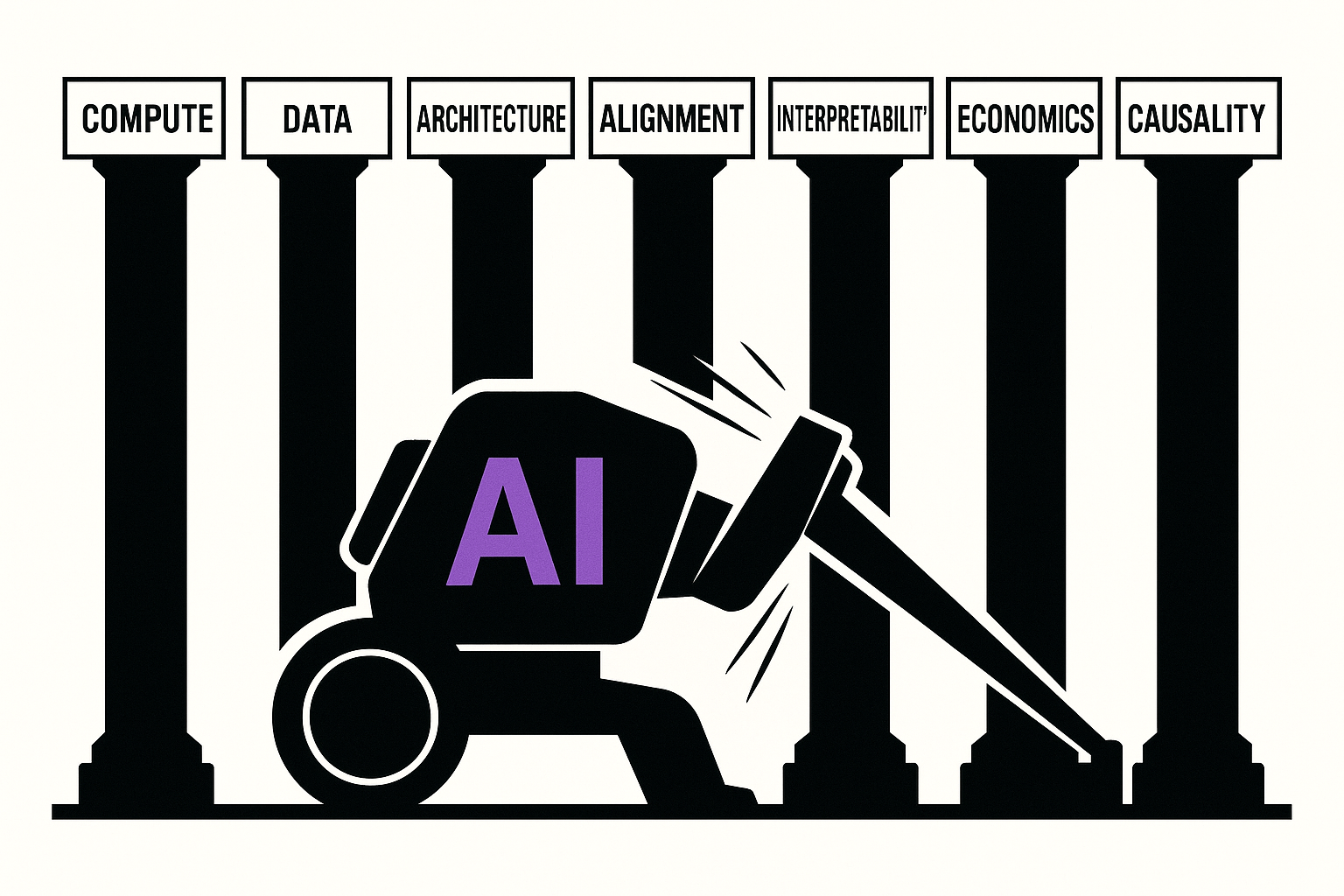
Compute: The Physics Wall
AI today is an optimisation problem pretending to be intelligence. Scale accelerates capability, but scale is not free. The hard limit is physics: energy, heat dissipation, memory bandwidth, and latency. The constraint is no longer transistor count. It is whether you can move electrons fast enough without cooking the chip or bankrupting the datacentre.
Every model is a race between parallelism and thermodynamics. Once you hit that ceiling, brute-force scaling stops being linear. That is why frontier labs obsess over efficiency papers masked as “AI breakthroughs”.
Data: The Entropy Wall
Training data is finite because human-generated knowledge is finite.
The internet is large, but noisy. After you scrape it and dedupe it, the usable corpus collapses sharply.
The top labs have already hit pretraining saturation: the model has seen most of what can be legally and ethically collected.
Once a model consumes the territory, you face diminishing returns. You cannot extract meaning from noise without inventing a new kind of reasoning engine.
Architecture: The Gradient Wall
Transformers work because they cheat by flattening causality into correlations that are easy to optimise.
But the architecture hits structural limits:
- Long-context scaling bends under quadratic attention.
- Reasoning requires iterative state, not static forward passes.
- Causality requires modelling counterfactual structure, not token prediction.
- You cannot reach deep generalisation using a machine optimised to autocomplete text. You reach a point where more layers simply deepen the illusion rather than the understanding.
Alignment: The Objective Wall
A model is a function of its objective.
Right now the objective is “predict the next token”.
This does not encode truth, consistency, or real-world fidelity.
It rewards persuasive noise.
As long as the optimisation target is divorced from the thing we actually want, you get capability without reliability.
You can bolt reinforcement learning on top, but that is patching the surface without fixing the objective mismatch.
Interpretability: The Transparency Wall
You cannot debug what you cannot see.
AI systems become harder to interpret as they become more capable because the complexity grows superlinearly.
If you cannot inspect the mechanism, you cannot guarantee its behaviour, and you cannot iterate safely.
The black-box nature introduces a ceiling: you hesitate to push capability because you cannot explain failures.
Engineering: The Systems Wall
Training a frontier model is not one problem.
It is thousands of failure points:
- Networking saturates
- GPUs desync
- Checkpoints corrupt
- Drivers mismatch
- Distributed training collapses under silent errors
- AI progress is now limited by the reliability of multi-million-node compute clusters. Each system break introduces drag that research papers never acknowledge but engineers bleed over.
Economics: The Incentive Wall
The cost curve bends the wrong way.
Training costs rise faster than monetisation.
A trillion-parameter model is impressive only if it can earn more than it costs.
Capital concentration restricts who can compete.
Once progress depends on capital rather than science, you slow discovery and skew incentives toward hype-driven releases.
Governance: The Friction Wall
AI is now a geopolitical object.
Export controls, chip embargoes, data localisation laws, copyright litigation, and safety regulations add external drag.
Even if the science is ready, the policy environment is not.
Progress becomes a negotiation rather than a computation.
Causality: The Understanding Wall
The real ceiling is conceptual.
Current systems map correlations.
Intelligence requires modelling how the world works and how it could have worked under different choices.
Until models can represent cause and effect instead of statistical shadows, they will plateau at pattern-completion rather than understanding.
The Unifying Constraint
All nine bottlenecks map to a single principle:
AI today is built on approximations of intelligence, not intelligence itself.
When you push an approximation far enough, you discover its boundary.
That is where the field stands.
AI will accelerate again only when it crosses this boundary with new mathematical foundations, new architectures, and new objective functions.





