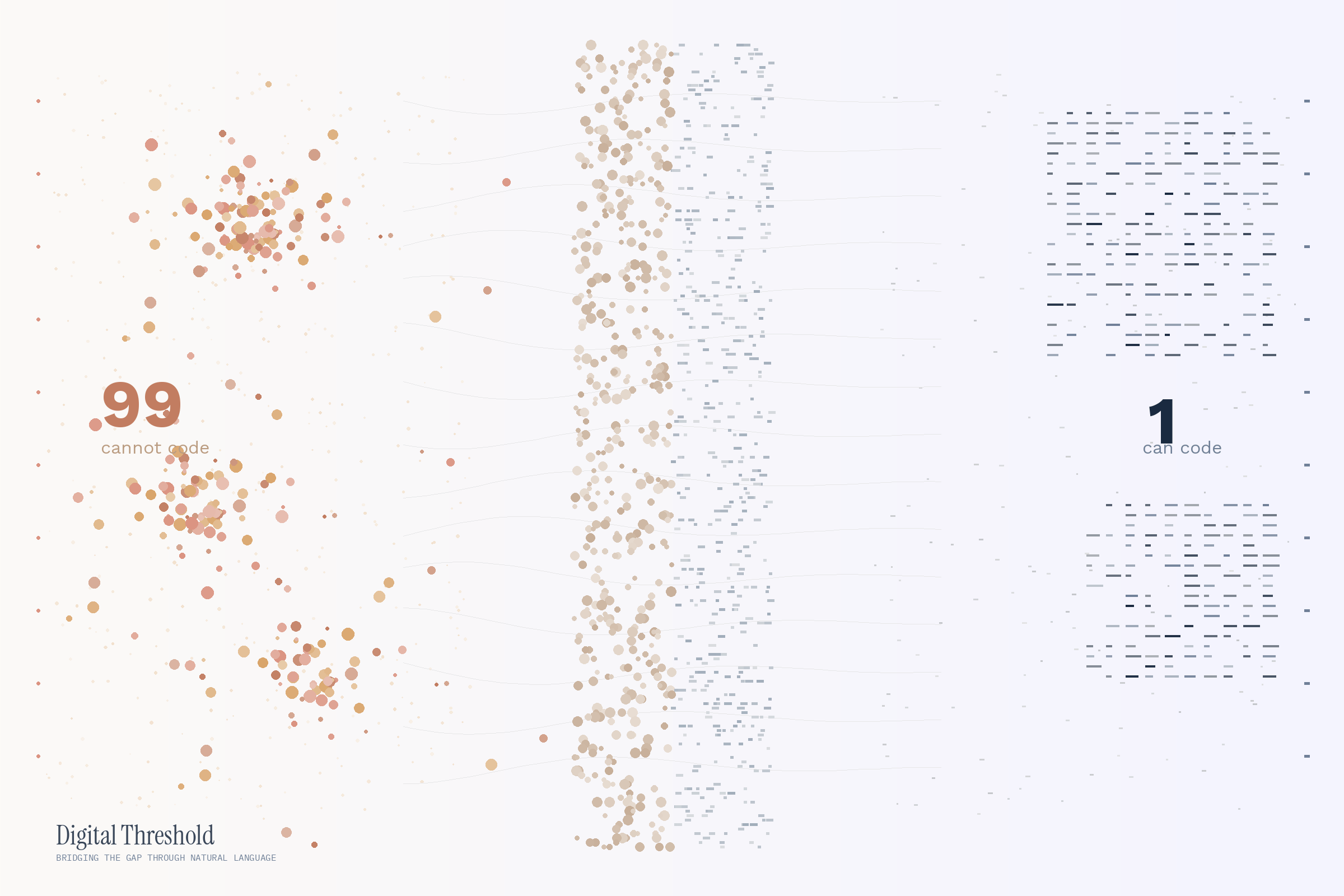
Less than 1% of the world's population knows how to code. Let that sink in. In an era where software shapes nearly every aspect of modern life, from how we bank to how we date to how we get medical diagnoses, the ability to create that software remains locked away from 99 out of every 100 people on Earth.
But that's starting to change, thanks to a phenomenon that AI researcher Andrej Karpathy dubbed "vibe coding."
What Exactly Is Vibe Coding?
Vibe coding flips the traditional programming paradigm on its head. Instead of learning syntax, memorizing functions, and debugging semicolons, you simply describe what you want to build in plain language. AI handles the translation into actual code.
Want a website that tracks your book collection? Just say so. Need a script that renames thousands of files based on their creation date? Describe the pattern. The barrier isn't technical skill anymore, it's imagination and the ability to articulate what you want.
This isn't about AI replacing programmers. It's about AI becoming a universal translator between human intent and machine instruction.
Why the Current Gap Matters
The 47 million developers worldwide aren't distributed evenly. They cluster in wealthy nations, in cities with tech ecosystems, in demographics that have historically had access to computer science education. This means the software that runs our world is built by a remarkably narrow slice of humanity.
The consequences ripple outward in ways we don't always recognize. Products get built for the people building them. Problems that affect billions go unsolved because the people experiencing them can't build solutions, and the people who can build solutions don't experience the problems.
Consider healthcare apps designed without input from nurses who work night shifts, or agricultural tools built by people who've never planted a seed, or educational software created by those who've never taught in an under-resourced classroom. Technical gatekeeping doesn't just limit who can code, it limits what gets built and for whom.
The Vibe Coding Revolution
Vibe coding fundamentally alters who can participate in software creation. A teacher in rural Kenya with a smartphone and an idea can now prototype an app. A retired grandmother who sees inefficiencies in her community organization can build a scheduling tool. A small business owner tired of expensive software subscriptions can create exactly what they need.
The democratization works on several levels. First, it eliminates the time barrier. Traditional coding proficiency takes months or years to develop. Vibe coding lets someone build their first working project in an afternoon. Second, it removes the intimidation factor. Code looks like an alien language to most people, a wall of cryptic symbols that signals "this isn't for you." Natural language is, by definition, natural. Third, it enables iteration without expertise. When your vibe-coded project doesn't quite work right, you describe what's wrong and what you want instead. No need to understand why the bug exists at a technical level.
What This Means for the 99%
The implications extend far beyond convenience. When more people can build software, more problems get solved. The long tail of human needs, too niche for commercial software companies to address, too specific for one-size-fits-all solutions, suddenly becomes addressable.
Local communities can build tools for local problems. Individuals can automate their own workflows without waiting for a developer to prioritize their request. Domain experts in every field can translate their knowledge directly into functional applications without the lossy translation layer of explaining requirements to technical teams who don't share their context.
This is particularly transformative for the developing world, where the developer shortage is most acute. Countries across Africa, Southeast Asia, and Latin America are leapfrogging traditional infrastructure in other domains, mobile banking, solar energy, telemedicine. Vibe coding offers a similar leapfrog opportunity for software creation.
The Limits and the Path Forward
Vibe coding isn't magic, and honesty about its limitations matters. Complex systems still require deep technical understanding. Performance optimization, security hardening, and large-scale architecture demand expertise that natural language prompts can't replace. The code AI generates can be flawed, inefficient, or subtly wrong in ways that matter.
But these limitations don't diminish the revolution, they define its scope. Vibe coding isn't coming for senior software architects. It's empowering the billions of people who currently can't build anything to build something. The gap between zero and one is far larger than the gap between competent and expert.
The trajectory is clear. As AI models improve, the ceiling of what's possible through vibe coding rises. Today's complex project becomes next year's afternoon hack. The 0.6% of humanity who can code won't shrink, but the definition of "coding" will expand to include forms of software creation that don't require traditional technical skills.
A More Participatory Digital Future
For most of human history, literacy was a specialized skill. The ability to read and write was gatekept by education, class, and access. Today, we recognize universal literacy as foundational to a functioning society. We may be approaching a similar inflection point with software creation.
This doesn't mean everyone will become a developer, any more than universal literacy made everyone a novelist. But it means the basic ability to shape digital tools to your needs, to participate in software creation rather than merely consuming whatever others build, could become widely accessible.
The 99% have been waiting on the sidelines of the software revolution. Vibe coding is their invitation onto the field.
The gap between those who can code and those who can't represents one of the most consequential divides of the digital age. As AI-assisted development matures, that divide may finally begin to close, not by making everyone a programmer, but by making programming itself more human.
Start vibe coding with Lovable, click here.





