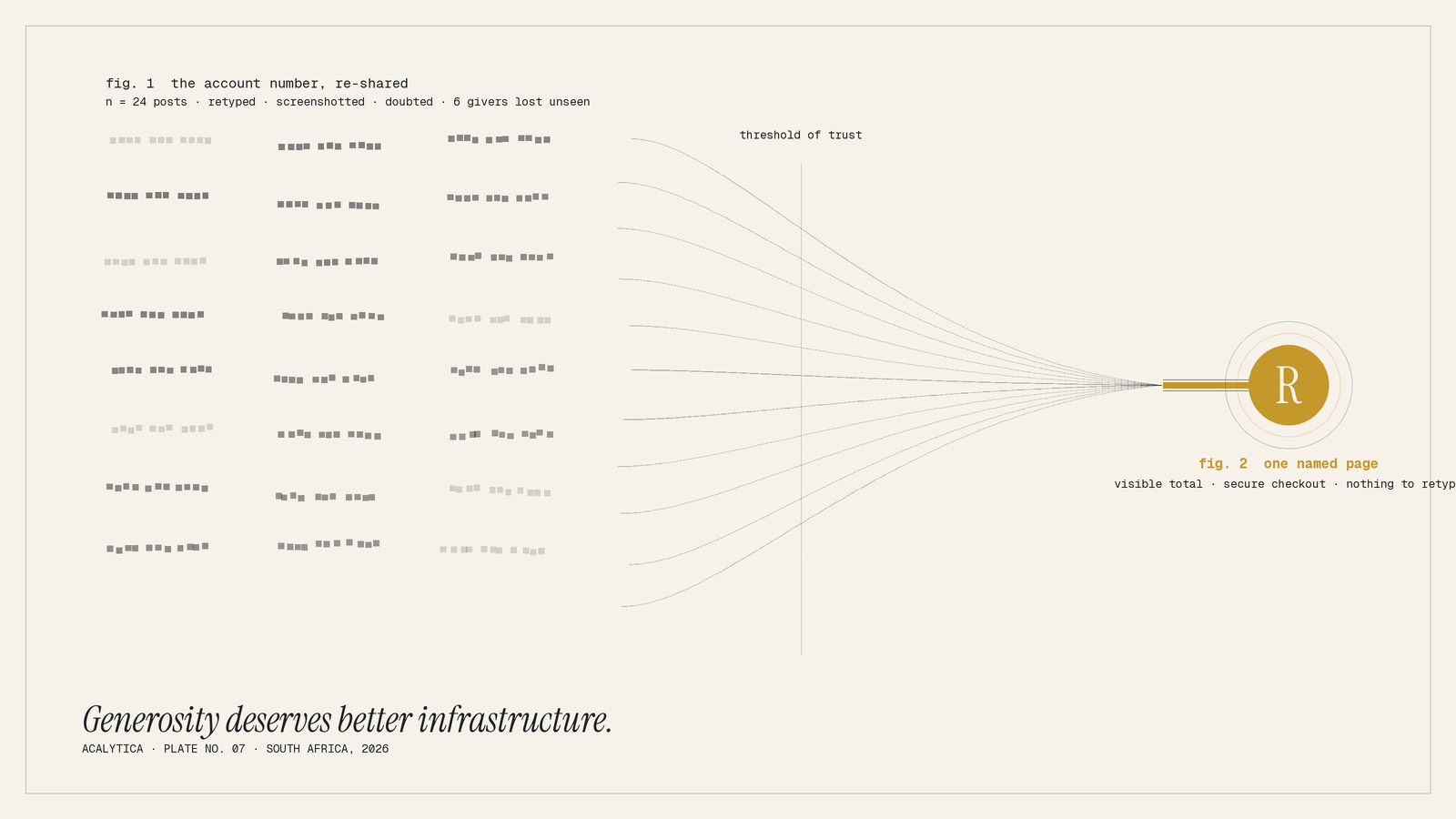
Scroll through any South African community Facebook group or family WhatsApp thread and you will find it: a photo, a heartfelt paragraph, and then a bank account number. A school needs funds for a learner's fees. A family is collecting for a funeral. A rescue needs vet money for a dog someone found on the N2. "Please DM for proof of payment. Every little bit helps."
The generosity behind these posts is real, and so is the giving; enormous amounts of money move through South African community fundraising this way every month. But the method is quietly working against the very causes it is trying to help. If you have ever run a collection like this, you already know the problems from the inside.
What actually happens when you post an account number
The scam tax. Every would-be donor has read the warnings about fake fundraising posts, cloned profiles and hijacked accounts. When the ask is a bare account number from a profile they half-know, a portion of people who genuinely wanted to give simply do not, not because they doubt you specifically, but because there is no way to tell your post apart from the ones that burned someone last year. You never see these lost donations. They are the biggest cost of the method, and they are invisible.
The admin spiral. Those who do give send proof-of-payment screenshots, and now you are the reconciliation department: checking the banking app, matching amounts to names, replying with thanks one by one, chasing the reference that just says "FNB APP PAYMENT". For a collection with fifty donors, this is hours of unpaid work in the middle of what is often already a stressful time.
Nobody can see the progress. Is the goal R5,000 or R50,000? Are we nearly there or nowhere? A bank account is a black box. Donors cannot see that the campaign is alive and moving, which means every share of the post starts the persuasion from zero, and there is no natural moment to post "we're almost there" because you would have to tally it up manually first.
No record, no report-back. When it is done, there is no page to point to, no total to celebrate, no artifact that says "87 people gave R31,450 and here is what it did". That matters more than sentiment: the report-back is what makes the next collection easier, and the method leaves you nothing to build on.
The typo problem. One wrong digit in a retyped account number, in a post that gets copied and re-shared across groups, and money goes to a stranger. It happens more than anyone admits.
What the safer version looks like
Now picture the same collection, run differently. The Facebook post has the same photo and the same heartfelt paragraph, but instead of an account number it ends with one link. The link opens a mobile page with the cause's name and photos, a clear goal, and a live progress bar: R18,250 raised of R25,000. There is a donate button. A supporter taps it, chooses an amount, and pays by card, instant EFT or Capitec Pay in a secure checkout, in Rands, in under a minute. The total ticks up. They get a confirmation. Nobody screenshots anything.
Every problem from the list above dissolves at once. The named, branded page with a visible running total is exactly the trust signal that a bare account number cannot provide. Payments confirm themselves, so the reconciliation job disappears. The progress bar does the persuading for every new arrival and hands you a ready-made update post at every milestone. And when it is done, the page itself is the record: the goal, the total, the thank-you, and the report-back photos, all at the same link everyone already has.
This is what a fundraising block on an Acalytica page does, and setting one up takes less time than replying to one evening's worth of proof-of-payment messages.
Setting it up for a community collection
Name the page after the cause, not yourself. acalytica.com/blankets-for-langa or acalytica.com/thandi-fees is instantly clearer and more shareable than a personal profile link, and it is what people will forward to their own groups.
State the goal and the deadline in one line. "R25,000 by 30 August for 200 winter blankets." Specific numbers are what donors repeat when they share, and a deadline creates the urgency a rolling ask never has.
Put faces and specifics on the page. Two or three photos and a short honest paragraph: who this is for, what the money does, who is running the collection and how to contact them. The willingness to be visible and reachable is itself the strongest anti-scam signal there is.
Connect a payment gateway. Paystack, Payfast, Yoco or your preferred processor, settling directly into the collection's bank account. Entry-level accounts are free and do not require a registered organisation, but allow a day or two for verification, so set this up before you announce, not after.
Seed the bar before you share widely. Get your inner circle, the committee, the family, the teachers, to donate first, so the page shows visible momentum from its first public hour. A bar at 15% says "this is real and moving" to every stranger who arrives.
Then post the link where the account number used to go. Same groups, same photo, same paragraph. Only the ending changes: from "banking details in comments" to one link. And when someone inevitably asks for an EFT instead, the answer is easy, because instant EFT is right there in the checkout.
A word to donors, too
If you are on the giving side, the same logic protects you. Before sending money to any collection, look for the things a bare account number cannot fake: a named page, a visible goal and running total, identifiable organisers with a way to contact them, and payment through a recognised checkout rather than a manual transfer to a personal account. Generous people deserve to give without gambling, and causes that make themselves verifiable deserve to receive more. The more our community fundraising moves onto pages like this, the more the genuine causes stand apart from the scams that exploit them.
The kindest thing you can do for your cause
Community generosity is one of the best things about this country. It deserves better infrastructure than screenshots and account numbers. The next time you or your school or your street committee needs to collect, give the cause a page: it will raise more, cost you fewer hours, and leave behind a record everyone can be proud of.
Create your free page on Acalytica, add a fundraising block, and share one link instead of your banking details. For the full playbook on running the campaign itself, read our complete guide to crowdfunding in South Africa.





