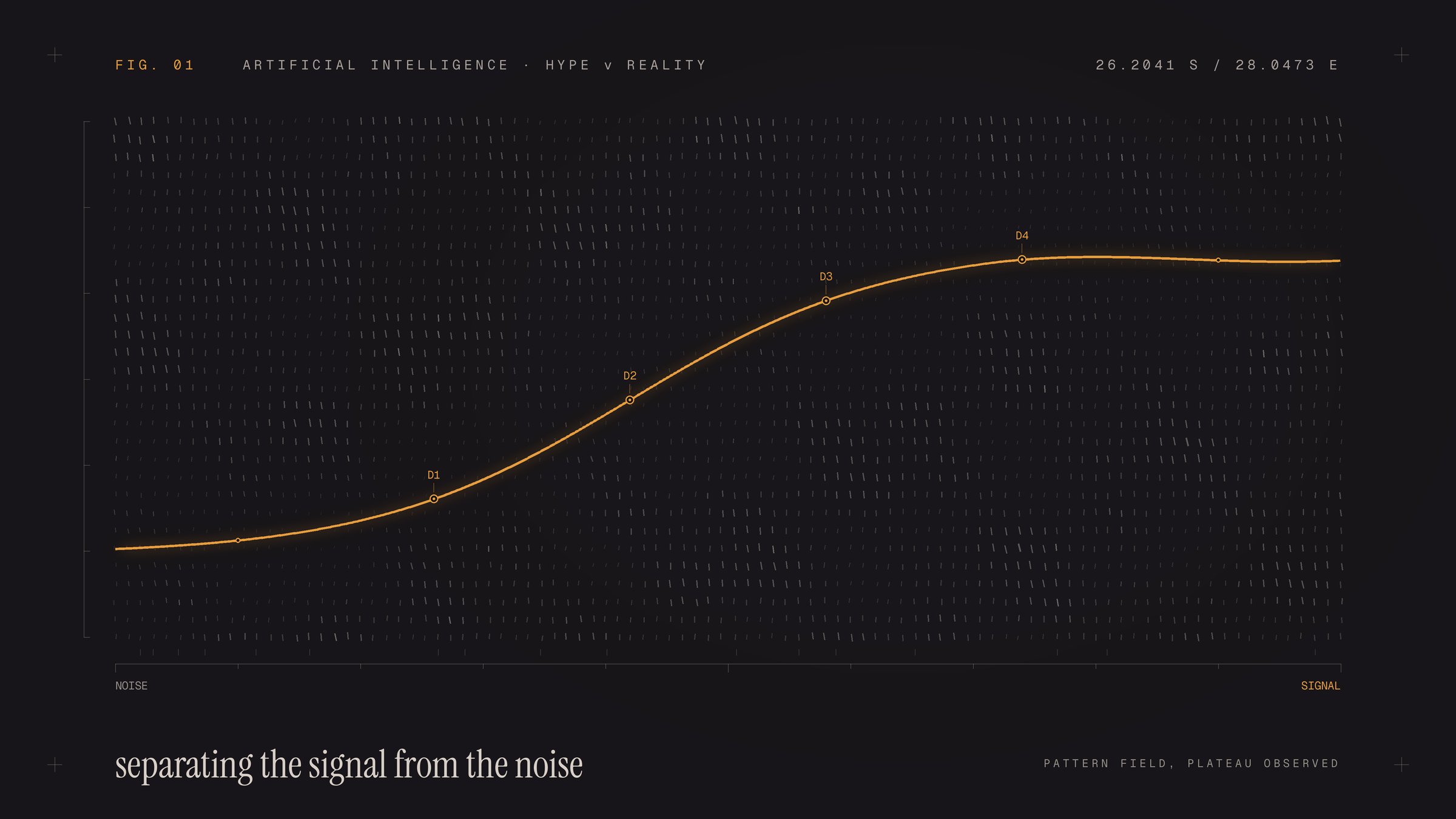
Everyone is an AI company these days. From the big foundation model labs right down to the traditional banks and insurers, "AI native" has become the label of choice. It looks good on valuations and it sounds good on investor calls, but according to mathematician Edzai Zvobwo, most of it is noise. Speaking to Colleen Makhubele on Power 98.7's Power Perspective, Zvobwo and fellow guest Paul Domanski spent an evening doing what the hype cycle seldom allows: separating what artificial intelligence actually is from what it is being sold as, and asking what a country like ours should be doing about it.
A statistical machine, not a mind
Zvobwo's starting point is that the AI dominating the headlines was never the only AI on offer. He contrasts two schools of thought: the symbolic, causality-focused tradition associated with Judea Pearl, and the deep learning, neural network tradition championed by Geoffrey Hinton. Deep learning won the last decade, but not necessarily because it was the better version. It won because it was the scalable, fundable one.
What we have ended up with is, at its core, a pattern-matching engine. Large language models generate text by asking, over and over, what the most probable next word is, and then stitching those probabilities into coherent paragraphs and images. What they do not do, Zvobwo stresses, is understand cause and effect the way a human being does. And that correlation-based approach, he says, has hit a plateau. That is exactly why the industry keeps demanding more electricity, more water and more compute. The approach does not scale gracefully, so it is being brute-forced.
He reaches for a historical analogy: the battle between Thomas Edison and Nikola Tesla over electricity. Edison's DC current had the backing, the distribution and the friends in high places, with JP Morgan in his corner. Tesla arguably had the better model, but it only broke through when Westinghouse funded it for long-distance generation at the Niagara Falls hydroelectric scheme. The lesson, for Zvobwo, applies directly to AI. It is not the best technology that wins. It is the one that is funded, that has distribution, and that suits whoever holds the power at the time.
Why most AI rollouts are falling flat
Domanski picks up the thread from the deployment side. The overwhelming majority of corporate AI rollouts worldwide, around 95% by widely reported figures, have shown no measurable impact on the bottom line, and a number of high-profile automation projects have quietly brought the humans back. His diagnosis is not that AI is weak. It is that it has been misunderstood. Companies treat it as an autonomous replacement for people when it is actually an extension of them.
"AI doesn't replace jobs. It replaces certain tasks." That, for Domanski, is the reframing that matters. Rollouts fail when they are too big, too fast, and give the machine far too much credit. His own practice is deliberately the opposite. Go into a business, find one task that one person does exceptionally well, and build an AI agent trained on that person's expertise, taste and way of working, with the expert involved throughout. The senior person is freed up to do the work that only they can do, and the juniors gain what amounts to a dedicated mentor that helps them come right much faster.
He applies the same logic to the flood of low-quality machine-generated content doing the rounds, the so-called AI slop. The slop exists, he says, because people put nothing into the engine, and the amplification of nothing is still nothing. A language model without human imagination simply regurgitates what was fed into it. Inject your own ideas, energy and beliefs, and it becomes a powerful amplifier. Either way, it has to start with the human. AI is not there to write your LinkedIn posts for you.
We cannot copy and paste the West's AI
One of the sharpest points in the conversation is about whose problems today's AI is actually built to solve. The West, Zvobwo points out, has an ageing population and a shrinking workforce, so automating and augmenting labour is squarely in its interest. South Africa and much of the Global South have the opposite problem: far too many unemployed young people. Importing the Western automation paradigm wholesale simply does not serve us. Any corporate deploying AI here should be asking a different question from first principles: how is this going to create jobs?
The disadvantage runs deeper still, right down to the data. Large language models were trained overwhelmingly on publicly available, Western-centric internet content, which means African experience is barely encoded in the systems everyone is now using. Add unequal access to data, electricity and compute, and the first-mover advantage sits elsewhere too. We are playing catch-up. Closing the gap, Zvobwo argues, means participating at a high level, contributing African knowledge and perspectives into these models rather than merely consuming their outputs. It is part of his broader case for what he calls mathematical sovereignty as the foundation of our technological independence.
Both guests trace part of the problem to a long-standing posture: through every industrial revolution, we have been consumers and super-users of technology developed elsewhere. In corporate South Africa, research and development is treated almost as a swear word because it takes too long, and the short-termism of import-and-deploy crowds out the slower first-principles thinking that produces real breakthroughs.
The maths problem is a presentation problem
No honest conversation about South Africa's AI readiness can dodge the state of our mathematics. The host points to the country sitting at or near the bottom of international maths rankings, learners drifting into maths literacy instead of core maths, and pass requirements set as low as 30%, particularly in our public schools.
Zvobwo's response is unexpected: the deficit is less about ability than about presentation. He describes an experiment from his earlier work in maths education. Ask learners a bread-price question in everyday terms, say the price went up by 50 cents to R5.50, what was it before, and they answer instantly and correctly, without even thinking. Present the identical information as "x + 5 equals" and half the class freezes, because now it looks like Mathematics, abstract and removed from their daily lives. The rigour must stay, he insists, but the way we present it has to connect to the reality our children actually live in.
He also wants the dogma taken out of the classroom. Maths is taught as a fixed rulebook with no room for creativity, yet the history of computing is a history of creative rule-bending. Computer scientists in the seventies and eighties deliberately chopped off decimal places in floating-point arithmetic, trading accuracy for speed. Compression is why we can watch videos on YouTube at all. And more recently, engineers staring down the enormous power, water and compute costs of AI have again chosen to sacrifice precision for efficiency.
These were executive decisions to bend the ideals of mathematics for practical gain, proof that creativity and maths have always gone hand in hand, from Leonardo da Vinci through to Newton. Zvobwo points to Finland's exam-light, project-based schooling as a model worth studying, and highlights the stark resource gap between our private and public schools, where even something like art is out of reach for most public school learners.
There is a cultural layer as well. Zvobwo recalls watching brilliant black graduates, top varsities, cum laude on their CVs, battle at a software company. Not for lack of ability, but for lack of socialised confidence: the fluency to ask when you are stuck, to express yourself, to survive failure. In our culture, respect and meekness are virtues. You address your elders properly, you give the other cheek. But those instincts are not optimised for a corporate world that rewards assertiveness. And where American tech culture celebrates failure, here a failed startup can mean being blacklisted and shamed by society. Building that confidence, he argues, has to be part of the education agenda too.
Fluency before regulation
So what should ordinary people and policymakers actually do? For individuals, Domanski's advice is to go one level deeper than the default. Most people's entire experience of AI is a Google search, yet for very little money anyone can get access to the frontier models. He names Claude and Codex among others. Just start asking questions, including asking the model itself what a good question would be. Start with a problem you already know how to solve, apply AI to it, and grow outward from that base of confidence. The first step is free, and everyone should take it.
Zvobwo puts a name to the goal: AI fluency, citing the 4D framework developed by Anthropic. Delegation is knowing which tasks to hand over to the machine entirely, which need a human reviewer, and which should never be delegated at all, such as ethics and anything that requires reading between the lines. Description is communicating explicitly with the model, because garbage in is still garbage out. Discernment is critically evaluating what the AI produces rather than swallowing it whole. And Diligence is the ethical layer, the consumer protection, the POPIA considerations, the responsibility. A technically impressive deepfake is still an ethical failure. Fluency, like Messi's ten thousand hours with a ball at his feet, is what comes before creativity.
On policy, the guests are blunt. South Africa has no AI-specific law, and our draft policy efforts have stumbled, including, ironically, over unchecked reliance on AI in the drafting itself. Domanski's prescription is to resist the temptation to invent yet another institution and rather enforce what we already have, build the capability first, and only then write the rules. His one non-negotiable standard: every AI output must have a named human owner. One accountable person, not a committee. Given that parliamentary processes take two or three years while the technology changes month to month, accountability, not exhaustive rulebooks, is the principle that will last.
The takeaway
The thread running through the whole episode is a double demystification. The technology is less magical than advertised: a probabilistic pattern-matcher with real limits, whose dominance owes as much to funding and power as to merit. But it is also more useful than the failed rollouts suggest, provided it is deployed the right way round. Small, focused, trained by humans, owned by humans, and, in the South African context, aimed deliberately at creating opportunity for our young people rather than automating them out of the picture. The digital revolution is open to anyone willing to take that free first step of simply engaging with it. And the countries that will shape AI, rather than merely consume it, are the ones that invest in the mathematics, the fluency and the confidence of their people.
Listen to the full conversation here





