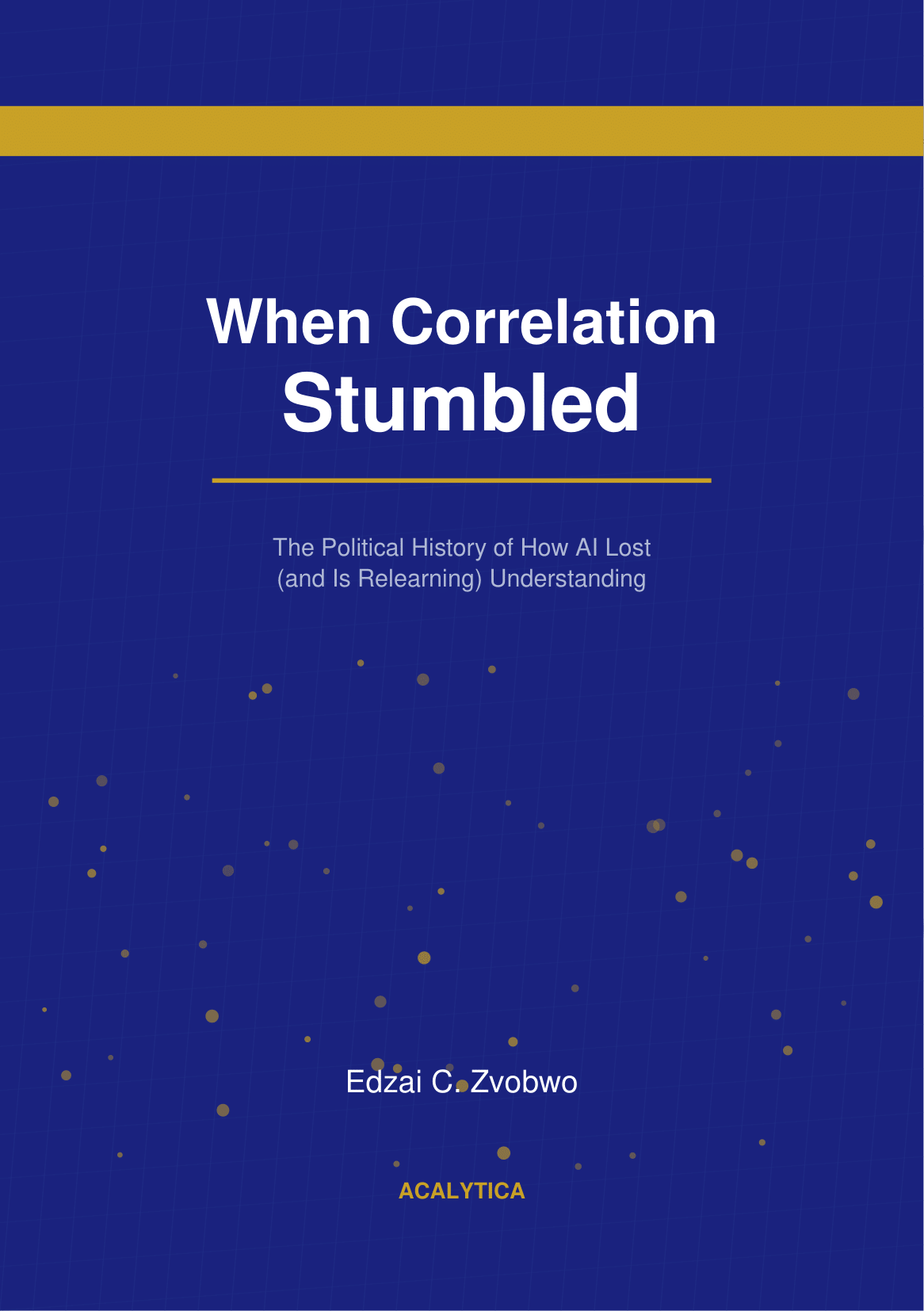
"When Correlation Stumbled" traces how artificial intelligence abandoned understanding—and what it will take to get it back
[JOHANNESBURG, SOUTH AFRICA] — As artificial intelligence systems increasingly shape decisions in healthcare, finance, criminal justice, and daily life, a provocative new book asks a fundamental question: Why can AI master complex games and generate human-like text, yet still fail at tasks a child could handle?
In "When Correlation Stumbled: The Political History of How AI Lost (and Is Relearning) Understanding" (Acalytica, 2025), researcher Edzai C. Zvobwo delivers a sweeping intellectual history that reveals how the field of AI made a fateful choice decades ago—one that continues to shape and constrain what these systems can achieve today.
"The systems we have built are the systems our priorities selected for. They reflect what we chose to value: performance over understanding, capability over comprehension. Different choices would have produced different systems."
A Choice That Shaped an Industry
The book traces how Cold War funding priorities, commercial pressures, and academic incentives pushed AI research away from causal understanding and toward pure pattern recognition. This "correlational turn," Zvobwo argues, produced systems that can predict without knowing why their predictions are right—and fail catastrophically when conditions change.
Drawing on philosophy of science, cognitive psychology, and political economy, Zvobwo examines:
- The Banishment of Causality: How AI abandoned the question "why" in favor of "what"
- Behaviorism in Silicon: The surprising revival of discredited psychological theories in modern machine learning
- Data Colonialism: The extractive practices that fuel today's AI systems
- The Benchmark Industrial Complex: How the metrics we use to measure AI progress have become obstacles to genuine advancement
Why It Matters Now
As large language models and generative AI capture public attention, "When Correlation Stumbled" offers essential context for understanding both their impressive capabilities and their characteristic failures.
"Scaling produces diminishing returns. Systems hallucinate with confidence. The absence of genuine understanding becomes impossible to ignore. The correlational paradigm is reaching its limits."
But the book is not merely a critique. Its final sections map paths forward—from correlation to causation, from prediction to decision, from behavior to genuine understanding—offering a vision of what AI could become if researchers, funders, and society make different choices.
Book Details
| Title: | When Correlation Stumbled: The Political History of How AI Lost (and Is Relearning) Understanding |
| Author: | Edzai C. Zvobwo |
| Publisher: | Acalytica |
| ISBN: | 978-1-291-92331-5 |
| Pages: | 231 |
| Format: | Paperback and eBook |
| Available: | Lulu.com, Amazon, and major booksellers |
About Acalytica
Acalytica publishes works at the intersection of technology, science, and society. We believe that understanding how technical systems work—and why they work that way—is essential for shaping a better future. Learn more at acalytica.com.
###





