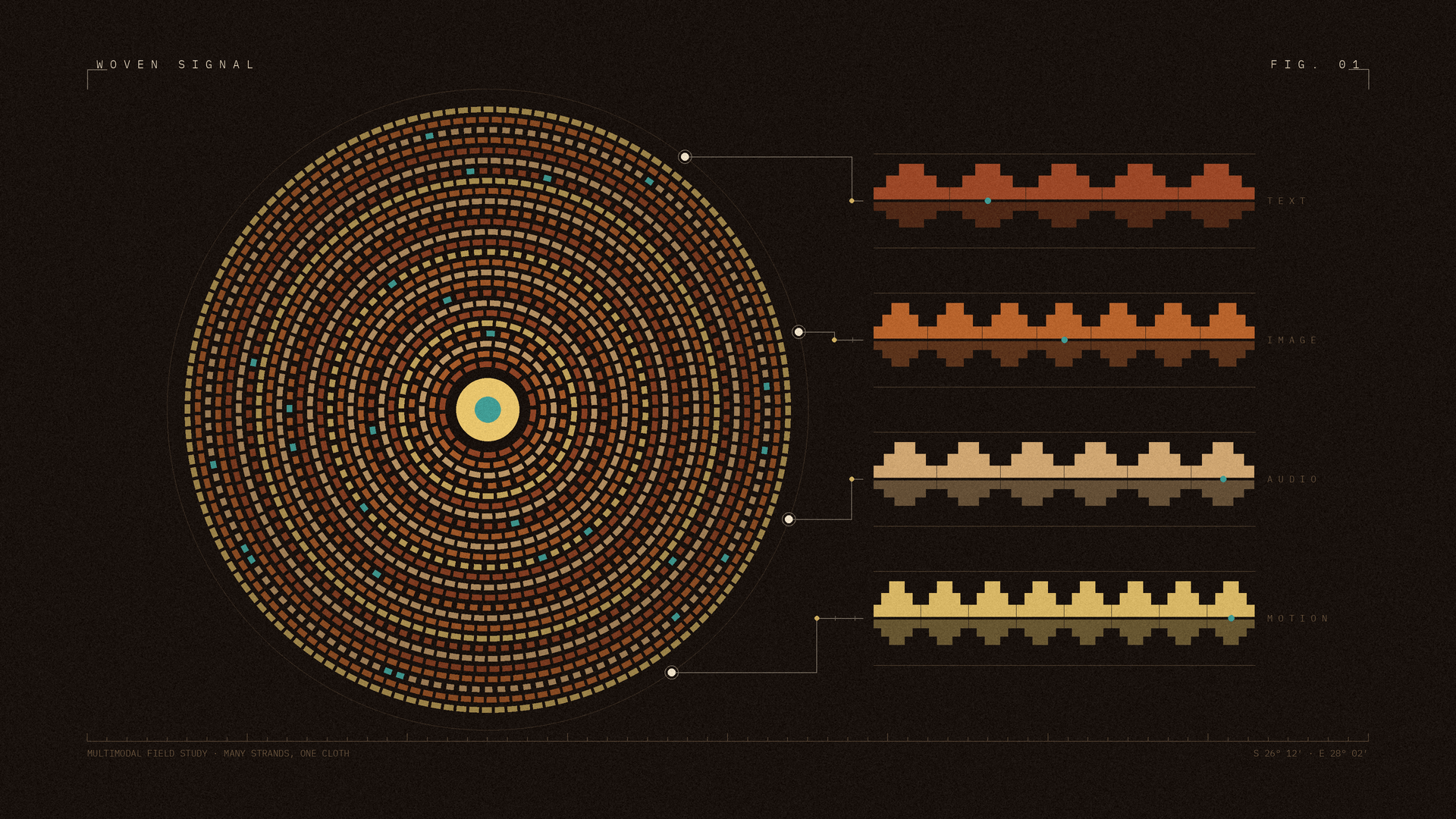
For most of the past decade, creative agencies have treated artificial intelligence as a collection of separate tools. There was one model for writing copy, another for generating images, a third for transcribing audio and perhaps a fourth for editing video. Each lived in its own tab, each spoke its own language, and a human sat in the middle stitching the outputs together. That era is closing.
Two shifts are converging at once: models have become multimodal, meaning they understand and generate across text, image, audio and video within a single system, and they have become agentic, meaning they can plan, use tools and carry out multi-step work with limited supervision. For agencies, the combination is not an incremental upgrade. It changes what a brief is, what a team looks like, and where the value of creative work actually sits.
What multimodal deep learning actually is
Multimodal deep learning refers to neural networks trained to process and relate multiple types of data within one shared representation. Rather than learning language in isolation and vision in isolation, these models learn a joint space in which the phrase "golden hour on the Sea Point promenade" sits close to actual photographs of that light, that place and that mood. The technical foundations include transformer architectures that treat images, audio waveforms and text tokens as sequences of the same fundamental kind, contrastive training methods that align captions with pictures, and diffusion models that generate images and video from those aligned representations.
The practical consequence is that the model does not merely convert between formats. It understands relationships across them. It can look at a rough storyboard sketch and write the voiceover script that matches its pacing. It can listen to a radio ad and describe the visual identity a matching billboard should carry. It can watch a competitor's television spot and produce a written teardown of the editing rhythm, colour grading and tonal choices. Cross-modal reasoning of this kind used to be the exclusive territory of experienced creative directors. It is now, at least in draft form, available on demand.
What "agentic" adds to the picture
A multimodal model on its own is still a very capable assistant waiting for instructions. An agentic system wraps that capability in a loop: it receives a goal, breaks it into steps, executes those steps using tools, evaluates its own output and revises until the goal is met or a human intervenes. In an agency context, the difference is the gap between "generate five headline options" and "take this campaign brief, research the category, draft a creative territory, produce moodboards, mock up three routes across social formats, and flag which route conflicts with the client's brand guidelines".
The agent does not do this by magic. It does it by calling tools: web search for category research, image generation for moodboards, layout engines for format adaptation, brand asset libraries for logo and typography rules, and review checklists for compliance. The multimodal foundation is what allows one agent to move fluidly between these tools, because it can read the brief, see the moodboard, and hear the draft voiceover without translation layers in between.
Why this matters specifically for agencies
Agencies sell three things: ideas, execution and judgement. Multimodal agentic AI compresses the cost of execution dramatically, puts pressure on the price of routine ideas, and raises the premium on judgement. It is worth being honest about each.
Execution is the most obviously affected. Resizing a master creative into forty digital formats, subtitling a film in eleven official languages, versioning a campaign for different LSM segments and provinces, retouching product shots, cutting a thirty-second edit down to six seconds for a bumper ad: this is skilled work, but it is also structured, repeatable work, and it is exactly what agentic pipelines do well. Agencies that still bill significant hours for adaptation and versioning will find those hours evaporating from their invoices, whether they adopt the technology or their competitors do.
Routine ideation is affected next. The middle of the creative bell curve, the competent but unremarkable concepts that fill out a tissue session, can now be generated in volume. This is not the same as saying machines produce great creative work. It is saying that the floor has risen. A junior team with strong AI fluency can produce a wall of plausible territories in an afternoon. The scarce resource becomes the ability to recognise which of those territories carries genuine cultural charge, which will survive contact with a real audience, and which is derivative sludge dressed in good typography.
Judgement, taste and accountability are where agencies retain and can even grow their margin. A client does not pay for pixels. A client pays for someone to stand behind the work, to understand the nuance of a Nando's-style topical piece versus a tone-deaf misfire, to know when a visual reference reads as homage and when it reads as theft, and to take responsibility when a campaign lands badly. No agent signs off on work. That remains a human act, and it becomes more valuable, not less, as the volume of machine-generated material grows.
The new agency workflow
In practice, the agentic multimodal workflow reshapes the production chain in recognisable stages.
At the briefing stage, the model becomes a research partner. Fed the client brief, past campaign performance, and category context, an agent can produce a synthesised landscape review, identify white space, and surface tensions worth building creative on. Strategists move from gathering to interrogating.
At the concepting stage, multimodality means ideas arrive fully dressed from the first round. A territory is no longer a sentence on a slide. It is a sentence, a moodboard, a sample key visual, a scratch voiceover and a rough animatic, generated together and coherent with one another. This changes internal reviews profoundly, because the room is reacting to something close to the finished feeling of the work rather than imagining it.
At the production stage, agents handle the combinatorial explosion of modern media. One master idea becomes hundreds of assets across placements, languages, aspect ratios and audience segments, with the agent applying brand rules and flagging exceptions for human review. Production specialists shift from making every asset to designing the system that makes assets and auditing its output.
At the measurement stage, multimodal models close the loop. They can watch the creative and read the performance data simultaneously, which allows them to form hypotheses that were previously locked in separate departments: this cut-down loses the product too early, this colourway underperforms in feed but not in stories, this voiceover pacing correlates with completion rates. Creative and media stop arguing across a wall.
The South African context
Local agencies face this shift with particular constraints and particular advantages. The constraints are real: tighter budgets than global network offices, load shedding and connectivity realities that make cloud-heavy workflows fragile in parts of the country, and clients who are often cautious adopters. The advantages are equally real. South African creative work has always punched above its weight precisely because it trades on cultural specificity, humour and insight rather than production budget. Those are exactly the qualities that generic global models are worst at replicating. An agent trained on the broad internet does not understand taxi hand signals, the emotional register of a Castle Lager reunion ad, or why certain code-switching lands and other attempts embarrass everyone. Agencies that treat local cultural fluency as their proprietary dataset, and build workflows where AI handles scale while humans supply that fluency, have a defensible position that a template shop in another timezone cannot match.
Language is a further frontier. Multimodal models are improving quickly in isiZulu, isiXhosa, Afrikaans, Sesotho and other South African languages, but quality remains uneven, particularly for generated speech and nuanced idiom. Agencies should treat multilingual output as a human-in-the-loop process for the foreseeable future, with mother-tongue reviewers as a non-negotiable stage. Done well, this becomes a service line: authentic multilingual campaign systems at a scale that was previously unaffordable for most clients.
Governance, rights and the trust question
None of this works without discipline. Agencies adopting agentic multimodal systems need clear answers to questions clients will increasingly ask. What training data sits beneath the generation tools, and what is the copyright exposure? POPIA applies the moment client data, customer imagery or campaign performance information flows into third-party models, so data processing agreements and on-platform privacy controls are not optional. Talent and likeness rights need explicit handling, because generating a synthetic voice or face that resembles a real performer is a legal and ethical minefield. Disclosure norms are hardening too, with the Advertising Regulatory Board and platform policies moving toward clearer labelling of synthetic media.
The agencies that thrive will treat governance as a selling point rather than a compliance chore. A documented AI policy, an audit trail of what was generated versus shot, and a clear human accountability chain will win pitches against competitors who wave vaguely at "we use AI".
How to start, practically
The temptation is to buy tools. The better move is to redesign one workflow end to end. Pick a high-volume, low-glamour process, such as social content adaptation for one retainer client, and rebuild it around an agentic pipeline with defined human checkpoints. Measure the hours saved, the error rate and the client's reaction. Then expand.
Alongside that, invest in people rather than only in licences. The most valuable person in an agency over the next few years is the hybrid: a creative who can direct agents the way a director directs a crew, who writes briefs precise enough for a machine to execute and loose enough for surprise, and who has the taste to kill ninety percent of what the machine produces. Job titles will shift, from finished artist to asset systems designer, from traffic manager to workflow orchestrator, but the underlying craft values of concept, craft and cultural truth carry straight through.
The honest conclusion
Multimodal deep learning in the agentic era does not make creative agencies obsolete. It makes a particular kind of agency obsolete: the one whose margin depended on charging handsomely for structured production work that machines now do in minutes. What remains, and what grows, is the agency as a house of judgement, cultural insight and accountability, operating a production capability that would have looked like science fiction five years ago. The agencies that win will not be the ones that adopted the most tools. They will be the ones that understood, earliest and most clearly, that the machine changed the cost of making, and never changed the value of knowing what is worth making.





