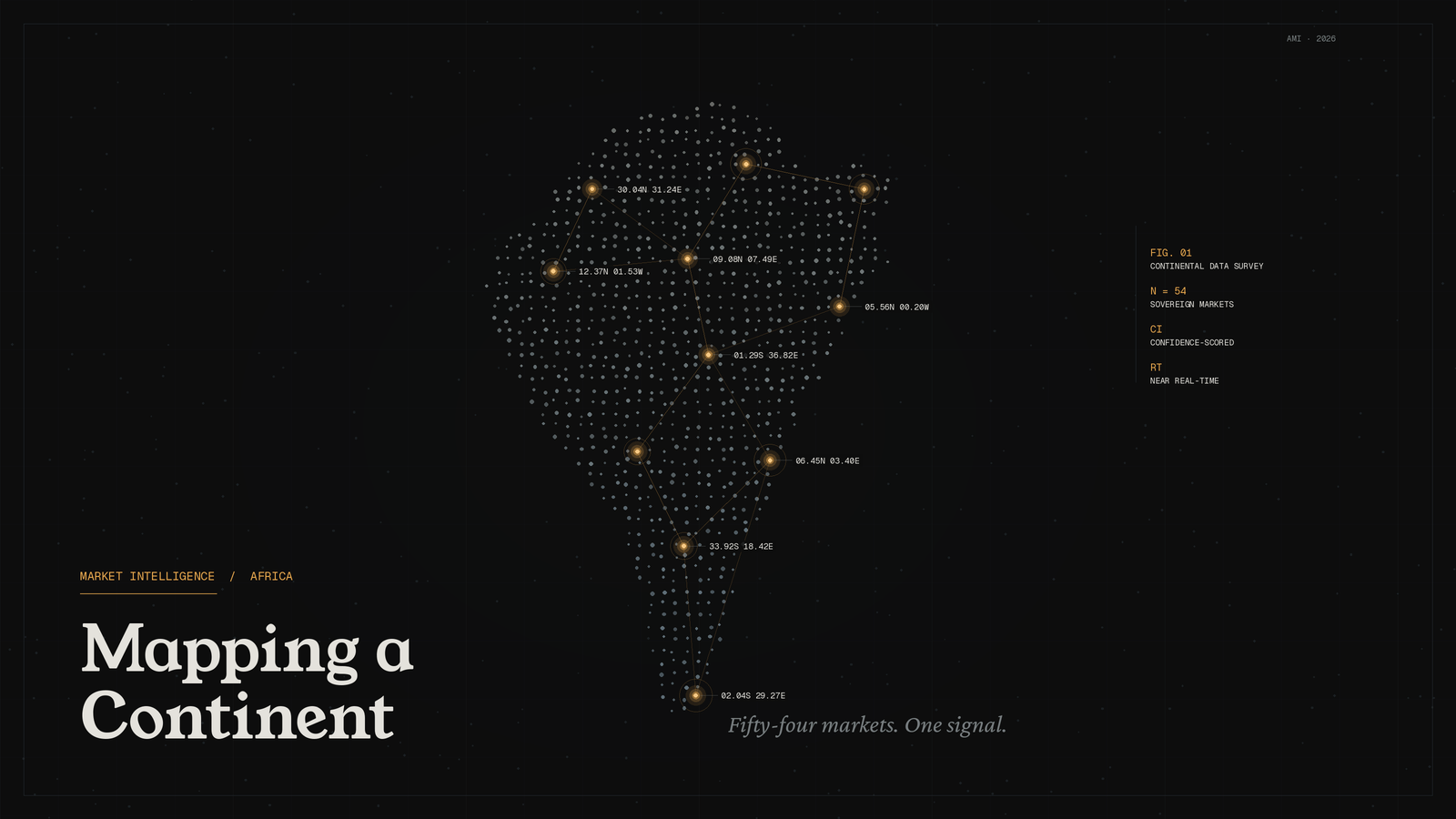
There is an old line that gets repeated so often in African business circles that it has become a cliché, and it stays a cliché only because it keeps being true: 54 countries, not one market. Lagos and Cairo have less in common, economically, than Frankfurt and Tokyo. Currencies revalue overnight. Census figures can be a decade stale. And in many countries, the majority of fast-moving consumer goods never pass through a formal retail till, they move through kiosks, open markets, and corner shops that no conventional retail audit can see.
That difficulty is precisely why an entire industry exists to make sense of it. African market intelligence is a business built on the fact that the data is genuinely hard to gather, which means someone has to be paid to gather it. For three decades the structure of that industry stayed remarkably stable. Today it is being rebuilt in real time.
The old order
For most of its history, the market followed a recognisable shape. At the top sat the global incumbents (NielsenIQ, Kantar, Ipsos, Euromonitor) selling rigour and brand trust to multinationals. In the middle came a layer of pan-African specialists who knew the terrain intimately. And underneath them all stretched a long tail of country-specific firms doing the actual fieldwork: the surveys, the store audits, the door-to-door interviews.
Money flowed in from four directions, multinationals planning expansion, regional brands defending share, investors hunting returns, and consultancies building decks, and it flowed out as PDF reports, syndicated trackers, and bespoke studies. The model worked. But it was slow, expensive, and locked inside documents that went out of date the moment they were printed.
The terminal model
The most visible change is a shift in what an intelligence product even looks like. A new cohort of platforms is explicitly positioning itself against the PDF-report era, building instead toward a single login, queryable data, structured outputs, and updates that arrive close to real time. The reference point is unmistakable: this is what Bloomberg did to financial data in the 1980s, now aimed at African markets.
Two names anchor this movement. AFRIQ Terminal brings the approach to consumer markets, offering confidence-scored briefs across all 54 countries (demographics, competitor density, venue mapping, category trends, and consumer signals) and tagging each claim on a ladder of causation so users can see what is observed versus inferred versus modelled. Mansa Markets, founded in Nigeria, does the equivalent for capital markets: a unified terminal pulling live stock prices, indices, disclosures, forex, and even crypto priced in African currencies across more than a dozen exchanges, with a developer API attached. Its founder framed the gap bluntly, institutional tools like Bloomberg and Refinitiv cost thousands of dollars a month, putting them out of reach of exactly the retail investors, developers, and smaller institutions who need African data most.
Whether the terminal model works at African scale is still unproven. But it is already pulling buyer expectations forward, and that alone reshapes the market.
Rigour you can inspect
The second shift is subtler. Older intelligence products treated methodology as something the brand vouched for, you trusted the data because you trusted the firm. Newer products are surfacing the method directly: confidence scores on individual claims, explicit source provenance, and a clear line between what was measured and what was estimated. In a region where data quality is the central anxiety, making rigour visible is becoming a feature rather than a footnote.
AI, applied carefully
The third shift is the obvious one, artificial intelligence, but its most credible use here is mundane rather than magical. The hard, expensive part of African intelligence has always been data acquisition: getting reliable information out of fragmented, informal, multilingual markets. AI is being layered on top to normalise, query, and surface that data faster, not to conjure it from nothing. The firms that win will be the ones that still do the unglamorous fieldwork underneath.
The players worth knowing
If you are trying to navigate the space, here is a working map of who does what.
Consumer and FMCG intelligence. KASI Insight runs more than 12,000 monthly interviews across 20-plus economies and publishes Africa's first monthly consumer-confidence index, now distributed through Bloomberg. Sagaci Research operates its own field teams and panels continent-wide, with SKU-level tracking of over 400,000 FMCG products. Trendtype covers 50 countries with a proprietary database of consumer indicators and distributor networks. AFRIQ Terminal delivers the same kind of consumer signal in a queryable, confidence-scored terminal.
Investment and corporate data. Asoko Insight maintains a deep database of private African companies for origination and due diligence across 25-plus countries. Stears is a financial-data platform focused on private markets, transactions, and macro risk for global funds. Mansa Markets covers listed equities and exchanges. Market Intelligence Africa offers boutique commercial due diligence for investors.
Surveys, forecasting, and entry research. Africa Surveys fields panels and telephone interviews across all 54 countries. ABiQ specialises in long-range forecasting for population, infrastructure, and utilities. Sagaci, AMENA Africa, and African Market Insights all support market-entry research, while Marketing Analytics Africa and Africa Insights AI lean into marketing ROI and AI-generated reporting respectively.
A caveat worth carrying: the lines between these categories blur constantly, several of these firms compete head-to-head, and the newest entrants are the least proven. Treat any single provider's "leading in Africa" claim, and almost all of them make one, as marketing until you have tested the data against your own market.
Where this is heading
The throughline across all three shifts is a generational repositioning of what African intelligence is for. The old product answered the question "what happened?" in a document you read once. The emerging product is built to answer "what is happening, how confident are we, and what should I do?", continuously, queryably, and at a price point that finally includes the smaller players who were priced out of the Bloomberg era.
The continent's data problem is far from solved. But for the first time, the tools being built to solve it look as ambitious as the markets they are trying to map.
This piece draws on public company disclosures and industry analysis as of mid-2026. The market intelligence landscape in Africa is moving quickly; details on coverage and capabilities are best verified directly with each provider.