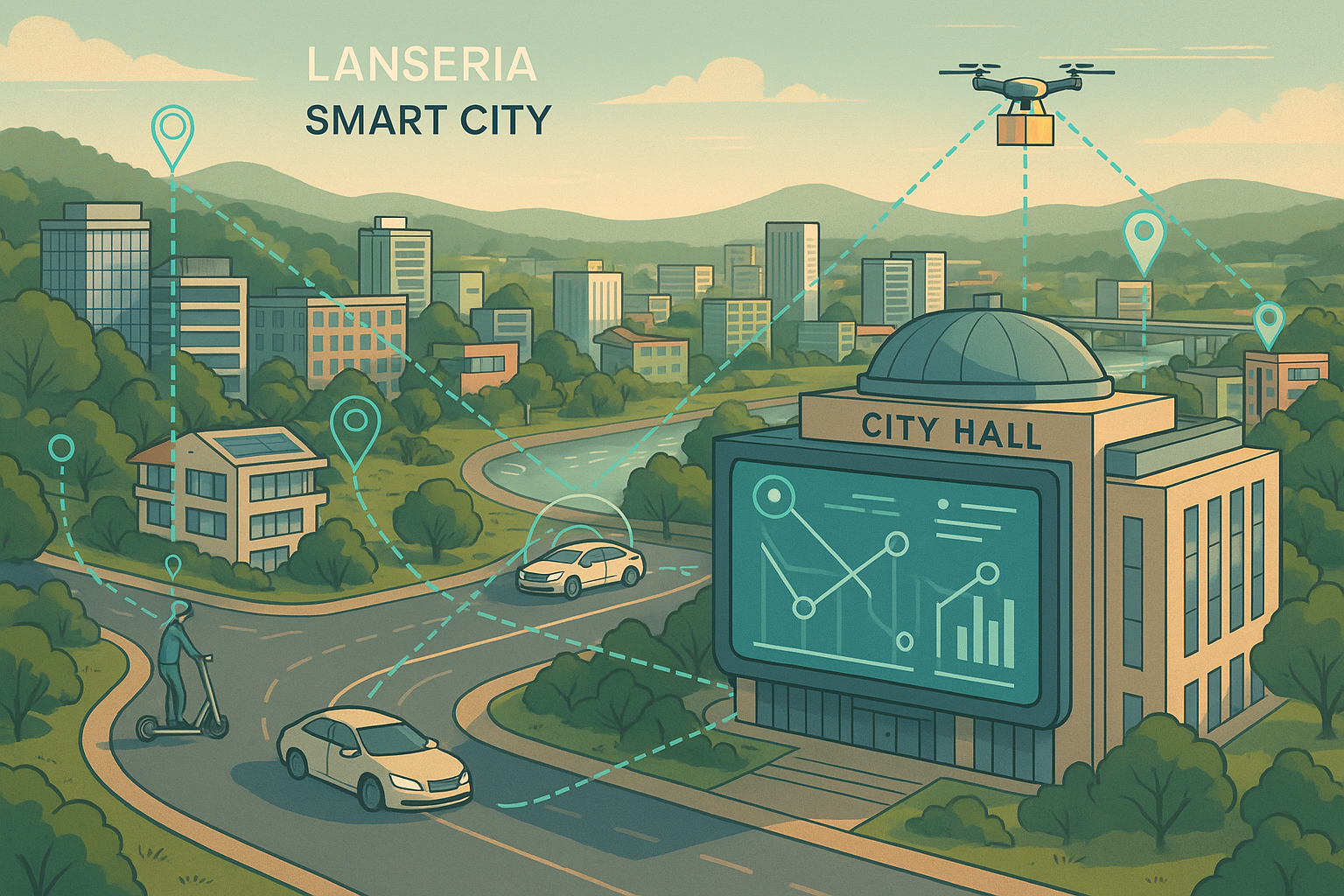
As Africa embraces the promise of smart cities, mobility emerges as a foundational pillar—intertwining infrastructure, economic opportunity, and sustainability. For Lanseria Smart City, South Africa’s flagship smart urban development, achieving seamless, efficient, and equitable transport requires more than just roads and ride-hailing apps. It demands data-driven coordination, interoperability, and public-private collaboration.
Enter the Mobility Data Specification (MDS)—a globally adopted open standard initially developed by the Los Angeles Department of Transportation (LADOT)—which enables cities to regulate, manage, and partner with private mobility providers using standardized APIs. When viewed through a Digital Public Infrastructure (DPI) lens, MDS becomes not just a tool, but an enabling layer for intelligent, interoperable governance of urban mobility.
The DPI Lens: MDS as a Foundational Mobility Protocol
Digital Public Infrastructure (DPI) refers to the foundational, interoperable digital layers (identity, payments, data exchanges) that enable equitable and inclusive service delivery. In the context of urban mobility, MDS acts as the mobility data protocol layer in a smart city's DPI stack, offering:
- Open, interoperable APIs between public authorities and private mobility operators (e-scooters, ride-hailing, delivery drones, AVs).
- Consent-based, secure data exchange respecting privacy and real-time regulation needs.
- Governance tools to enforce rules dynamically—such as speed limits, geofencing, and equitable access mandates.
For Lanseria, which aims to become a model for inclusive and sustainable urbanism, MDS is not just a technical specification—it's a civic architecture for managing digital mobility.
Five Use Cases for MDS in Lanseria Smart City
1. Integrated Mobility Governance
Using MDS APIs, the Lanseria Smart City Authority (LSCA) can establish real-time data connections with:
- E-scooter companies operating in specific zones
- Ride-hailing services entering congested hubs
- Delivery bots navigating pedestrian zones
This enables real-time policy enforcement and granular permit monitoring, giving the city full visibility and control over multi-modal movement.
2. Dynamic Curb Management
Through MDS, Lanseria can monitor how curbsides are used—e.g., delivery pickups, drop-offs, passenger waiting zones—and dynamically allocate them based on demand. This is vital in reducing congestion around commercial and transit nodes.
3. Equity and Access Auditing
MDS enables disaggregated data by neighborhood, allowing Lanseria to assess:
- Which areas are underserved by mobility services
- Where affordability gaps or accessibility barriers exist
This supports inclusive transport planning, aligned with South Africa’s broader equity and environmental justice objectives.
4. Emergency Response Optimization
Real-time location and movement data from MDS can be integrated into emergency management systems to:
- Reroute traffic during crises
- Enable first responder prioritization
- Shut down or divert mobility fleets during floods, fires, or security events
This creates a resilient, adaptive mobility network.
5. Sustainable Mobility Incentives
By integrating MDS with emissions APIs or energy usage data, the city can create smart incentives (e.g., congestion pricing, low-emission zones) to shift transport behaviors. These can be tied to real-time data captured through MDS telemetry.
Implementation Considerations
📌 Policy Infrastructure
- Data Privacy: Ensure adherence to South Africa’s POPIA (Protection of Personal Information Act) and international best practices.
- Public-Private Frameworks: Establish MoUs with mobility operators for data sharing under MDS.
- Governance Sandbox: Launch a regulatory sandbox in Lanseria Innovation Precinct to pilot MDS.
📌 Technical Infrastructure
- API Gateways: Deploy DPI-aligned API gateways with audit trails, version control, and modular access.
- Cloud Infrastructure: Host secure, scalable MDS endpoints and integrate them into the city’s digital twin system.
- Visualization Tools: Use platforms like Kepler.gl or Urban SDK for dashboarding MDS feeds.
What This Means for Policymakers
- Smart city projects without a real-time data backbone are blind. MDS gives Lanseria a scalable digital interface to shape mobility in the public interest.
- By adopting MDS as part of its Digital Public Infrastructure, Lanseria ensures vendor-neutral, future-proof governance of its urban transport layer.
- MDS also sets the stage for inter-city interoperability across Gauteng and beyond—creating a harmonized transport layer in the African Continental Free Trade Area (AfCFTA) context.
Conclusion
For Lanseria to evolve into a truly intelligent, human-centric city, mobility must become programmable, responsive, and inclusive. The Mobility Data Specification provides not just a protocol, but a principled infrastructure to manage the digital and physical flows that define modern cities.
By embedding MDS in its digital governance fabric, Lanseria can offer a replicable model of data-driven mobility DPI for South Africa—and the continent.





